
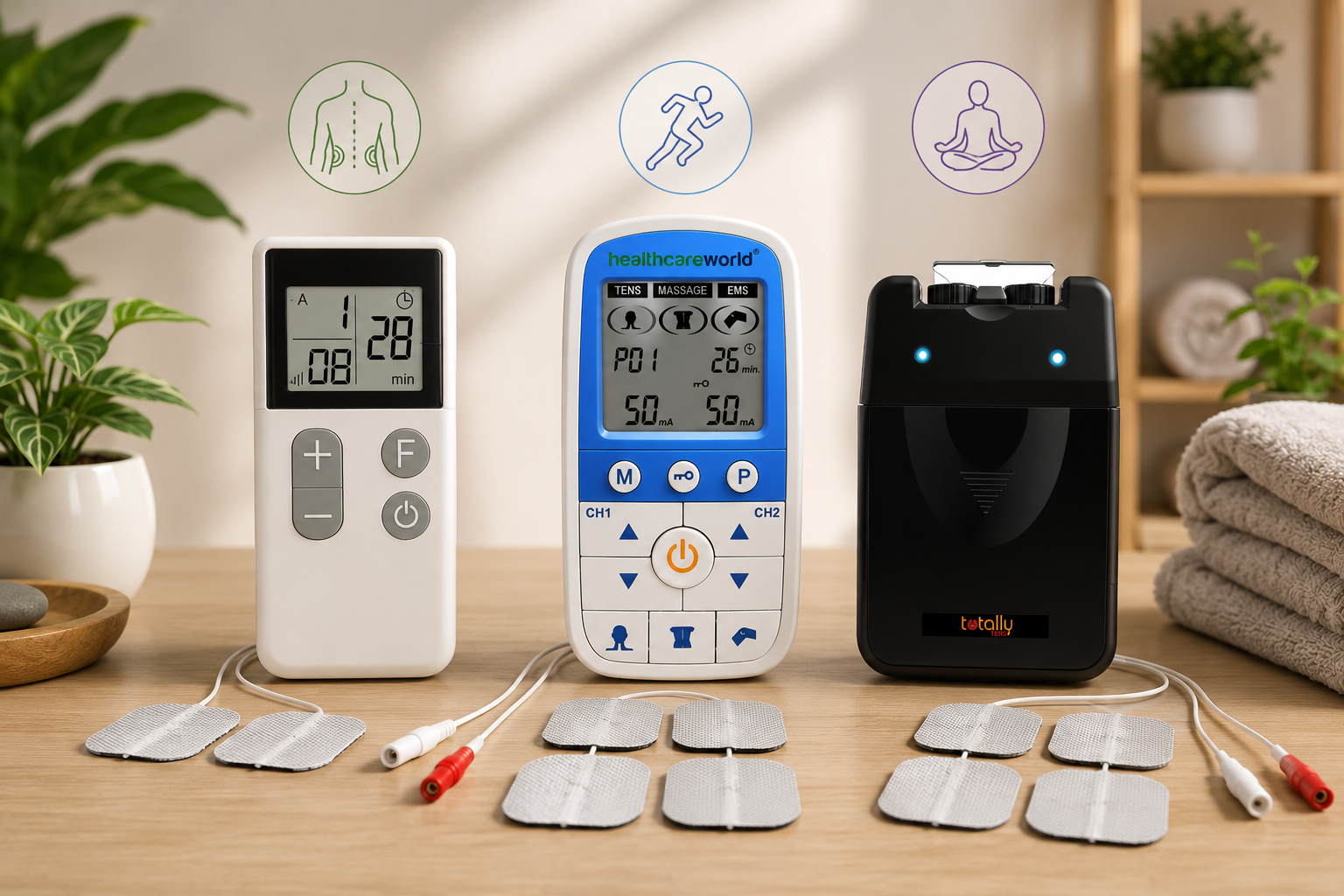
Rechargeable TENS Machines: A UK Guide to Choosing and Using One
If you want a TENS machine that is convenient for regular use, a rechargeable TENS machine can be worth considering. Instead of relying on replaceable batteries, these devices have an internal rechargeable battery that can be topped up when needed. TENS stands for transcutaneous electrical nerve stimulation. A TENS machine delivers mild electrical impulses through electrode pads placed on the skin and can provide temporary pain relief for some people. The NHS describes TENS machines as small, portable, battery-powered devices, while also noting that TENS does not work for everyone. (nhs.uk) For people who use TENS regularly, rechargeable power can make the device easier to maintain, carry and use at home or while travelling. If you’re new to TENS, start with our TENS Machine Guide for Beginners and What Is a TENS Machine?.
Safety disclaimer: This article is for general educational purposes and isn’t a substitute for personalised medical advice. Always follow the instructions supplied with your specific device. If you have a pacemaker or other implanted electrical device, epilepsy, are pregnant or have another relevant condition, seek appropriate professional advice before using TENS.
Quick Answer: What Is a Rechargeable TENS Machine?
A rechargeable TENS machine is a TENS device powered by a built-in rechargeable battery rather than relying solely on disposable or replaceable batteries. The basic function is the same as other TENS machines: Rechargeable battery → control unit → electrical impulses → electrode pads → skin The rechargeable design mainly affects convenience and power management, rather than changing how TENS itself works.
Why choose rechargeable?
A rechargeable TENS machine can be useful if you:
- Use TENS regularly
- Don’t want to keep buying batteries
- Travel frequently
- Prefer USB or mains charging
- Want a compact device
- Want fewer battery replacements
- Prefer a cleaner, simpler setup
However, rechargeable doesn’t automatically mean better. You should still compare electrode quality, intensity controls, programmes, battery life, charging method and overall usability.
How Does a Rechargeable TENS Machine Work?
TENS works by sending mild electrical impulses through electrode pads attached to the skin. The NHS explains that TENS may help by affecting pain signals travelling through the nerves and encouraging the release of endorphins, the body’s natural pain-relieving chemicals. (nhs.uk) You may feel:
- Tingling
- Pulsing
- Buzzing
- A tapping sensation
The stimulation should generally be noticeable but comfortable rather than painful. The NHS advises increasing the current slowly until you feel a tingling sensation that isn’t painful. (nhs.uk) The rechargeable battery simply provides the electrical power needed by the device. For a deeper explanation, read How Does a TENS Machine Work?.
Rechargeable vs Battery-Powered TENS Machines
The biggest difference is how the device gets its power.
| Feature | Rechargeable TENS | Replaceable-Battery TENS |
|---|---|---|
| Power source | Built-in rechargeable battery | Replaceable batteries |
| Charging required | Yes | No |
| Need spare batteries | Usually no | Often useful |
| Long-term convenience | High for regular users | Depends on battery availability |
| Travel | Convenient if charged | Convenient if spare batteries are packed |
| USB charging | Common on some models | Usually not applicable |
| Battery replacement | Not normally user-replaceable | Simple battery replacement |
| Running cost | Charging electricity | Ongoing battery purchases |
Neither system is automatically superior. A person who uses TENS occasionally might prefer replaceable batteries because there’s no need to remember to recharge the machine. Someone using TENS regularly may prefer rechargeable power.
Benefits of Rechargeable TENS Machines
1. No Regular Battery Purchases
One of the biggest advantages is avoiding repeated purchases of disposable batteries. If you use a TENS machine frequently, this can make ownership more convenient. Instead of keeping spare batteries nearby, you simply recharge the device.
2. Convenient for Regular Use
Rechargeable power is particularly useful for people who use TENS frequently. You can charge the machine after a session and have it ready for the next one.
3. Travel Friendly
A rechargeable TENS machine can be convenient when travelling because you don’t necessarily need to pack multiple spare batteries. You do, however, need to remember the correct charging cable or adapter.
4. Compact Design
Many rechargeable TENS machines are designed to be portable. This means you can potentially keep the machine in:
- A handbag
- Backpack
- Work bag
- Bedside drawer
- Travel case
Leeds Teaching Hospitals describes TENS as a small, lightweight, battery-powered machine that can be carried with you. (Leeds Teaching Hospitals NHS Trust)
5. Wireless Designs Are Available
Some rechargeable TENS machines are also wireless. This can reduce cable clutter between the control unit and electrode pads. The Healthcare World Wireless TENS Machine supplied for this project is an example. It combines rechargeable power with wireless operation, 15 automated TENS programmes and 16 intensity levels.
Rechargeable TENS Machines for Home Use
A rechargeable device can be particularly convenient if you mainly use TENS at home. You can:
- Charge the machine.
- Store it with the electrodes.
- Use it when needed.
- Recharge it after use.
You don’t have to keep a supply of batteries in a drawer. A carrying case can also keep the machine, electrodes and charging accessories together. However, convenience should never replace safe use. The NHS advises against using TENS while sleeping, driving or operating machinery, and in the bath or shower. (nhs.uk)
Rechargeable TENS Machines for Travel
Portability is one of the strongest reasons to choose rechargeable. Before travelling, make sure you pack:
- TENS machine
- Charging cable
- Correct power adapter if required
- Electrode pads
- Electrode leads, if applicable
- Carrying case
- Manufacturer’s instructions
Check the battery before leaving
A common mistake is packing the device but forgetting to charge it. If you’re travelling for several days, check how the machine charges and whether you will have access to a suitable power source.
Keep the charger with the machine
A rechargeable TENS machine isn’t much use if the charging cable is sitting at home. For regular travellers, keeping the charger permanently inside the carrying case can help avoid this problem.
What Battery Features Should You Check?
Not all rechargeable TENS machines are the same.
Battery Life
Look at the manufacturer’s stated operating time. Battery life can vary depending on:
- Intensity
- Programme
- Frequency
- Screen usage
- Wireless features
- Age of the battery
Don’t assume that every rechargeable model will last the same amount of time between charges.
Charging Time
A machine that takes several hours to recharge may be less convenient if you frequently use it. Check the manufacturer’s charging specifications before buying.
Charging Connection
Some devices use USB charging, while others may have a dedicated charging adapter. A USB connection can be convenient if you already carry compatible chargers.
Battery Indicator
A clear battery indicator is useful because it lets you know when the machine needs charging. The Healthcare World Wireless model provided for this project has a digital display showing battery information.
Automatic Shut-Off
A timer or automatic shut-off can help manage sessions and may prevent unnecessary battery drain.
How Long Does a Rechargeable TENS Battery Last?
There isn’t one universal answer. Battery life depends on the specific device and how you use it. For example, higher stimulation levels and certain programmes may consume more power than others. The manufacturer’s stated battery runtime is therefore more useful than comparing devices based only on whether they are rechargeable. When comparing machines, look for: Battery capacity + expected runtime + charging time rather than simply asking whether the device is rechargeable.
How Often Do You Need to Charge a TENS Machine?
That depends on your usage. If you use TENS occasionally, you may only need to recharge the machine after several sessions. If you use it frequently, you may need to charge it more often. A simple routine is: Use → check battery → recharge when needed → store safely Avoid waiting until the battery is completely empty every time if the manufacturer’s instructions recommend a different charging routine.
How to Charge a Rechargeable TENS Machine Safely
Always follow the charging instructions supplied with your device. As a general principle:
- Use the manufacturer’s recommended charger or cable.
- Charge the device in a suitable location.
- Keep the charging equipment away from water.
- Don’t use visibly damaged charging equipment.
- Don’t use a damaged battery.
- Disconnect and store the charger according to the manufacturer’s instructions.
NHS guidance on battery-powered equipment recommends charging and using batteries according to the manufacturer’s instructions and not charging damaged batteries. (NHS England) Don’t assume that because a TENS machine is small, battery safety doesn’t matter.
Rechargeable TENS vs Wireless TENS
These features are often confused. Rechargeable describes how the machine gets its power. Wireless describes how the control unit communicates with the electrodes or how the electrodes are connected. A machine can be:
- Rechargeable and wired
- Rechargeable and wireless
- Battery-powered and wired
- Battery-powered and wireless
Therefore, don’t treat “wireless” and “rechargeable” as the same feature. The Healthcare World Wireless TENS Machine provided for this project combines both.
Three TENS Machines and Their Power Options
The three machines supplied for this project demonstrate different approaches.
Healthcare World Wireless TENS Machine
This is the strongest example of a rechargeable portable TENS machine among the three. Features include:
- Rechargeable design
- Wireless remote control
- 15 automated TENS programmes
- 16 intensity levels
- Digital display
- Adhesive electrode pads
- Compact, portable design
- Carrying case
Good fit for: users prioritising wireless convenience and rechargeable portability.
Healthcare World 3-in-1 Digital TENS and EMS Machine
This device combines TENS and EMS functionality. The supplied information lists:
- TENS
- EMS
- Massage functionality
- Dual independent channels
- 28 therapy modes
- 40 intensity levels
- Four self-adhesive electrodes
- Battery-powered operation
Good fit for: users who want TENS and EMS functionality in one device. Note that the supplied product information describes this model as battery powered rather than specifically rechargeable, so it should not be presented as a rechargeable model without verifying the current manufacturer’s specification.
Totally TENS TPN-Type Analogue Dual Channel Machine
The supplied information lists:
- Dual independent channels
- Burst, Normal and Modulation modes
- Adjustable intensity
- Pulse-width adjustment
- 30- and 60-minute timer options
- Battery operation
Good fit for: users looking for a traditional dual-channel TENS design. Again, the supplied information identifies this as battery powered rather than specifically rechargeable.
What Else Should You Look for in a Rechargeable TENS Machine?
Battery life is important, but it shouldn’t be your only consideration.
Adjustable Intensity
You should be able to adjust the electrical stimulation to a comfortable level.
Multiple Programmes
Different programmes can offer different stimulation patterns. However, more programmes don’t necessarily mean better results.
Timer
A timer can help you control treatment duration.
Dual Channels
A dual-channel machine may allow you to treat two suitable areas independently, depending on the model.
Clear Display
A readable screen can make it easier to monitor:
- Battery
- Programme
- Intensity
- Timer
Electrode Availability
Check whether compatible replacement electrodes are easy to obtain.
Simple Controls
A rechargeable machine with dozens of settings isn’t necessarily better than a simpler model. For beginners, ease of use can be more valuable than a huge number of programmes.
Are Rechargeable TENS Machines Better?
Not necessarily. Rechargeability is primarily a convenience feature. A rechargeable machine may be better for you if you:
- Use TENS regularly
- Travel frequently
- Don’t want to buy batteries
- Prefer USB charging
- Want fewer accessories
A replaceable-battery machine may make more sense if you:
- Use TENS occasionally
- Don’t want to remember to recharge
- Prefer carrying spare batteries
- Want to replace the battery yourself
The important thing is to choose according to your routine.
Are Rechargeable TENS Machines Safe?
The rechargeable battery itself doesn’t make a TENS machine inherently safer or less safe than a replaceable-battery model. The important considerations are:
- Whether TENS is appropriate for you
- Correct electrode placement
- Appropriate intensity
- Proper device operation
- Battery and charger condition
- Following the manufacturer’s instructions
The NHS advises against TENS for people with epilepsy or a pacemaker and recommends professional advice during pregnancy. It also advises against using TENS on irritated, broken, infected or numb skin. (nhs.uk) The Royal National Orthopaedic Hospital similarly advises people with pacemakers or other electrical/metal implants, epilepsy, heart problems or sensory changes to obtain medical advice before using TENS. (Royal National Orthopaedic Hospital) For a more detailed explanation, read Is TENS Safe? and TENS Contraindications.
Common Mistakes With Rechargeable TENS Machines
Forgetting to Charge It
This is probably the most obvious rechargeable-device problem. Make charging part of your normal routine.
Using the Wrong Charger
Use the charger or charging cable recommended by the manufacturer. Don’t assume every USB cable or adapter is appropriate.
Charging a Damaged Device
If the battery, charging port or cable is damaged, don’t continue using it. Follow the manufacturer’s safety instructions.
Assuming Rechargeable Means Waterproof
It doesn’t. A rechargeable TENS machine should not be used in the bath or shower unless the manufacturer specifically states otherwise. The NHS advises against using TENS in the bath or shower. (nhs.uk)
Using It While Charging
Don’t assume you can use the machine simply because it’s connected to a charger. Check your manufacturer’s instructions. If the device isn’t designed for simultaneous charging and operation, don’t do it.
Sleeping With It
Rechargeable doesn’t change the rules. The NHS advises against using TENS while sleeping. (nhs.uk)
Driving While Using It
Don’t use TENS while driving or operating machinery. (nhs.uk)
How to Use a Rechargeable TENS Machine
The basic process remains the same regardless of the power source.
Before Your Session
- Make sure the machine has enough charge.
- Read the manufacturer’s instructions.
- Check that TENS is appropriate for you.
- Inspect the electrodes and leads.
- Clean and dry your skin.
- Make sure the machine is switched off.
During Your Session
- Apply the electrodes correctly.
- Switch the machine on.
- Start with a low intensity.
- Increase gradually.
- Keep the sensation comfortable.
- Follow the recommended treatment duration.
After Your Session
- Switch the machine off.
- Remove the electrodes carefully.
- Check your skin.
- Store the electrodes correctly.
- Recharge the device when necessary.
Cambridge University Hospitals advises switching the machine off before applying or removing electrode pads and using comfortable settings. (Cambridge University Hospitals)
How Long Should You Use a Rechargeable TENS Machine?
Rechargeability doesn’t determine treatment duration. The appropriate session length depends on the device, programme and individual. Cambridge University Hospitals advises starting with 30–60 minutes and increasing use if helpful. Its patient guidance notes that TENS can be used continuously during the day when appropriate. (Cambridge University Hospitals) However, you should always follow the instructions for your particular machine. Read How Long Should You Use a TENS Machine? for more information.
Can You Use a Rechargeable TENS Machine Every Day?
Some people use TENS regularly, including daily use. However, rechargeable does not mean unlimited. The appropriate frequency depends on your circumstances and your machine’s instructions. Check your skin regularly, particularly if you’re using adhesive electrodes frequently. Cambridge University Hospitals recommends monitoring the skin underneath the pads and moving the electrode position if redness or soreness develops. (Cambridge University Hospitals) For more information, read Can You Use TENS Every Day?.
Can You Sleep With a Rechargeable TENS Machine?
No. The fact that the machine has a rechargeable battery doesn’t make it suitable for overnight use. NHS guidance advises against using TENS while sleeping. (nhs.uk) If you use TENS before bed, switch it off before you fall asleep. Read Can You Sleep with a TENS Machine?.
Can You Use a Rechargeable TENS Machine While Travelling?
Yes, portability is one of the main advantages of rechargeable models. However, remember:
- Charge it before travelling.
- Pack the charging cable.
- Carry compatible electrodes.
- Store everything securely.
- Follow the manufacturer’s instructions.
If you’re travelling by air, check current airline and airport rules for electronic devices and lithium batteries where applicable.
Rechargeable TENS Machine Buying Checklist
Before choosing a model, ask yourself:
1. How often will I use it?
Frequent users may benefit more from rechargeable power.
2. How long does the battery last?
Compare manufacturer specifications.
3. How long does charging take?
A shorter charging time can be convenient.
4. Does it have a battery indicator?
Useful for preventing unexpected loss of power.
5. What charger does it use?
Check whether it uses USB or a dedicated charger.
6. Can it be used while charging?
Don’t assume it can. Check the manufacturer’s instructions.
7. Is it wireless?
Wireless operation is separate from rechargeable power but can make the machine more convenient.
8. Does it have enough intensity levels?
Adjustable intensity is important for finding a comfortable setting.
9. Does it have a timer?
Useful for managing treatment sessions.
10. Are replacement pads available?
This matters for long-term use.
11. Is it easy to operate?
A simple interface may be preferable for beginners.
12. Does it come with a case?
Useful for keeping the machine and accessories organised.
Rechargeable TENS Machine Comparison
| Feature | Healthcare World Wireless | Healthcare World 3-in-1 | Totally TENS TPN-Type |
|---|---|---|---|
| TENS | ✓ | ✓ | ✓ |
| EMS | — | ✓ | Product information includes TENS/EMS functionality |
| Rechargeable | ✓ | Not specified as rechargeable | Not specified as rechargeable |
| Wireless | ✓ | No | No |
| Intensity levels | 16 | 40 | Adjustable |
| Programmes/modes | 15 automated TENS programmes | 28 therapy modes listed | Burst, Normal & Modulation |
| Channels | Wireless electrode design | Dual | Dual |
| Display | Digital | Digital | LED |
| Electrodes | Adhesive electrodes | 4 | Included |
| Portable | ✓ | ✓ | ✓ |
| Main strength | Rechargeable wireless convenience | TENS + EMS versatility | Dual-channel control |
Note: Product specifications are based on the machine information supplied for this project. Specifications, accessories and availability can change, so verify current manufacturer information before purchase.
Who Should Consider a Rechargeable TENS Machine?
A rechargeable model may be worth considering if you:
- Use TENS regularly.
- Want to avoid buying replacement batteries.
- Travel frequently.
- Prefer a compact device.
- Want a rechargeable rather than disposable power source.
- Like the convenience of wireless operation.
- Want to keep your TENS machine ready for use.
If you only use TENS occasionally, however, a replaceable-battery model may be perfectly practical.
Rechargeable TENS Machines vs Other Drug-Free Pain Relief Options
Rechargeable TENS is one option among several non-drug approaches.
| Approach | Main method | Portable options |
|---|---|---|
| TENS | Electrical nerve stimulation | Yes |
| EMS | Electrical muscle stimulation | Yes |
| Heat therapy | Controlled warmth | Yes |
| Cold therapy | Cooling | Yes |
| Massage | Mechanical/manual stimulation | Yes |
| Exercise/physiotherapy | Movement and rehabilitation | Depends |
These approaches aren’t necessarily alternatives where only one can be used. The appropriate approach depends on the individual and the type or cause of pain. For a comparison between TENS and heat, read TENS vs Heat Therapy.
FAQs
Are rechargeable TENS machines worth it?
They can be, particularly for regular users who want to avoid repeatedly buying batteries. Occasional users may prefer a replaceable-battery device.
Do rechargeable TENS machines work better?
No. Rechargeability is a power feature, not an indication that the TENS therapy itself will be more effective.
How long does a rechargeable TENS machine last?
Battery runtime varies by model and usage. Check the manufacturer’s stated runtime rather than assuming all rechargeable devices are the same.
How often do you need to charge a rechargeable TENS machine?
It depends on the battery and how frequently you use the device. Regular users will generally need to recharge more often than occasional users.
Can I use my rechargeable TENS machine while charging?
Only if the manufacturer specifically states that this is supported. Otherwise, use the machine independently of the charging process.
Can I charge a TENS machine overnight?
Follow the manufacturer’s charging instructions. Don’t charge a damaged battery or use damaged charging equipment. (NHS England)
Are rechargeable TENS machines wireless?
Not necessarily. Rechargeable describes the power source, while wireless describes the connection between the controller and electrodes.
Can I take a rechargeable TENS machine on holiday?
Generally, portable TENS machines are convenient for travel. Take the charger, electrodes and accessories and check relevant transport rules for battery-powered electronics.
Can I use a rechargeable TENS machine every day?
Some people use TENS daily, but the appropriate frequency depends on the individual and the machine. Follow the manufacturer’s instructions and monitor your skin. (Cambridge University Hospitals)
Can I sleep with a rechargeable TENS machine?
No. NHS guidance advises against using TENS while sleeping. (nhs.uk)
Can I use a rechargeable TENS machine in the shower?
No. TENS should not be used in the bath or shower. (nhs.uk)
Can I use a rechargeable TENS machine while driving?
No. The NHS advises against using TENS while driving or operating machinery. (nhs.uk)
What happens if my TENS battery runs out during treatment?
The machine will stop operating once its available power is exhausted. Recharge it according to the manufacturer’s instructions before your next session.
How do I know when my TENS battery needs charging?
Many rechargeable devices have a battery indicator. If yours doesn’t, follow the manufacturer’s recommended charging routine.
Are rechargeable TENS machines safe?
TENS can be suitable for many people, but it isn’t appropriate for everyone. Certain conditions, implanted devices and pregnancy may require avoidance or professional advice. (nhs.uk)
The Bottom Line: Are Rechargeable TENS Machines a Good Choice?
A rechargeable TENS machine can be a convenient choice for regular users, particularly if portability and avoiding disposable batteries are priorities. The biggest advantages are:
- No routine battery replacement
- Convenient charging
- Portable design
- Good suitability for regular use
- Potentially less waste from disposable batteries
- Wireless options available on some models
But rechargeable power is only one part of the decision. Before buying, consider: Battery life + charging time + intensity control + programmes + electrodes + timer + channels + portability + ease of use. And remember that rechargeable doesn’t change the basic safety rules for TENS. Don’t use TENS while sleeping, driving or in water, and don’t use it if it is unsuitable for your medical circumstances. (nhs.uk) If you’re ready to compare models, Explore TENS and EMS Machines. For more practical information, visit the TENS Education Hub.
Related TensLeads Guides
- TENS Machine Guide for Beginners
- What Is a TENS Machine?
- How Does a TENS Machine Work?
- Portable TENS Machines
- How Long Should You Use a TENS Machine?
- Can You Use TENS Every Day?
- Can You Sleep with a TENS Machine?
- Is TENS Safe?
- TENS Contraindications
- TENS Side Effects
- TENS vs Heat Therapy
Medical Sources
- NHS — TENS guidance
- Cambridge University Hospitals — TENS for pain relief
- Cambridge University Hospitals — TENS usage advice
- Royal National Orthopaedic Hospital — TENS patient guide
- Cleveland Clinic — TENS
- Leeds Teaching Hospitals — TENS for pain control
Safety Disclaimer
This article is for general educational purposes only and does not provide medical diagnosis or personalised treatment advice. TENS is not suitable for everyone and does not guarantee pain relief. Always read and follow the instructions supplied with your device. If you have an implanted electrical device, epilepsy, are pregnant, have reduced sensation or have unexplained or persistent pain, consult an appropriate healthcare professional before using TENS.