
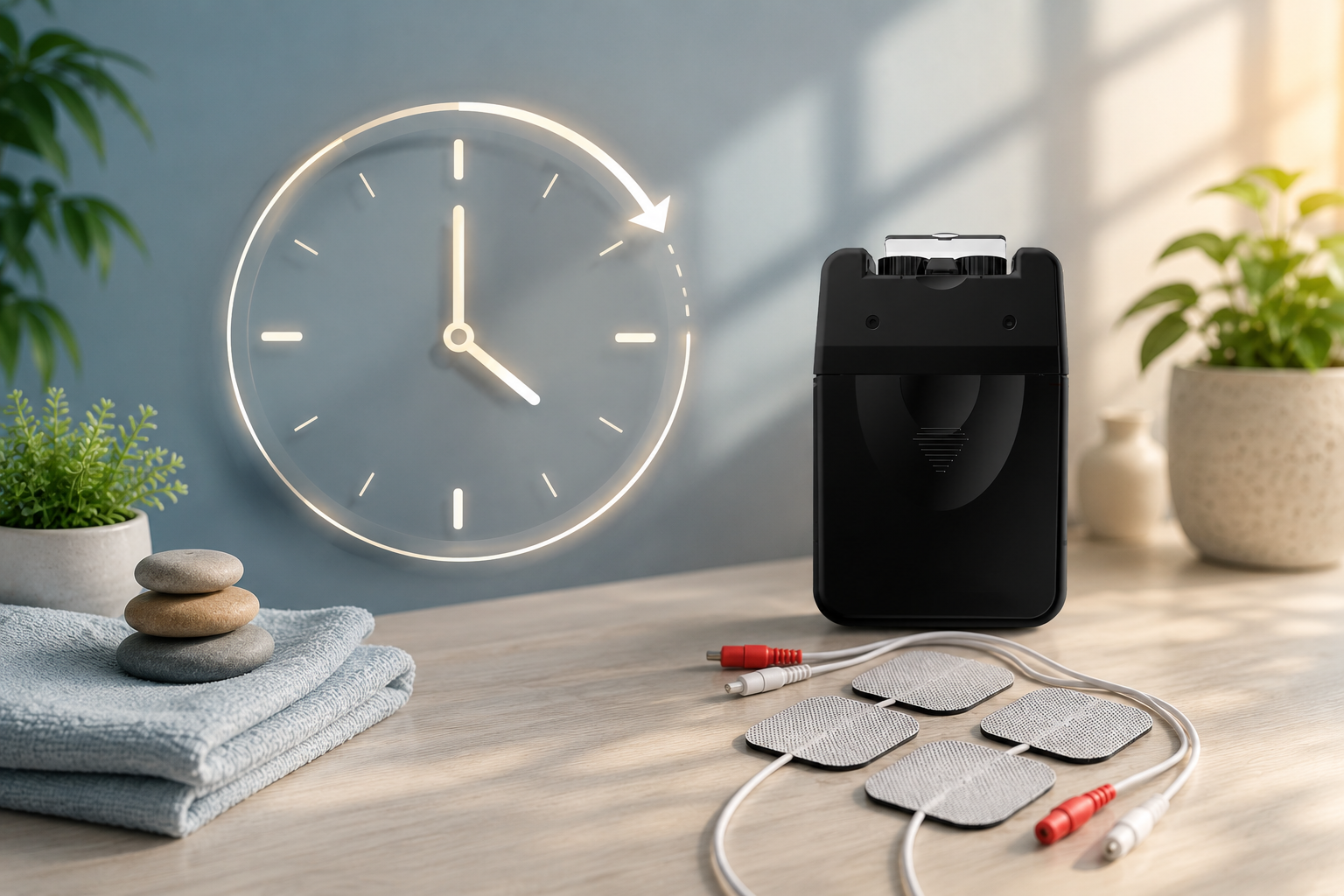
How Long Should You Use a TENS Machine?
If you’re using a TENS machine for pain relief, one of the first questions you may have is: how long should you use a TENS machine at a time?
There isn’t one universal treatment duration that applies to everyone. NHS guidance varies depending on the person, the TENS programme, the reason for treatment and the specific device. Some NHS guidance recommends starting with 30–60 minutes, while other guidance allows longer sessions or use for several hours when appropriate.
For many beginners, starting with a shorter session and gradually increasing the duration if it is comfortable and helpful is a sensible approach. The manufacturer’s instructions should always take priority.
If you’re new to TENS, our guide to what a TENS machine is is a useful starting point.
Safety disclaimer: This article provides general educational information and is not a substitute for personalised medical advice. Always follow the instructions supplied with your TENS machine and speak to an appropriate healthcare professional if you’re unsure whether TENS is suitable for you.
Quick Answer: How Long Should You Use a TENS Machine?
For a beginner, 30–60 minutes is a reasonable starting point for many TENS machines. If you find the treatment comfortable and helpful, some NHS guidance allows the duration to be increased to several hours or, with certain devices and programmes, much of the day.
For example:
- Starting out: around 30–60 minutes
- If helpful and comfortable: gradually increase the duration
- Some NHS guidance: allows several hours of use
- Certain programmes/devices: may allow use for up to 12 hours
- Sleeping: do not use TENS while asleep
- Driving: do not use TENS while driving or operating machinery
- Bathing: never use TENS in the bath or shower
The correct duration depends on your individual circumstances and the instructions for your particular machine.
How Long Does a TENS Session Usually Last?
There is no single standard TENS session length.
Cambridge University Hospitals recommends using TENS for a minimum of 30–60 minutes, increasing to a few hours continuously if it is helpful. Its patient guidance also states that TENS can be used throughout the day when appropriate.
Leeds Teaching Hospitals recommends starting with 30–45 minutes at a time. Once someone becomes accustomed to TENS, its guidance says it can be used for up to 12 hours a day.
Meanwhile, the Royal National Orthopaedic Hospital gives more conservative guidance of a maximum of 60 minutes at a time, usually up to three times a day.
These differences demonstrate why there isn’t a single number that applies to every TENS machine or every user.
Why Do Recommended Times Differ?
TENS machines can have different:
- Programmes
- Pulse settings
- Intensity ranges
- Electrode configurations
- Manufacturer recommendations
The type of pain and the way the machine is being used can also affect the recommended schedule.
That’s why you should use general guidance as a starting point rather than assuming that the longest recommended duration is automatically best for you.
How Does TENS Work?
TENS stands for transcutaneous electrical nerve stimulation.
A TENS machine sends a weak electrical current through electrode pads attached to the skin. You normally experience this as a tingling, buzzing or pulsing sensation.
The NHS explains that TENS provides temporary pain relief and is thought to work partly by encouraging the body to release natural painkillers called endorphins and by affecting pain messages travelling from the nerves to the brain.
For a more detailed explanation, read our guide to how a TENS machine works.
TENS does not work for everyone, and it should be viewed as a pain-management option rather than a guaranteed solution.
What Should TENS Feel Like?
A TENS machine should normally produce a noticeable but comfortable sensation.
You may feel:
- Tingling
- Pulsing
- Buzzing
- A mild electrical sensation
The intensity should be strong enough to feel but not painful or unpleasant. Leeds Teaching Hospitals recommends gradually increasing the intensity until the sensation is strong but comfortable.
If the stimulation becomes painful, reduce the intensity.
You should not assume that turning the machine to its highest setting will provide better pain relief.
How Should Beginners Use a TENS Machine?
If you’re using TENS for the first time, don’t feel that you need to keep it running for hours immediately.
1. Check the Instructions First
Read the instructions supplied with your particular machine.
Different TENS devices can have different recommended treatment times and programmes.
2. Start With 30–60 Minutes
For many beginners, starting with around 30–60 minutes provides an opportunity to see how your body responds.
Cambridge University Hospitals specifically recommends starting with 30–60-minute periods before increasing use if helpful.
3. Use a Comfortable Intensity
Turn the intensity up gradually.
The sensation should be strong but comfortable, rather than painful.
4. Check Your Skin
Before and after treatment, check the skin underneath the electrodes.
Don’t use TENS on:
- Broken skin
- Infected skin
- Irritated skin
- Numb areas
The NHS specifically advises against using TENS on irritated, broken, infected or numb skin.
5. Increase the Duration Gradually
If a 30–60-minute session is comfortable and useful, you may be able to increase the duration depending on your device and circumstances.
Some NHS guidance permits several hours of continuous use, while other guidance recommends shorter sessions.
6. Stop If Something Feels Wrong
If the stimulation becomes painful or your pain gets worse, stop the session rather than simply increasing the intensity or duration.
How Long Can You Leave a TENS Machine On?
Some TENS machines can be used for several hours.
Cambridge University Hospitals states that TENS can be used continuously throughout the day if helpful.
Leeds Teaching Hospitals says that, after becoming accustomed to TENS, users can use it for up to 12 hours a day.
However, this does not mean every TENS machine should be used for 12 hours.
For example, the Royal National Orthopaedic Hospital recommends a maximum of 60 minutes at a time, usually up to three times daily.
A more recent University Hospitals of Leicester guide gives programme-specific instructions for one particular dual-channel TENS device: continuous/normal and modulation settings can be used for up to 12 hours, while burst mode is limited to four 30-minute sessions per day.
This is why the specific machine and programme matter.
Can You Use TENS All Day?
Some people can, but it depends on the machine and treatment plan.
Cambridge University Hospitals says TENS can be used throughout the day when helpful, while Leeds Teaching Hospitals says experienced users may use it for up to 12 hours a day.
However, all-day use should not be treated as a target.
If you get useful pain relief from a 30-minute session, you may not need several hours.
If you have been advised to use TENS for longer periods, follow the treatment plan and monitor your skin.
How Long Should You Use TENS for Back Pain?
TENS is sometimes used as part of pain management for back and other musculoskeletal pain.
The duration should still be based on your machine’s instructions and how you respond.
A sensible starting point may be:
30–60 minutes → assess comfort and benefit → increase gradually if appropriate.
Some NHS guidance permits substantially longer use once a person is accustomed to TENS.
If you have unexplained, persistent or worsening back pain, however, don’t simply increase TENS use without considering whether the underlying problem needs assessment.
How Long Should You Use TENS for Knee Pain?
TENS may also be used around the knee for pain management.
For knee treatment, place the electrodes according to the instructions supplied with your machine or guidance from a healthcare professional.
The NHS demonstrates TENS electrode placement around the knee and recommends placing the pads on clean skin near the painful area while leaving a gap between them.
Again, 30–60 minutes can be a reasonable starting point for many users, but the appropriate duration depends on your device and circumstances.
Can You Use TENS Every Day?
Yes, daily use can be appropriate for some people.
Cleveland Clinic states that TENS can generally be used as often as needed, with some people using it several times a day for up to 60 minutes per session. It recommends checking with a healthcare provider before starting.
NHS guidance is similarly flexible. Some services allow prolonged daily use when helpful, while others provide specific limits based on the device or programme.
Daily use does not mean you need to use TENS continuously.
The most important considerations are:
- Is TENS appropriate for you?
- Is the treatment comfortable?
- Is your skin tolerating the electrodes?
- Is it providing useful relief?
- Are you following your device’s instructions?
For more information, see our related guide on how long you can use a TENS machine every day.
Should You Take Breaks From TENS?
There isn’t one universal rule requiring a particular break between every TENS session.
Some NHS guidance allows continuous use for several hours, while other guidance recommends defined sessions and breaks.
If you’re using TENS for long periods, regular skin checks are particularly important.
Cambridge University Hospitals advises checking the skin under the electrodes, while its guidance also recommends checking the electrode gel twice a day when TENS is used for long periods.
If your skin becomes sore or irritated, stop and give it time to recover.
What Happens If You Use TENS for Too Long?
Using TENS for longer than necessary does not automatically provide more pain relief.
Potential problems from inappropriate or prolonged use include:
- Skin irritation
- Redness
- Discomfort
- Electrode-related skin damage
- Rarely, burns
Cleveland Clinic lists allergic reactions to electrode adhesives, uncomfortable sensations and rare burns as potential disadvantages of TENS.
The Royal National Orthopaedic Hospital also warns about skin damage and burns and recommends following the manufacturer’s instructions.
If you notice persistent redness, soreness, blistering or other unusual skin changes, stop using the machine and seek appropriate advice.
How Long Does It Take for TENS to Work?
Don’t necessarily expect immediate pain relief.
West Suffolk NHS guidance notes that it can take up to 30 minutes to feel the effects of TENS.
Cleveland Clinic reports that many people experience pain relief during treatment, although the duration of relief after a session varies considerably between individuals.
This is one reason why immediately increasing the intensity or extending a session may not be necessary.
Give the treatment enough time to assess whether it is useful, while remaining within your device’s recommended settings.
Does a Longer TENS Session Work Better?
Not necessarily.
There is no simple rule that says a two-hour session will provide twice the benefit of a one-hour session.
TENS response varies between people. Some users may experience relief during treatment, while others may continue to feel some benefit after the machine is switched off.
The aim should be to find a duration that provides useful relief while remaining comfortable and safe.
TENS Session Length: A Simple Guide
| User situation | Possible approach |
| Complete beginner | Start around 30–60 minutes |
| Comfortable with TENS | Gradually increase if appropriate |
| Regular user | Follow your machine’s recommended schedule |
| Long-duration use | Monitor skin regularly |
| Using different programmes | Check programme-specific instructions |
| Pain becomes worse | Stop treatment |
| Skin becomes irritated | Remove electrodes and stop |
| While sleeping | Do not use TENS |
| While driving | Do not use TENS |
| In bath/shower | Do not use TENS |
This table is a general guide rather than a personalised treatment plan. Your manufacturer’s instructions should take priority.
Common Mistakes When Deciding How Long to Use TENS
Using It for the Maximum Possible Time
If your machine permits 12 hours of use, that doesn’t mean you need 12 hours.
Use the amount that is appropriate and useful for you.
Turning Up the Intensity Instead of Waiting
If you don’t immediately notice a benefit, don’t automatically turn the intensity up.
Give the treatment time to work and keep the sensation comfortable.
Ignoring Skin Irritation
If your skin becomes sore, itchy or red, remove the electrodes.
The NHS specifically recommends stopping TENS if the skin becomes itchy, irritated or red.
Assuming Every TENS Machine Has the Same Time Limit
Different devices and programmes can have different recommendations.
For example, one NHS device guide allows up to 12 hours for some modes but limits burst mode to shorter sessions.
Sleeping With the Machine On
The NHS advises against using TENS while sleeping.
Using TENS While Driving
Don’t use TENS while driving or operating machinery.
Who Should Avoid Long TENS Sessions?
The question isn’t only how long you can use TENS. First, you need to establish whether you should use it at all.
The NHS says not to use TENS if you have:
- Epilepsy
- A pacemaker
- Pregnancy unless your doctor or midwife tells you to use it
It also advises against using TENS on irritated, broken, infected or numb skin, or on the neck, mouth or eyes.
Cleveland Clinic lists additional circumstances requiring medical advice or avoidance, including certain implanted devices, heart disease, DVT and bleeding disorders.
If you have an implanted device or relevant medical condition, speak to a healthcare professional before starting regular TENS.
When Should You Stop a TENS Session?
Stop the session if:
- The stimulation becomes painful.
- Your pain noticeably worsens.
- Your skin becomes significantly irritated.
- You develop a rash.
- You experience unusual symptoms.
- The electrodes are no longer making proper contact.
- You feel dizzy or unwell.
If you develop persistent or concerning symptoms, seek appropriate medical advice.
Choosing a TENS Machine for Your Typical Session Length
If you plan to use TENS regularly, the machine’s controls and features can make a difference to convenience.
Consider:
Adjustable Intensity
Useful for gradually finding a comfortable stimulation level.
Timer
A timer can help you keep track of treatment sessions.
Multiple Programmes
Different programmes may provide different sensations and treatment options, but always check the recommended duration for each programme.
Dual Channels
A dual-channel device can allow two electrode sets to be controlled independently.
Rechargeable Operation
A rechargeable device can be convenient if you use TENS regularly or travel with it.
Clear Controls
Simple controls make it easier to adjust intensity and session settings.
For example, the Healthcare World 3-in-1 Digital TENS and EMS Machine supplied for this project is a dual-channel model with TENS, EMS and massage functions, multiple therapy modes and adjustable intensity.
The Healthcare World Wireless TENS Machine offers 15 automated TENS programmes and 16 intensity levels, together with wireless operation and rechargeable power.
The Totally TENS TPN-Type Analogue Dual Channel TENS Machine offers independent channels, Burst, Normal and Modulation modes, adjustable intensity, pulse-width adjustment and timed sessions.
These specifications can help with convenience and flexibility, but they don’t determine whether TENS is medically suitable for you.
Compare available TENS and EMS machines to find a device that matches your intended use.
When Should You Speak to a Healthcare Professional?
Speak to an appropriate healthcare professional before using TENS if:
- You have a pacemaker or implanted electrical device.
- You have epilepsy.
- You have heart disease.
- You are pregnant.
- You have DVT or a bleeding disorder.
- You have significant numbness.
- You don’t know what is causing your pain.
- You’re unsure where to position the electrodes.
- You’re considering prolonged regular use and have an existing medical condition.
The NHS recommends checking with a healthcare professional if you’re unsure whether TENS is safe or where to place the pads.
FAQs
How long should you use a TENS machine at one time?
For many beginners, 30–60 minutes is a reasonable starting point. Some NHS guidance allows longer sessions when appropriate, while other NHS guidance recommends a maximum of 60 minutes at a time.
Can you use a TENS machine for hours?
Yes, some TENS machines and programmes can be used for several hours. Certain NHS guidance permits use for up to 12 hours a day for experienced users or particular programmes.
Can you use TENS every day?
Yes, daily use can be appropriate for some people. The appropriate duration depends on your machine, programme and individual circumstances.
Can you use TENS all day?
Some NHS guidance allows TENS to be used throughout the day when helpful, but other guidance recommends shorter sessions or programme-specific limits. Always follow your machine’s instructions.
How long does it take TENS to work?
It may take around 30 minutes for some people to notice an effect. However, response varies considerably between individuals.
Can you sleep with a TENS machine?
No. The NHS advises against using TENS while sleeping.
Can you use TENS while driving?
No. The NHS advises against using TENS while driving or operating machinery.
Can you use TENS in the shower?
No. TENS should not be used in the bath or shower.
What happens if you use TENS for too long?
You may experience skin irritation or discomfort, and inappropriate use can rarely cause burns. Follow the instructions for your machine and monitor your skin.
Should you take breaks from TENS?
It depends on the machine and programme. Some NHS guidance permits prolonged use, while other guidance recommends defined sessions and breaks. Follow the instructions supplied with your device.
What intensity should TENS be?
The stimulation should normally feel strong but comfortable rather than painful. Start low and gradually increase the intensity.
Can you use TENS every day for chronic pain?
Some people use TENS regularly for ongoing pain, but daily use should form part of an appropriate pain-management approach rather than replace assessment of unexplained or worsening pain.
The Bottom Line: How Long Should You Use a TENS Machine?
For many beginners, 30–60 minutes is a sensible starting point. If the treatment is comfortable and helpful, the duration may be increased depending on your particular machine, programme and circumstances. NHS guidance ranges from shorter sessions to several hours or, for certain devices and programmes, up to 12 hours a day.
The key points are:
- Start with a shorter session.
- Keep the stimulation strong but comfortable.
- Follow your manufacturer’s instructions.
- Increase duration gradually if appropriate.
- Monitor your skin.
- Stop if TENS makes your pain worse.
- Never use it while sleeping, driving or in water.
- Don’t assume that longer treatment means better results.
- Seek professional advice if you have a medical condition or are unsure whether TENS is suitable.
If you’re looking for a machine for regular home use, Explore TENS and EMS Machines.
For more practical information about TENS, visit the TENS Education Hub.
Safety Disclaimer
This article is for general educational purposes only and is not a substitute for personalised medical advice, diagnosis or treatment. TENS is not appropriate for everyone. Always read and follow the instructions supplied with your device. If you have an implanted device, epilepsy, heart disease, are pregnant, have reduced sensation or experience unexpected symptoms, consult an appropriate healthcare professional before using TENS.
Supporting Medical Sources
- NHS — TENS (transcutaneous electrical nerve stimulation) NHS TENS guidance
- Cambridge University Hospitals — TENS for pain relief Cambridge University Hospitals TENS guidance
- Leeds Teaching Hospitals NHS Trust — TENS for pain control Leeds Teaching Hospitals TENS guidance
- Royal National Orthopaedic Hospital — Patient Guide to TENS RNOH TENS guide
- Cleveland Clinic — Transcutaneous Electrical Nerve Stimulation Cleveland Clinic TENS guidance
- University Hospitals of Leicester — Using a TENS machine for pain relief University Hospitals of Leicester TENS guide