
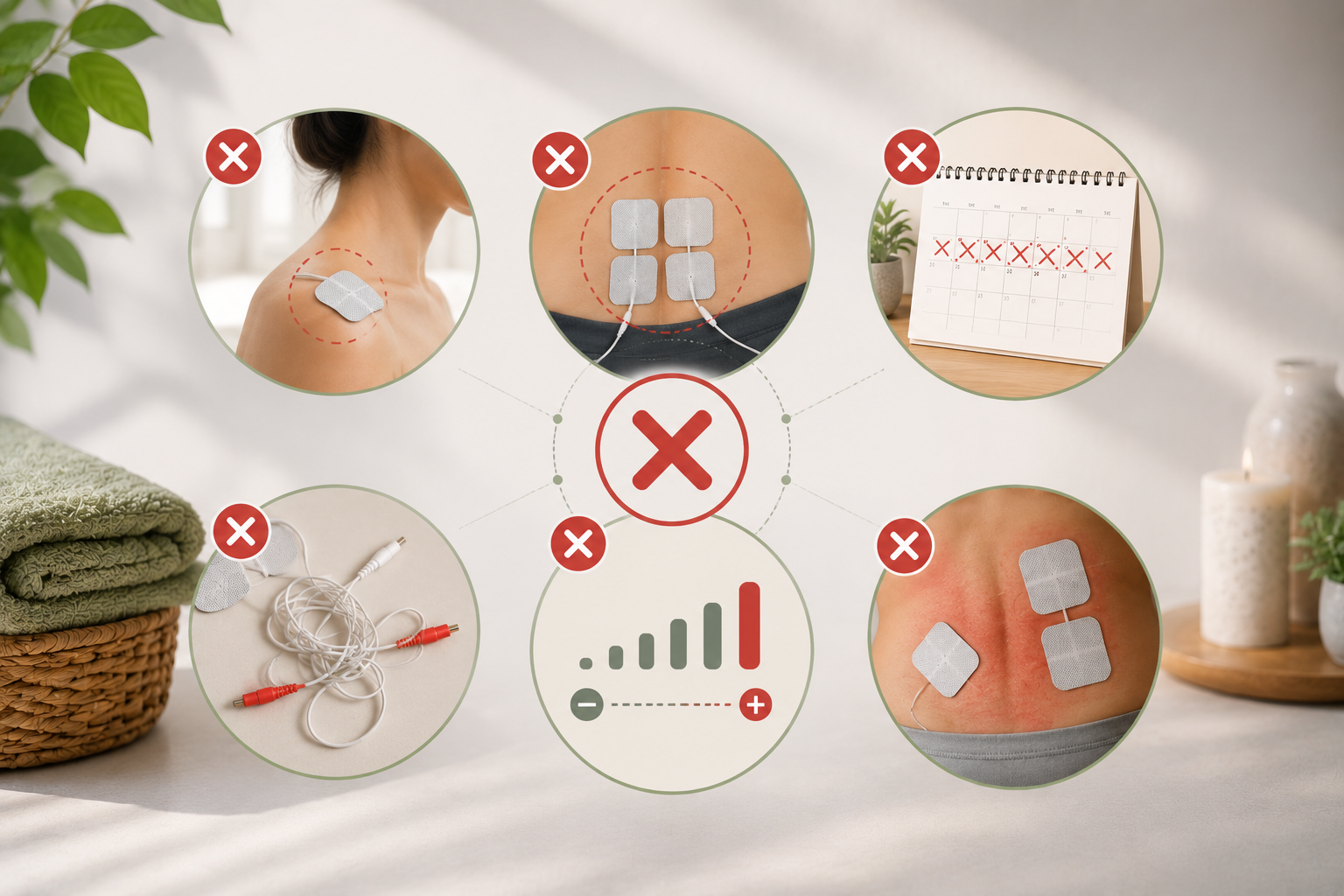
Common TENS Machine Mistakes
A TENS machine can be relatively simple to use, but beginners can still make mistakes with electrode placement, intensity, treatment time and basic safety. Using a TENS machine incorrectly may make the treatment uncomfortable, irritate the skin or reduce the usefulness of the session.
The good news is that most common TENS machine mistakes are easy to avoid.
The most important rules are simple: use the electrodes on appropriate, clean and intact skin, start with a comfortable intensity, follow your machine’s instructions, and never use TENS while sleeping, driving or in water. NHS guidance also recommends checking with a healthcare professional if you’re unsure whether TENS is suitable for you. (nhs.uk)
If you’re completely new to TENS, start with our TENS Machine Guide for Beginners and What Is a TENS Machine?.
Safety disclaimer: This article provides general educational information and is not a substitute for personalised medical advice. Always follow the instructions supplied with your specific TENS machine. If you have an implanted electrical device, epilepsy, are pregnant or have another relevant medical condition, seek appropriate professional advice before using TENS.
Quick Answer: What Are the Most Common TENS Machine Mistakes?
Common mistakes include:
- Putting electrodes in the wrong place.
- Applying electrodes to broken or irritated skin.
- Starting with an intensity that is too high.
- Assuming stronger stimulation means better results.
- Placing electrode pads too close together.
- Applying pads while the machine is switched on.
- Using TENS for longer than recommended.
- Sleeping with the machine switched on.
- Using TENS while driving.
- Using the machine in the bath or shower.
- Ignoring skin irritation.
- Using old or poorly maintained electrodes.
- Using TENS despite a relevant contraindication.
- Expecting TENS to cure the underlying cause of pain.
Understanding these mistakes can make TENS use safer and more comfortable.
1. Putting the TENS Pads in the Wrong Place
Incorrect electrode placement is one of the biggest mistakes beginners make.
TENS works through electrodes placed on the skin around the area being treated. The exact positioning depends on the body area, the machine and the instructions provided with the device.
The NHS recommends placing the pads on clean skin near the painful area and leaving a gap between them. If you’re unsure where they should go, a GP, physiotherapist or other healthcare professional can provide guidance. (nhs.uk)
Some areas should be avoided altogether.
Do not place TENS electrodes:
- On the front or sides of the neck
- Near the eyes
- In or around the mouth
- On broken or infected skin
- On numb areas
- On areas where your device’s instructions specifically prohibit use
Cambridge University Hospitals also advises against positioning electrodes near the heart or over the spinal cord. (Cambridge University Hospitals)
How to Avoid This Mistake
Before your first session, check the electrode-placement instructions for your particular machine.
If you’re treating an unfamiliar area and aren’t sure where the pads belong, ask a healthcare professional rather than guessing.
2. Putting Pads on Broken or Irritated Skin
TENS electrodes should be applied to appropriate, intact skin.
A common mistake is placing them over a cut, rash, infection, inflamed area or other skin problem simply because it is close to the painful area.
The NHS advises against using TENS on irritated, broken, infected or numb skin. (nhs.uk)
This matters because the electrical stimulation and adhesive can further irritate already-sensitive skin.
Better Approach
Check the skin before every session.
If it is:
- Broken
- Sore
- Irritated
- Infected
- Significantly inflamed
- Numb
don’t simply place the electrodes somewhere else without checking that the alternative position is appropriate.
3. Starting With the Intensity Too High
Another common beginner mistake is turning the intensity up too quickly.
You might assume that a stronger electrical sensation will produce better pain relief. That isn’t necessarily the case.
TENS should generally feel strong enough to notice but comfortable rather than painful. Cambridge University Hospitals recommends using comfortable settings, while NHS guidance says to increase the current slowly until you feel a tingling sensation that isn’t painful. (Cambridge University Hospitals)
What Should TENS Feel Like?
Depending on the programme, you might experience:
- Tingling
- Pulsing
- Buzzing
- A rhythmic sensation
If the stimulation feels sharp, painful or unpleasant, reduce the intensity.
Kent Community Health NHS Foundation Trust specifically warns against setting the sensation too high because over-stimulation may make pain worse. (Kent Community Health)
4. Assuming Stronger TENS Is Always Better
This is closely related to intensity, but it’s worth treating separately.
Beginners sometimes think:
Low intensity = weak treatment
High intensity = effective treatment
TENS doesn’t work that way.
The appropriate sensation depends on the programme, individual tolerance and the machine being used. The aim is generally to find a stimulation level that is noticeable and comfortable.
If you’re constantly increasing the intensity because you believe you need a stronger sensation, you may simply make the session uncomfortable.
Comfort should be the guide, not the maximum number on the display.
5. Putting the Pads Too Close Together
Electrode spacing matters.
The pads should have an appropriate gap between them rather than touching or being positioned immediately next to each other.
Cambridge University Hospitals advises keeping electrodes at least 2 cm apart, while RNOH recommends approximately 2.5 cm (1 inch) between pads. (Cambridge University Hospitals)
Always follow the instructions for your particular device if they specify a different arrangement.
Why Does Pad Spacing Matter?
Correct spacing helps the electrical stimulation pass through the intended area.
Poor positioning can make the stimulation uncomfortable and may reduce the usefulness of the session.
6. Applying or Removing Pads While the Machine Is On
Always switch the TENS machine off before applying or removing the electrode pads.
This is a simple rule that beginners can easily overlook.
Cambridge University Hospitals specifically advises switching the machine off before applying or removing electrodes. (Cambridge University Hospitals)
A good routine is:
Machine OFF → apply pads → connect → switch ON → adjust intensity
When finished:
Machine OFF → remove pads → store electrodes
This is particularly important if you’re new to electrical stimulation.
7. Using TENS for Too Long
Another common mistake is assuming that longer treatment automatically means better pain relief.
There isn’t one universal TENS schedule for everyone.
For example, Cambridge University Hospitals advises starting with 30–60-minute periods and increasing use if helpful, whereas RNOH recommends a maximum of 60 minutes at a time for its patient guidance. (Cambridge University Hospitals)
This difference demonstrates why you should follow the instructions for your specific device rather than copying someone else’s routine.
For more information, read How Long Should You Use a TENS Machine?.
8. Sleeping With the TENS Machine Switched On
Don’t sleep with a TENS machine switched on.
The NHS explicitly advises against using TENS while sleeping. (nhs.uk)
Cambridge University Hospitals explains that it isn’t advisable to sleep with TENS switched on because you could accidentally knock the controls while asleep. (Cambridge University Hospitals)
You may be able to use TENS before going to bed while you’re awake, depending on your circumstances.
But once you’re ready to sleep:
Switch it off.
For more information, read Can You Sleep with a TENS Machine?.
9. Using TENS While Driving
TENS and driving don’t mix.
The NHS advises against using TENS while driving or operating tools and machinery. (nhs.uk)
Even if you have used your machine many times before, the stimulation can be distracting.
Instead, use your TENS machine when you’re safely stationary.
This includes avoiding TENS while:
- Driving
- Operating machinery
- Using power tools
- Performing tasks requiring full concentration
10. Using TENS in the Bath or Shower
TENS machines are electrical devices and should not be used in water.
The NHS advises against using TENS in the bath or shower. (nhs.uk)
Cambridge University Hospitals gives the same warning. (Cambridge University Hospitals)
Don’t assume that a portable or wireless TENS machine is automatically waterproof.
Always check the manufacturer’s instructions, but unless the device is specifically designed and approved for the intended environment, keep the machine away from water.
11. Ignoring Skin Irritation
TENS electrodes sit directly against your skin, so it’s important to check the area regularly.
Some people can experience:
- Redness
- Itching
- Soreness
- Irritation
- Adhesive reactions
The NHS advises switching the machine off and removing the pads if the skin becomes itchy, irritated or red. (nhs.uk)
Cambridge University Hospitals also recommends checking the skin underneath the electrodes during use. (Cambridge University Hospitals)
If irritation continues, stop using the electrodes and seek appropriate advice.
Read our guide to TENS Side Effects for more information.
12. Using the Same Electrode Position Every Day
If you use TENS frequently, repeatedly placing the electrodes in exactly the same spots can contribute to skin irritation.
RNOH recommends avoiding applying TENS electrodes to the exact same spot every day. (Royal National Orthopaedic Hospital)
This doesn’t mean you should randomly move the electrodes around.
Instead, use appropriate alternative positions around the treatment area when your device instructions or healthcare professional allow it.
If you develop soreness, stop and allow the skin to recover.
13. Using Worn-Out or Poorly Maintained Electrodes
Electrodes don’t last forever.
With repeated use, the adhesive gel can become less effective.
A common mistake is continuing to use pads that:
- No longer stick properly
- Have dried out
- Are visibly damaged
- Don’t maintain good contact with the skin
Poor contact can make stimulation less consistent and may make the sensation uncomfortable.
Some NHS guidance recommends checking that pads remain sticky and storing reusable electrodes properly after use. (Alder Hey Children’s Hospital Trust)
How to Make TENS Pads Last Longer
After your session:
- Switch the machine off.
- Remove the electrodes carefully.
- Return reusable pads to their protective sheet.
- Store them as directed by the manufacturer.
- Keep the electrode surface clean and protected.
Don’t use damaged leads or electrodes with exposed wires.
14. Forgetting to Check the Wires and Connections
Traditional TENS machines use electrode leads connecting the pads to the control unit.
Before using the device, check that:
- The leads are connected properly.
- There are no visible cracks or exposed wires.
- The electrode connections are secure.
- The machine is functioning normally.
Alder Hey Children’s Hospital advises checking the wires for damage or exposed wires before use. (Alder Hey Children’s Hospital Trust)
Wireless models reduce cable clutter, but you should still check the electrodes and device before each session.
15. Using TENS Despite a Contraindication
One of the most serious mistakes is assuming that TENS is suitable for everyone.
The NHS advises against using TENS if you have epilepsy or a pacemaker, and says that pregnant people should only use TENS if their doctor or midwife advises them to. (nhs.uk)
Other medical conditions may also require caution.
For example, Cleveland Clinic advises people with certain implanted devices, heart disease, DVT or bleeding disorders to seek medical advice before using TENS. (Cleveland Clinic)
If you have a relevant condition or aren’t sure whether TENS is suitable, don’t rely on an online article alone.
Speak with an appropriate healthcare professional.
You can also read our detailed TENS Contraindications guide.
16. Using TENS on Numb Areas
Reduced sensation can make it difficult to judge whether the stimulation is becoming too strong or causing discomfort.
The NHS advises against using TENS on numb skin. (nhs.uk)
This is particularly important for people who have reduced sensation because of an underlying condition.
If you aren’t sure whether an area has sufficient sensation for TENS, seek professional advice before applying the electrodes.
17. Placing Electrodes on the Neck or Head
The neck and head aren’t areas where beginners should experiment with electrode placement.
The NHS advises against using TENS on the neck, mouth or eyes. (nhs.uk)
Cambridge University Hospitals similarly advises against electrode placement on the front of the neck, near the eyes, or in the mouth or throat. (Cambridge University Hospitals)
If your pain is around your neck or head, speak with an appropriate professional about suitable electrode positioning rather than improvising.
18. Placing Pads Across the Chest
Electrode placement across the chest can be unsafe.
The NHS specifically advises against using TENS on the chest and back at the same time. (nhs.uk)
Cambridge University Hospitals also advises against placing pads around the heart. (Cambridge University Hospitals)
Don’t experiment with electrode configurations involving the chest unless a qualified professional has specifically instructed you to do so.
19. Expecting TENS to Cure the Cause of Pain
TENS is a pain-management tool, not a guaranteed cure.
The NHS describes TENS as providing temporary pain relief and notes that it doesn’t work for everyone. (nhs.uk)
RNOH similarly explains that TENS is not a cure for pain and may provide short-term relief while the machine is being used. (Royal National Orthopaedic Hospital)
This distinction is important.
If you have persistent or unexplained pain, don’t use TENS as a reason to delay appropriate assessment.
20. Stopping Other Medication Without Advice
Another mistake is assuming that feeling better with TENS means you should immediately stop prescribed or other regular pain medication.
Don’t change medication without discussing it with your doctor, pharmacist or another appropriate healthcare professional.
Cambridge University Hospitals specifically advises patients to discuss any changes to pain medication with their healthcare provider. (Cambridge University Hospitals)
TENS can be used alongside other approaches when appropriate, but it shouldn’t be used to make unsupervised medication changes.
21. Using TENS Only When Pain Becomes Severe
Waiting until pain is at its worst isn’t necessarily the best strategy for everyone.
RNOH advises using TENS before pain becomes severe because it may be more effective for that individual. (Royal National Orthopaedic Hospital)
That doesn’t mean everyone should follow exactly the same schedule.
Instead, learn how your body responds and follow the treatment plan recommended for you.
If you’re considering regular use, our guide Can You Use TENS Every Day? covers frequency in more detail.
22. Assuming Every TENS Machine Works the Same Way
TENS machines can vary considerably.
A basic device may have only a few programmes and controls, while a more advanced model may include:
- Multiple TENS programmes
- Adjustable intensity
- Pulse-width control
- Frequency adjustment
- Dual channels
- EMS functionality
- Massage programmes
- Timers
- Wireless controls
- Rechargeable batteries
For example, the Healthcare World Wireless TENS Machine used in our product information has 15 automated TENS programmes and 16 intensity levels.
The Healthcare World 3-in-1 Digital TENS and EMS Machine has dual independent channels, multiple therapy modes and adjustable intensity.
The Totally TENS TPN-Type Analogue Dual Channel TENS Machine offers Burst, Normal and Modulation modes, independent channels and adjustable pulse width.
The important point is that more features don’t remove the need to follow the instructions.
A machine with 40 intensity levels isn’t automatically better for every user than one with 16.
A Simple TENS Mistakes Checklist
Before using your machine, run through this quick checklist:
| Check | What to remember |
|---|---|
| Skin | Clean, dry and intact |
| Pads | Correctly positioned and spaced |
| Intensity | Strong but comfortable |
| Machine | Switched off when applying/removing pads |
| Duration | Follow device instructions |
| Skin reaction | Stop if irritation develops |
| Sleep | Never use while asleep |
| Driving | Never use while driving |
| Water | Never use in bath or shower |
| Medical conditions | Check contraindications |
| Electrodes | Keep clean and properly stored |
| Leads | Check for visible damage |
| Placement | Avoid restricted areas |
| Medication | Don’t change medication without advice |
| ### How to Use a TENS Machine Correctly |
Before the Session
- Read your machine’s instructions.
- Check that TENS is suitable for you.
- Inspect the electrodes and leads.
- Clean and dry the skin.
- Position the pads correctly.
- Make sure the machine is switched off while applying them.
During the Session
- Start at a low intensity.
- Increase it gradually.
- Keep the sensation comfortable.
- Follow the recommended programme.
- Monitor your skin.
- Don’t drive, operate machinery or use the machine near water.
After the Session
- Switch the machine off.
- Remove the pads carefully.
- Check your skin.
- Return reusable electrodes to their protective sheet.
- Store the device according to the manufacturer’s instructions.
This basic routine eliminates many of the most common beginner errors.
When Should You Stop Using TENS?
Stop your session if:
- The stimulation becomes painful.
- Your pain noticeably worsens.
- Your skin becomes very irritated.
- You develop a rash or unusual reaction.
- You feel dizzy or unwell.
- The electrodes aren’t staying properly attached.
- The machine or cables appear damaged.
Cleveland Clinic advises contacting a healthcare provider if you develop symptoms such as a rash, itching, dizziness, headache or nausea. (Cleveland Clinic)
If you have persistent or concerning symptoms, seek appropriate medical advice.
Does TENS Work for Everyone?
No.
TENS can provide temporary pain relief for some people, but the NHS states that it doesn’t work for everyone. (nhs.uk)
If you try TENS and don’t experience useful relief, don’t automatically assume you need:
- Higher intensity
- Longer sessions
- More frequent treatment
The issue could relate to electrode positioning, settings, the type of pain or simply the fact that TENS isn’t effective for you.
If you’re unsure, speak with a healthcare professional.
Choosing a TENS Machine That Is Easy to Use
Adjustable Intensity
Useful for finding a comfortable stimulation level.
Clear Controls
Straightforward controls can make a machine easier for beginners.
Timer
A timer can help manage session duration.
Dual Channels
Dual-channel models can allow independent treatment of two areas, depending on the device.
Rechargeable Power
Useful if you want to use the machine regularly or while travelling.
Wireless Operation
Wireless models can reduce cable clutter and allow greater freedom of movement.
Replaceable Electrodes
Check whether replacement pads are readily available.
You can compare available TENS and EMS Machines to find a model suited to your needs.
FAQs
What is the biggest mistake when using a TENS machine?
Incorrect electrode placement is one of the most important mistakes to avoid. The pads should be positioned according to the machine’s instructions or professional guidance.
Should TENS hurt?
No. TENS should generally feel noticeable but comfortable. If the sensation becomes painful or unpleasant, reduce the intensity. (nhs.uk)
Can you use TENS every day?
Some people can use TENS regularly or daily, but the appropriate duration and frequency depend on the individual and the machine. Follow your device instructions and seek professional advice if necessary.
Can you sleep with a TENS machine?
No. NHS guidance advises against using TENS while sleeping. (nhs.uk)
Can you use TENS while driving?
No. TENS should not be used while driving or operating machinery. (nhs.uk)
Can you use TENS in the shower?
No. TENS should not be used in the bath or shower. (nhs.uk)
Why are my TENS pads not sticking?
The electrode gel may have dried out or become worn. Check the manufacturer’s care instructions and replace the pads when necessary.
Why does my TENS machine feel too strong?
The intensity may be set too high, or the electrode contact or positioning may need checking. Reduce the intensity until the sensation is comfortable.
Can I put TENS pads directly over the painful spot?
It depends on the area and your machine’s instructions. In many cases, electrodes are positioned around the painful area rather than directly over certain structures. If you’re unsure, ask a healthcare professional.
Can TENS make pain worse?
It can happen. Excessively strong stimulation may be uncomfortable, and Kent Community Health NHS Foundation Trust warns that over-stimulation can make pain worse. (Kent Community Health)
If TENS consistently makes your pain worse, stop using it and seek appropriate advice.
How far apart should TENS pads be?
This depends on the device and treatment area. Cambridge University Hospitals recommends at least 2 cm between electrodes, while RNOH recommends approximately 2.5 cm (1 inch). (Cambridge University Hospitals)
Can I use TENS on numb skin?
No. The NHS advises against using TENS on numb areas. (nhs.uk)
Can I use TENS on my neck?
Do not place TENS electrodes on the front or sides of the neck. (nhs.uk)
What happens if TENS irritates my skin?
Switch the machine off and remove the pads. If the irritation persists or is significant, seek appropriate medical advice. (nhs.uk)
Can I stop taking painkillers because TENS helps?
Don’t change your medication without speaking with your doctor, pharmacist or another appropriate healthcare professional. (Cambridge University Hospitals)
The Bottom Line: Avoiding Common TENS Machine Mistakes
Using a TENS machine doesn’t have to be complicated.
The most important thing is to use the machine according to its instructions rather than assuming more stimulation, longer sessions or more frequent treatment will automatically produce better results.
Remember to:
- Place electrodes correctly.
- Use clean, intact skin.
- Keep the pads appropriately spaced.
- Start with a low intensity.
- Keep stimulation strong but comfortable.
- Switch the machine off before applying or removing electrodes.
- Follow the recommended treatment duration.
- Check your skin regularly.
- Never use TENS while sleeping, driving or in water.
- Don’t use it on restricted areas.
- Check whether TENS is appropriate for you.
- Don’t change medication without professional advice.
- Stop if the treatment causes significant discomfort or unusual symptoms.
If you’re ready to compare devices, Explore TENS and EMS Machines.
For more practical information, visit the TENS Education Hub.