
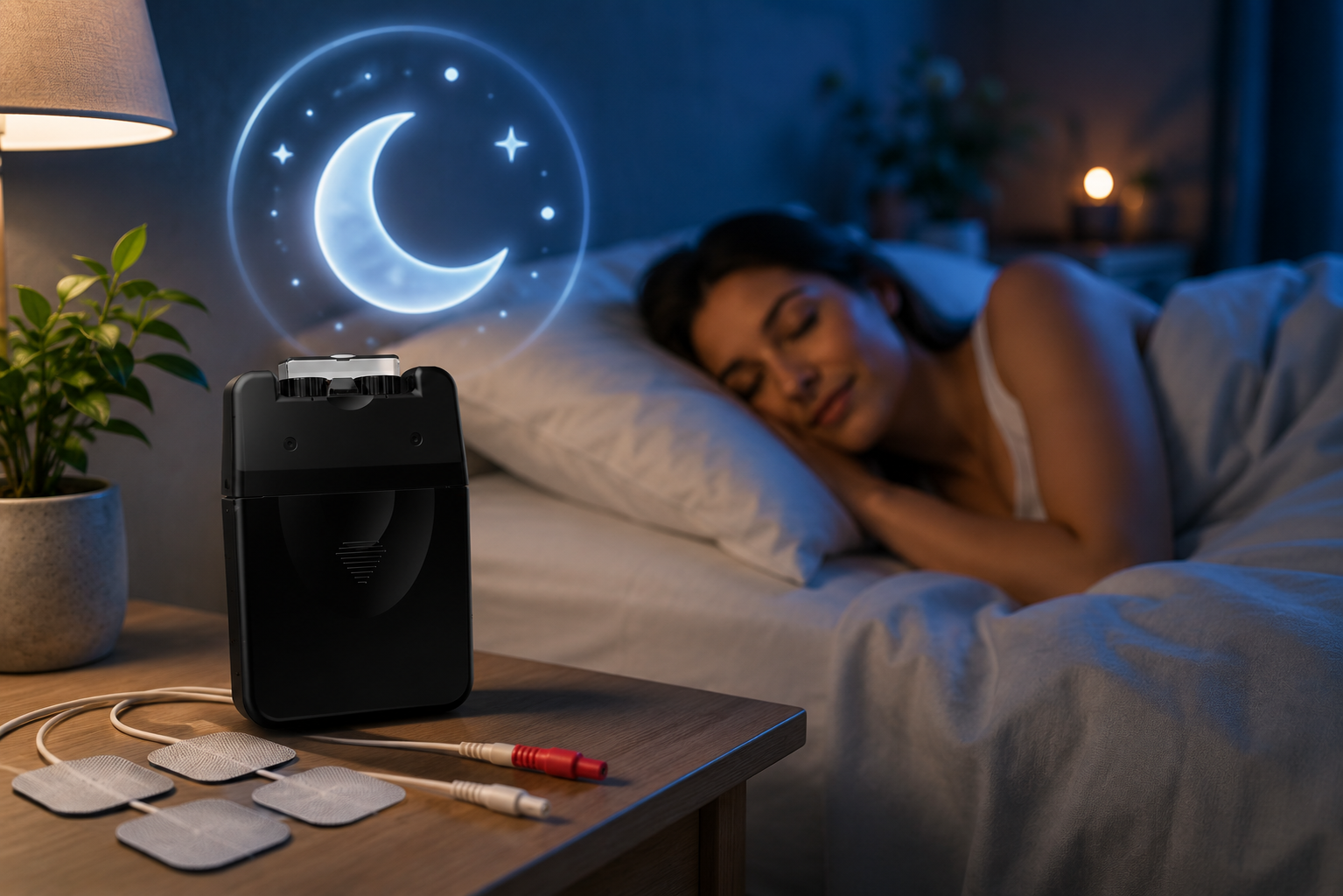
Can You Sleep with a TENS Machine?
If you use a TENS machine for pain relief, you may wonder whether you can leave it switched on while you sleep. The short answer is no: you should not sleep with a TENS machine switched on. NHS guidance specifically advises against using TENS while sleeping, even though some people may use it before bedtime to help manage pain and get comfortable. (nhs.uk)
This distinction is important. Using TENS before going to bed can be appropriate for some people; falling asleep while the machine is still operating is not recommended.
If you’re new to TENS, it can also help to understand what a TENS machine is and how a TENS machine works before using one regularly.
Safety disclaimer: This article provides general educational information and is not a substitute for personalised medical advice. Always follow your TENS machine’s instructions and speak to a healthcare professional if you’re unsure whether TENS is appropriate for you.
Quick Answer: Can You Sleep with a TENS Machine?
No. You should not sleep with a TENS machine switched on.
The NHS advises users not to use TENS while sleeping. Cambridge University Hospitals explains that it is not advisable to sleep with TENS on because you could accidentally knock the controls while asleep. (nhs.uk)
Other NHS trusts give similar advice:
- Leeds Teaching Hospitals says it is best not to wear TENS at night in bed because you could knock the controls. (Leeds Teaching Hospitals NHS Trust)
- Royal National Orthopaedic Hospital (RNOH) advises users not to wear TENS in bed or fall asleep with it switched on. (Royal National Orthopaedic Hospital)
- Royal Berkshire NHS also advises against sleeping with TENS switched on. (Royal Berkshire NHS Foundation Trust)
- University Hospitals of Leicester recommends that users do not sleep while using the machine. (UH Leicester)
However, you may be able to use TENS before bedtime. Dorset County Hospital notes that TENS can be helpful before bedtime for people whose pain makes it difficult to get to sleep, while still advising that it should not be used while sleeping. (DCHFT)
Why Shouldn’t You Sleep with TENS On?
There are several practical reasons for avoiding overnight use.
You Cannot Monitor the Machine
When you’re awake, you can notice if the sensation becomes uncomfortable, the pads move, or the machine behaves unexpectedly.
When you’re asleep, you cannot respond immediately.
Cambridge University Hospitals specifically highlights the possibility of accidentally knocking the controls while asleep. (Cambridge University Hospitals)
The Electrode Pads Can Move
TENS electrodes are designed to remain attached to the skin, but movement during sleep can cause them to shift.
If pads move closer together or end up in an inappropriate position, the stimulation may become uncomfortable or ineffective.
RNOH warns that incorrect electrode positioning and pads placed too close together can contribute to skin damage and burns, particularly when TENS is used for prolonged periods. (Royal National Orthopaedic Hospital)
You May Not Notice Skin Irritation
TENS electrodes are attached directly to the skin.
NHS guidance recommends checking the skin and stopping treatment if it becomes itchy, irritated or red. (nhs.uk)
You cannot reliably monitor this while asleep.
The Device May Be Difficult to Access
A TENS machine is generally designed to be controlled while you’re awake. If it is clipped to clothing or placed beside you, moving around in bed could put pressure on the unit, cables or electrodes.
This is another reason NHS guidance recommends removing or switching off the device before sleeping.
Can You Use TENS Before Bed?
Yes, TENS may be used before bedtime if it is suitable for you.
The important difference is between using TENS to help you relax before sleep and leaving it running after you fall asleep.
Dorset County Hospital specifically states that TENS may be useful for people who have difficulty getting to sleep because of pain, but advises that it should not be used while sleeping. (DCHFT)
A simple routine could therefore look like:
- Apply the electrodes correctly while awake.
- Switch the machine on.
- Use a comfortable intensity.
- Continue for the recommended treatment period.
- Switch the machine off before you fall asleep.
- Remove the electrodes if your device instructions require this.
- Store the machine safely.
The exact treatment duration should follow your machine’s instructions and any guidance provided by your healthcare professional.
For more information about treatment duration, see our guide to how long you should use a TENS machine.
Can TENS Help You Get to Sleep?
TENS is not a sleeping treatment, but pain relief before bedtime may make it easier for some people to settle down.
Dorset County Hospital says TENS may be helpful before bedtime when pain is making it difficult to get to sleep. (DCHFT)
However, this does not mean TENS should be left running overnight.
The NHS describes TENS as a treatment that can provide temporary pain relief, but also notes that it does not work for everyone. (nhs.uk)
If pain is repeatedly interfering with your sleep, it is worth discussing the underlying problem with an appropriate healthcare professional rather than simply increasing TENS use.
How Long Before Bed Should You Use TENS?
There isn’t one universally recommended amount of time before going to sleep.
Some people may use a session shortly before bedtime, while others may use it earlier in the evening.
Your machine’s instructions should determine the appropriate session duration.
For example, Cambridge University Hospitals recommends beginning with 30–60-minute periods and increasing use if helpful, while RNOH recommends a maximum of 60 minutes at a time for its guidance. (Cambridge University Hospitals)
This demonstrates why you shouldn’t assume that every TENS machine has the same treatment schedule.
A sensible beginner approach is to start with a shorter session and assess how comfortable and useful it is.
What Should TENS Feel Like Before Bed?
TENS should normally feel like a tingling, buzzing or pulsing sensation.
It should be noticeable but comfortable rather than painful.
Leeds Teaching Hospitals recommends gradually increasing the intensity until the sensation is strong but comfortable. If it becomes unpleasant, the intensity should be reduced. (Leeds Teaching Hospitals NHS Trust)
You should not turn the intensity up simply because you’re about to go to sleep.
A stronger setting is not automatically a better setting.
If you’re trying to understand settings such as intensity, frequency or pulse width, our TENS pulse width guide can help explain how these controls affect the sensation.
Should You Remove TENS Pads Before Sleeping?
If you are finished with your session, switch the machine off before removing the pads.
The NHS recommends switching the machine off if the skin becomes irritated and removing the electrodes. (nhs.uk)
Whether you need to remove the pads immediately after switching off depends on your device and the manufacturer’s instructions.
For example, some NHS guidance allows the pads to remain in position for extended periods while the machine itself is switched on and off as needed. Leeds Teaching Hospitals says pads can be left in place during the day while the TENS is switched on and off as required. (Leeds Teaching Hospitals NHS Trust)
However, don’t assume that leaving electrodes attached overnight is appropriate for every device or person. Follow the instructions supplied with your particular machine.
What If You Fall Asleep While Using TENS?
If you accidentally fall asleep while TENS is operating, switch the machine off when you wake up and remove the electrodes if appropriate.
Don’t panic, but don’t make overnight TENS use a routine.
The reason for the recommendation is that you cannot monitor the device, electrode placement or your skin while asleep.
If you notice persistent skin irritation, pain, blistering or another unusual reaction, stop using the machine and seek appropriate medical advice.
RNOH notes that TENS can cause burns or significant skin damage when the current is too high, electrodes are incorrectly positioned or pads are too close together, particularly with prolonged use. (Royal National Orthopaedic Hospital)
Is It Safe to Leave a TENS Machine on Overnight?
No, overnight use is not recommended.
The NHS explicitly lists sleeping as something you should not do while using TENS. (nhs.uk)
The same recommendation appears across several NHS sources, although daytime TENS schedules can vary considerably.
For example:
| Source | Guidance |
| NHS | Do not use TENS while sleeping |
| Cambridge University Hospitals | Not advisable to sleep with TENS switched on |
| Leeds Teaching Hospitals | Best not to wear TENS at night in bed |
| RNOH | Do not wear in bed or fall asleep with it on |
| Royal Berkshire NHS | Do not sleep with TENS switched on |
| University Hospitals of Leicester | Do not sleep while using the machine |
(nhs.uk)
So while there is variation in how long TENS can be used during the day, the advice about sleeping is much more consistent.
Can You Use TENS While Lying in Bed?
Being in bed is not automatically the same as sleeping.
You can be awake and lying down while using TENS, provided the machine is suitable for you and you’re following the correct electrode placement and device instructions.
For example, you might use TENS while:
- Reading
- Watching television
- Relaxing
- Sitting or lying comfortably
- Preparing to go to sleep
Dorset County Hospital says TENS can be used while sitting or lying down and may be useful for helping someone get to sleep, but it should not be used while sleeping. (DCHFT)
The key distinction is:
Awake + TENS = potentially appropriate
Asleep + TENS switched on = not recommended
What Are the Risks of Sleeping With TENS?
The main concerns are related to losing control and awareness of the treatment.
1. Accidentally Changing the Settings
You may move against the controls while asleep.
Cambridge University Hospitals specifically identifies this as a reason not to sleep with TENS. (Cambridge University Hospitals)
2. Electrode Movement
Pads may shift during the night.
Incorrect positioning can affect comfort and safety.
3. Skin Irritation
Long periods of electrode contact can cause redness or soreness in some people.
Regular users are advised to check their skin. (Cambridge University Hospitals)
4. Burns
Burns are uncommon but can occur when TENS is used incorrectly, particularly with inappropriate intensity, electrode placement or prolonged treatment. (Royal National Orthopaedic Hospital)
5. Reduced Awareness
You may not notice immediately if something feels wrong.
This is particularly important because TENS should feel comfortable rather than painful.
Can You Use TENS Every Day but Not While Sleeping?
Yes. Daily use and overnight use are two different questions.
Some NHS guidance allows TENS to be used for many hours during the day when appropriate.
Cambridge University Hospitals says users can increase from 30–60 minutes to several hours if helpful and states that TENS can be used throughout the day. (Cambridge University Hospitals)
Leeds Teaching Hospitals says that once accustomed to TENS, it can be used for up to 12 hours a day, while still recommending that it not be worn at night in bed. (Leeds Teaching Hospitals NHS Trust)
So you may be able to use TENS regularly during waking hours without using it overnight.
For more information, read our guide on Can You Use TENS Every Day?.
Does TENS Work Better If You Use It for Longer?
Not necessarily.
Using TENS for a longer period does not automatically mean you will receive greater pain relief.
NHS guidance varies significantly between devices and treatment programmes. Some guidance recommends shorter sessions, while some allows several hours of daytime use. (Cambridge University Hospitals)
The goal should be to find a duration that is:
- Comfortable
- Appropriate for your machine
- Suitable for your circumstances
- Helpful for managing your symptoms
- Within the manufacturer’s recommendations
Don’t treat the maximum permitted duration as a target.
Can You Sleep with a Wireless TENS Machine?
A wireless design does not change the general advice about sleeping with TENS.
A wireless TENS machine may eliminate cables connecting the electrode pads to a separate controller, but it is still an electrical stimulation device.
If the machine is switched on while you’re asleep, you still cannot monitor the stimulation, electrode position or your skin.
So even if your TENS device is wireless, follow the same basic rule: switch it off before you fall asleep unless a qualified healthcare professional has specifically given you different instructions for your particular device.
What About TENS Machines With Timers?
A built-in timer can make it easier to control session duration, but a timer does not automatically make overnight use safe.
Some devices allow you to set a treatment period and automatically stop afterwards.
That can be useful for daytime sessions, but NHS guidance still advises against sleeping with TENS switched on. (nhs.uk)
A timer should therefore be viewed as a convenience feature rather than permission to fall asleep while wearing the machine.
How Should Beginners Use TENS Before Bed?
If you want to try TENS as part of an evening routine, keep it simple.
Step 1: Check That TENS Is Suitable
The NHS says TENS should not be used if you have epilepsy or a pacemaker, and pregnancy requires advice from a doctor or midwife. (nhs.uk)
If you have an implanted electrical device or another relevant medical condition, ask a healthcare professional before using TENS.
Step 2: Position the Pads Correctly
Use clean, dry skin and follow your device’s instructions.
Do not use TENS on irritated, broken, infected or numb skin. The NHS also advises against using it on the neck, mouth or eyes. (nhs.uk)
Step 3: Start With a Comfortable Setting
Turn the intensity up gradually until you feel a strong but comfortable sensation.
Step 4: Complete Your Session While Awake
Use TENS for the recommended period.
Beginners may start with around 30–60 minutes, depending on their device and circumstances. (Cambridge University Hospitals)
Step 5: Switch It Off Before Sleeping
This is the most important step.
Once you are ready to sleep, switch the machine off.
Step 6: Check Your Skin
If you’ve been using TENS regularly, check the areas underneath the electrodes for redness, soreness or irritation.
If your skin reacts badly, stop using the device and seek appropriate advice.
Common Mistakes to Avoid
Falling Asleep With the Machine On
This is the main mistake this article addresses.
Set a reminder or use the device’s timer if that helps you remember to switch it off before sleep.
Assuming Wireless Means Safe Overnight
Wireless removes cables. It does not remove the need to follow TENS safety guidance.
Increasing Intensity Before Bed
Don’t increase the intensity simply because you want stronger relief before sleeping.
TENS should remain comfortable.
Putting Pads in the Wrong Place
Incorrect electrode placement can reduce effectiveness and increase risks.
If you’re unsure about placement, ask a healthcare professional.
Ignoring Skin Changes
Don’t continue using electrodes over sore, irritated or damaged skin.
Using TENS in the Shower Before Bed
TENS should not be used in the bath or shower. (nhs.uk)
Dry off and follow your machine’s instructions before starting another session.
Who Should Speak to a Healthcare Professional Before Using TENS?
TENS isn’t suitable for everyone.
Speak to an appropriate healthcare professional before using TENS if you:
- Have a pacemaker or implanted electrical device
- Have epilepsy
- Are pregnant
- Have significant reduced sensation
- Have a heart condition
- Have broken, infected or damaged skin where electrodes would be placed
- Are unsure about electrode placement
- Have unexplained or worsening pain
The NHS recommends checking with a healthcare professional if you’re unsure whether TENS is appropriate for you. (nhs.uk)
For a more detailed overview, see our guide to TENS contraindications.
What If Pain Keeps You Awake Every Night?
If pain regularly prevents you from sleeping, TENS may be one option to discuss with a healthcare professional, but it shouldn’t become a substitute for investigating persistent pain.
TENS can provide temporary pain relief for some people, but it does not work for everyone. (nhs.uk)
If your pain is new, unexplained, getting worse or repeatedly disrupting your sleep, consider speaking with your GP or another appropriate healthcare professional.
The aim should be to understand and manage the underlying problem, rather than simply increasing TENS use.
Choosing a TENS Machine for Evening Use
If you regularly use TENS before bedtime, certain features can make daytime and evening sessions easier to manage.
Timer Functions
A built-in timer can help prevent sessions from continuing longer than intended.
Adjustable Intensity
Different people tolerate electrical stimulation differently, so adjustable intensity is useful.
Clear Controls
Simple controls make it easier to switch the device off before going to bed.
Multiple Programmes
Different programmes may provide different stimulation patterns, although you should always follow the recommended settings for your particular device.
Dual Channels
Dual-channel machines can allow treatment of two areas independently, depending on the device.
Rechargeable or Battery Operation
The best option depends on how and where you use your machine.
If you’re comparing models for home use, Explore TENS and EMS Machines.
The Healthcare World machines supplied for this project include options such as wireless operation, rechargeable power, multiple programmes, adjustable intensity and dual-channel TENS/EMS functionality. These features may improve convenience, but they do not make overnight TENS use appropriate.
FAQs
Can you sleep with a TENS machine on?
No. NHS guidance advises against using TENS while sleeping. You should switch the machine off before you fall asleep. (nhs.uk)
Can I use TENS before bed?
Yes, TENS may be used before bedtime if it is appropriate for you. Dorset County Hospital notes that it may help people whose pain makes it difficult to get to sleep, but it should not be used while sleeping. (DCHFT)
Can I fall asleep with TENS pads on?
You should not fall asleep while TENS is switched on. Whether pads can remain attached after the machine is switched off depends on the device instructions. (Leeds Teaching Hospitals NHS Trust)
Why shouldn’t you sleep with a TENS machine?
You may accidentally knock the controls, the electrode pads may move, and you cannot monitor your skin or the stimulation while asleep. (Cambridge University Hospitals)
Can you use TENS while lying in bed?
Yes, being awake and lying in bed is different from sleeping. You can use TENS while awake if it is suitable for you and you follow the correct instructions. (DCHFT)
Can TENS help you fall asleep?
It may help indirectly if pain is making it difficult to get comfortable. Dorset County Hospital notes that TENS can be useful before bedtime for people struggling to get to sleep because of pain. (DCHFT)
Can you use TENS every day?
Some people can use TENS daily, including for several hours during the day, depending on their device and circumstances. However, daily use does not mean you should use TENS while sleeping. (Cambridge University Hospitals)
Can you use TENS all night if it has a timer?
A timer does not change the general advice against sleeping with TENS. The NHS advises not to use TENS while sleeping. (nhs.uk)
Can you sleep with a wireless TENS machine?
No. Being wireless does not remove the safety considerations associated with using TENS while asleep.
What happens if I accidentally fall asleep with TENS on?
Switch the machine off when you wake. Check your skin and stop using it if you notice significant irritation, pain or another unusual reaction. Seek appropriate medical advice if symptoms persist.
Can TENS cause burns?
Burns are uncommon but can occur if TENS is used incorrectly, including with excessive current or inappropriate electrode positioning. (Royal National Orthopaedic Hospital)
How long should you use TENS before bed?
There is no universal bedtime duration. Many beginners start with around 30–60 minutes, but the correct duration depends on the machine, programme and individual circumstances. (Cambridge University Hospitals)
Should you remove TENS pads before sleeping?
Follow your device’s instructions. At minimum, switch the machine off before sleeping. If the manufacturer recommends removing the pads after each session, do so.
The Bottom Line: Can You Sleep with a TENS Machine?
No. You should not sleep with a TENS machine switched on.
You can potentially use TENS while relaxing before bed, and some NHS guidance specifically recognises that it may help with pain that makes getting to sleep difficult. But once you’re ready to sleep, switch the machine off. (DCHFT)
Remember:
- TENS before bed: potentially suitable for some people.
- TENS while asleep: not recommended.
- Wireless TENS overnight: still not recommended.
- TENS in bed while awake: potentially fine if used correctly.
- TENS in the bath or shower: never.
- TENS while driving: never.
- TENS on damaged or numb skin: avoid.
- Pacemaker, epilepsy or pregnancy: seek appropriate professional advice.
If you’re looking for a machine for regular home use, Explore TENS and EMS Machines.
For more practical TENS guidance, visit the TENS Education Hub.
Related TensLeads Guides
- What Is a TENS Machine? — Understand the basics before using TENS.
- How Does a TENS Machine Work? — Learn how electrical stimulation is delivered.
- Can You Use TENS Every Day? — Understand daily use and treatment frequency.
- TENS Contraindications — Review important situations where TENS may not be suitable.
- TENS Side Effects — Learn about potential skin and other reactions.
Medical Sources
- NHS — TENS guidance
- Cambridge University Hospitals — TENS for pain relief
- Leeds Teaching Hospitals — TENS for pain control
- Royal National Orthopaedic Hospital — TENS patient guide
- Royal Berkshire NHS — TENS patient information
- Dorset County Hospital — TENS guidance
Safety Disclaimer
This article is for general educational purposes only and is not a substitute for personalised medical advice, diagnosis or treatment. TENS is not appropriate for everyone. Always read and follow the instructions supplied with your device. If you have an implanted electrical device, epilepsy, are pregnant, have reduced sensation or have concerns about your symptoms, speak with an appropriate healthcare professional before using TENS.