
TENS vs Heat Therapy: Which Is Better for Pain Relief?
If you’re looking for a drug-free way to manage everyday aches, stiffness or certain types of pain, you may be comparing TENS vs heat therapy. Both are commonly used at home, but they work in very different ways.
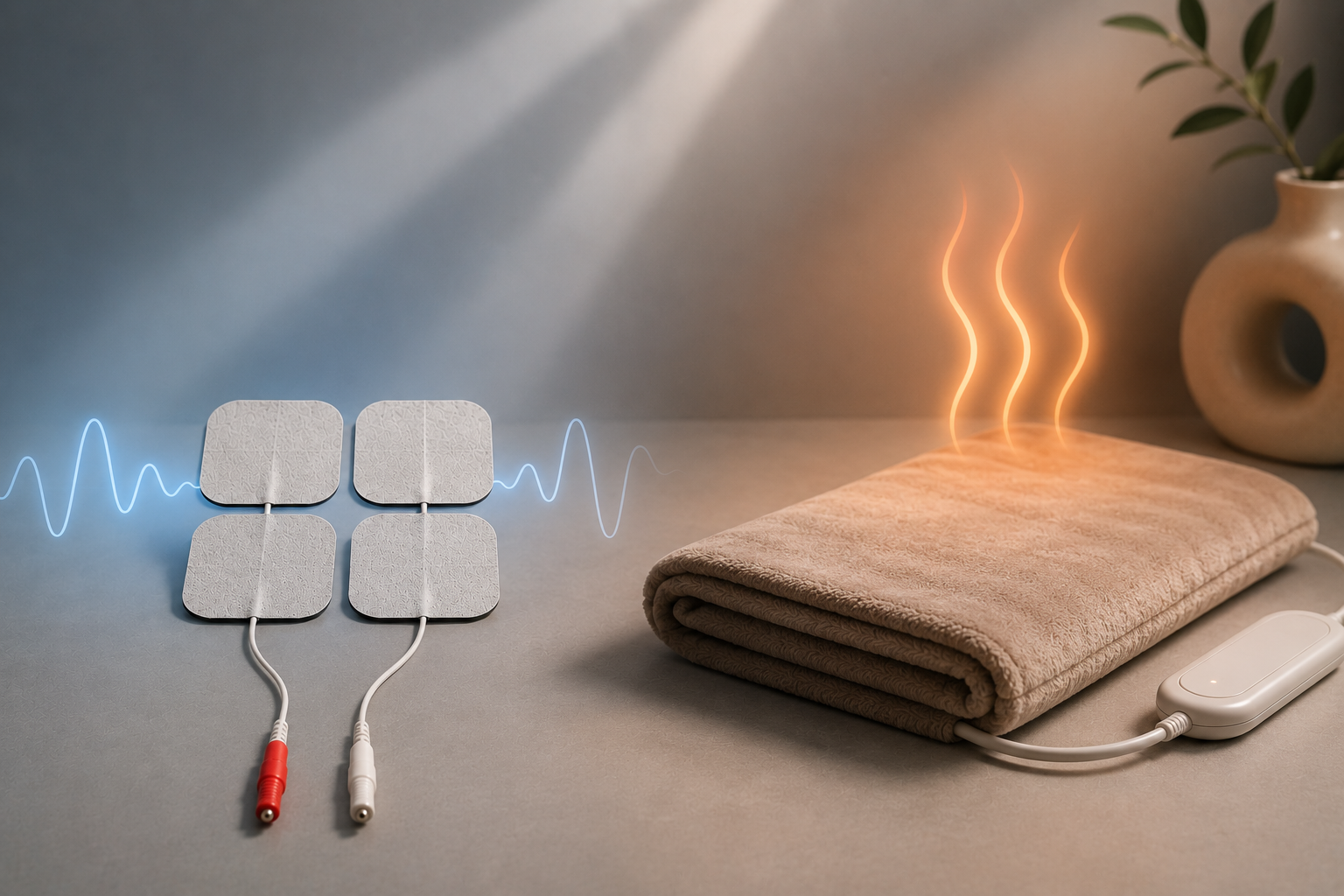
TENS, or transcutaneous electrical nerve stimulation, uses mild electrical impulses delivered through electrode pads. Heat therapy uses warmth applied to an area of the body and is often used to ease stiffness, aching and muscle spasm.
Neither treatment is guaranteed to work for everyone. The most suitable option depends on the type of discomfort you’re experiencing, your circumstances and whether the treatment is safe for you.
In short: TENS may be useful when you want adjustable electrical stimulation for temporary pain relief, while heat therapy may be particularly useful for stiffness, muscle tightness and some forms of aching. Neither should be treated as a cure for an underlying condition.
If you’re new to TENS, it’s useful to first understand what a TENS machine is and what it is designed to do.
Safety note: This article provides general information and is not a substitute for medical advice, diagnosis or treatment. Always follow the instructions supplied with your device or heat product.
TENS vs Heat Therapy: What You Need to Know
The biggest difference between TENS and heat therapy is the type of stimulus they use.
| Feature | TENS | Heat Therapy |
|---|---|---|
| Main method | Mild electrical stimulation | Local warmth |
| Applied with | Electrode pads | Heat pack, hot-water bottle or similar product |
| Common purpose | Temporary pain relief | Easing stiffness, aching and muscle spasm |
| Intensity | Usually adjustable | Depends on the heat source |
| Portability | Many TENS units are portable | Depends on the product |
| Main safety concern | Incorrect use or unsuitable placement | Burns or skin damage |
| Suitable for everyone? | No | No |
The NHS describes TENS as a treatment that can provide temporary pain relief, although it does not work for everyone. Heat is also recommended in NHS guidance for certain musculoskeletal problems, including some forms of back pain and muscle spasm. (NHS)
The important point is that TENS and heat therapy are symptom-management options, not guaranteed solutions.
How Does TENS Work?
TENS uses a small electrical current delivered through electrode pads placed on the skin. The stimulation can affect how pain signals are processed and perceived.
The NHS explains that TENS is thought to work partly by interfering with pain messages travelling to the brain and by encouraging the release of natural pain-relieving chemicals. (NHS)
For a more detailed explanation, read our guide to how TENS works.
A typical TENS session involves:
Checking that the skin is clean and suitable for electrode placement.
Positioning the electrodes according to the manufacturer’s instructions.
Selecting an appropriate programme or mode.
Starting at a low intensity.
Gradually increasing the intensity to a strong but comfortable sensation.
Stopping if the treatment becomes painful or causes skin irritation.
TENS should generally feel noticeable but comfortable rather than painful. If you’re new to the treatment, don’t assume that the highest intensity will provide better results.
What Can TENS Help With?
TENS may provide temporary relief for some types of pain. The NHS lists examples including period pain, labour pain, sports injuries and pain associated with certain long-term conditions. (NHS)
However, results vary between individuals. Some people may experience useful temporary relief, while others may notice little or no benefit.
That is why a TENS machine is best viewed as one possible tool for managing symptoms, rather than a treatment that is guaranteed to solve the underlying cause.
How Does Heat Therapy Work?
Heat therapy involves applying warmth to an area of the body. Common options include heat packs and hot-water bottles.
Heat is frequently used when stiffness, aching or muscle spasm contributes to discomfort. For example, NHS guidance for back pain recommends a heat pack or hot-water bottle wrapped in a towel to help relieve joint stiffness or muscle spasms. (NHS)
Heat may feel soothing because it provides a different sensory stimulus to the affected area and can make stiff or tight muscles feel more comfortable.
However, hotter does not mean better. Excessive heat can damage the skin.
How to Use Heat More Safely
When using heat at home:
Follow the instructions supplied with the product.
Use a suitable barrier between the heat source and your skin where recommended.
Keep the temperature comfortable.
Do not leave a very hot product against your skin for prolonged periods.
Check your skin during and after treatment.
Stop if the skin becomes painful, excessively red or blistered.
NHS guidance recommends particular caution for people with reduced sensation or circulation because they may not be able to detect excessive heat normally.
TENS vs Heat Therapy: Which Should You Choose?
There isn’t one answer that applies to everyone.
Instead, think about what you want the treatment to do and what type of discomfort you’re experiencing.
TENS May Suit You If:
You want a portable treatment option.
You prefer adjustable electrical stimulation.
You want to target a particular area with electrode pads.
You’re looking for a drug-free approach to temporary pain relief.
You want to use a device at home, work or while travelling.
The TENS market also includes devices with very different features.
For example, the Healthcare World Wireless TENS Machine has 15 automated TENS programmes and 16 intensity levels. It uses a wireless remote-control design and is rechargeable, making portability one of its main selling points.
Heat Therapy May Suit You If:
Your main issue is stiffness.
Your muscles feel tight or tense.
Warmth feels soothing to the affected area.
You prefer a simple treatment without electrode pads.
You’re managing certain forms of muscle ache or stiffness.
NHS guidance specifically recommends heat for some types of back and neck discomfort, including muscle spasm and stiffness. (NHS)
Does It Have to Be TENS or Heat?
Not necessarily.
TENS and heat therapy work differently, so there isn’t a universal rule that you must choose one and never use the other.
However, don’t assume that combining treatments will automatically provide better results. If you’re considering using both, follow the instructions for each treatment and seek professional advice if you’re uncertain about whether either option is appropriate.
Does TENS vs Heat Therapy Work?
Both TENS and heat therapy can help some people manage certain symptoms, but neither is guaranteed to work for everyone.
For TENS, the NHS states that it can provide temporary pain relief but does not work for everyone. (NHS)
Heat therapy is recommended by NHS guidance for certain musculoskeletal symptoms, such as stiffness and muscle spasm. (NHS)
The important distinction is between managing symptoms and treating their underlying cause.
If an underlying condition is responsible for persistent pain, a TENS machine or heat pack should not replace appropriate assessment or treatment.
How Should Beginners Use TENS vs Heat Therapy?
If you’re new to both options, start conservatively.
Using TENS for the First Time
1. Read the instructions
Different TENS machines have different programmes, controls and electrode configurations.
2. Check your skin
Avoid applying electrodes to broken, irritated, infected or numb skin.
3. Position the electrodes correctly
Follow the manufacturer’s guidance for placement. If you’re unsure, ask a healthcare professional.
4. Start at a low intensity
Increase gradually until the sensation is strong but comfortable.
5. Monitor your skin
Remove the pads and stop using the device if you develop significant irritation or discomfort.
6. Follow the recommended treatment time
Don’t assume that longer sessions automatically provide better results.
Using Heat for the First Time
1. Choose an appropriate heat source
Use a heat pack, hot-water bottle or other product designed for safe heat application.
2. Protect your skin
Follow the product instructions regarding towels or protective barriers.
3. Keep the temperature comfortable
You should not need extremely high temperatures.
4. Limit the treatment period
Follow the guidance for the particular product or condition. NHS Inform guidance for several musculoskeletal problems recommends limiting heat application to around 20 minutes. (NHS Inform)
5. Check your skin
Stop if you notice excessive redness, pain, blistering or other signs of skin damage.
Common TENS and Heat Therapy Mistakes
1. Assuming Stronger TENS Is Better
A higher intensity isn’t automatically more effective. Increase the intensity gradually and keep the sensation comfortable.
2. Placing TENS Electrodes Anywhere You Like
Electrode placement matters.
The NHS advises against using TENS on areas such as the neck, mouth or eyes and recommends avoiding irritated, broken, infected or numb skin. (NHS)
Always follow the manufacturer’s placement instructions.
3. Applying Heat Directly to Bare Skin
Direct exposure to high temperatures can cause burns. Use the appropriate barrier and follow the heat product’s instructions.
4. Sleeping While Using TENS
The NHS advises against using TENS while sleeping. (NHS)
5. Assuming Every Pain Needs Heat
Heat may be useful for some forms of stiffness and muscle discomfort, but it isn’t appropriate for every type of pain.
6. Ignoring Persistent Symptoms
If pain continues, worsens or keeps returning, don’t simply keep increasing your use of home treatments. The underlying cause may need assessment.
Who Should Avoid TENS vs Heat Therapy?
This is one of the most important parts of the decision.
TENS Safety
According to the NHS, TENS should not be used by people with epilepsy or a pacemaker. If you’re pregnant, you should speak to a doctor or midwife before using TENS. (NHS)
You should also avoid placing TENS electrodes on unsuitable areas or damaged skin.
If you have an implanted medical device or a medical condition that could affect your suitability for electrical stimulation, speak to an appropriate healthcare professional before use.
Heat Therapy Safety
Extra caution is needed when using heat if you have reduced sensation or circulation.
Someone who cannot reliably feel temperature may not realise that a heat source is too hot, increasing the risk of burns.
If you have circulation or sensation problems, ask a healthcare professional whether heat therapy is appropriate before using it.
How to Choose a TENS Machine
If you’ve decided that TENS is worth trying, don’t simply choose a machine because it has the largest number of programmes.
Consider the features you’ll actually use.
Intensity Levels
Adjustable intensity allows you to find a comfortable stimulation level.
Therapy Modes
Different programmes may offer different stimulation patterns. More modes can provide flexibility, but a larger number does not automatically mean better treatment.
Dual Channels
A dual-channel machine can allow you to treat two areas independently.
Electrode Pads
Check how many pads are supplied, how they connect to the device and whether replacement pads are available.
Portability
A compact rechargeable or battery-powered model may be more convenient if you want to use TENS outside the home.
Display and Controls
A clear display can make it easier to monitor intensity, programme and treatment time.
TENS and EMS Functions
If you also want muscle stimulation, you may prefer a combination device.
For example, the Healthcare World 3-in-1 Digital TENS and EMS Machine combines TENS, EMS and massage functions. It has dual-channel operation, multiple therapy modes, adjustable intensity and four self-adhesive electrodes.
The Totally TENS TPN-Type Analogue Dual Channel TENS Machine is another option, offering independent channels, Burst, Normal and Modulation modes, adjustable intensity, pulse-width adjustment and 30- or 60-minute timer settings.
You can explore the available TENS and EMS machines to compare different types and features.
When Should You Speak to a Healthcare Professional?
Home treatments are not a substitute for assessment when symptoms are unexplained, persistent or concerning.
Consider seeking professional advice if:
You don’t know what is causing your pain.
Your pain is persistent or worsening.
You develop significant weakness or numbness.
Your symptoms began after a serious injury.
You have an implanted medical device and are considering TENS.
You’re pregnant and want to use TENS.
You have circulation or sensation problems and want to use heat.
You experience significant skin irritation or burns.
You’re unsure where to place TENS electrodes.
You’re uncertain whether either treatment is appropriate for you.
The NHS recommends seeking advice if you’re unsure about using TENS or where to position the electrodes. (NHS)
FAQs
Is TENS better than heat therapy?
Not necessarily. TENS and heat work differently, so the more appropriate option depends on your symptoms, preferences and individual circumstances.
Does TENS work for back pain?
TENS may provide temporary relief for some people, but it does not work for everyone. If back pain persists or is accompanied by concerning symptoms, seek appropriate medical advice.
Is heat good for muscle stiffness?
Heat is commonly used to help ease stiffness and muscle spasm. NHS guidance recommends heat packs or hot-water bottles for some back problems. (NHS)
Can I use TENS and heat therapy on the same day?
Some people may use different symptom-management approaches, but combining treatments isn’t automatically better. Follow the instructions for each treatment and ask a healthcare professional if you’re unsure.
Can I sleep with a TENS machine?
No. The NHS advises against using TENS while sleeping. (NHS)
What should TENS feel like?
TENS should generally produce a noticeable electrical sensation that remains comfortable. Start with a low intensity and increase gradually rather than immediately selecting a high setting.
Can everyone use TENS?
No. TENS isn’t suitable for everyone. For example, the NHS advises people with epilepsy or a pacemaker not to use TENS and recommends medical advice during pregnancy. (NHS)
How long should I use heat therapy?
There isn’t one duration that applies to every condition. Follow the instructions for your heat product and any professional guidance relevant to your symptoms. For several musculoskeletal problems, NHS Inform guidance recommends limiting heat application to around 20 minutes.
TENS vs Heat Therapy: The Bottom Line
When comparing TENS vs heat therapy, the better option isn’t necessarily the one with more features or a stronger sensation.
TENS uses electrical stimulation and may provide temporary pain relief for some people. Heat therapy uses warmth and can be useful for certain forms of stiffness, aching and muscle spasm.
Your choice should depend on the symptoms you’re trying to manage, the features you value and whether the treatment is safe for you.
If you’re considering TENS, look for a device that offers controls and features you’ll genuinely use. If heat seems more appropriate, use it carefully and protect your skin.
And if pain is persistent, unexplained or getting worse, don’t rely solely on home treatments. Appropriate professional advice can help identify whether further assessment is needed.
For more information and practical guides, visit the TENS Education Hub.
Safety disclaimer: This article is for general information only and is not a substitute for medical advice, diagnosis or treatment. Always follow the instructions supplied with your TENS machine or heat product. Speak with a qualified healthcare professional if you have a medical condition, are pregnant, have an implanted device, have circulation or sensation problems, or are unsure whether a treatment is suitable for you.