
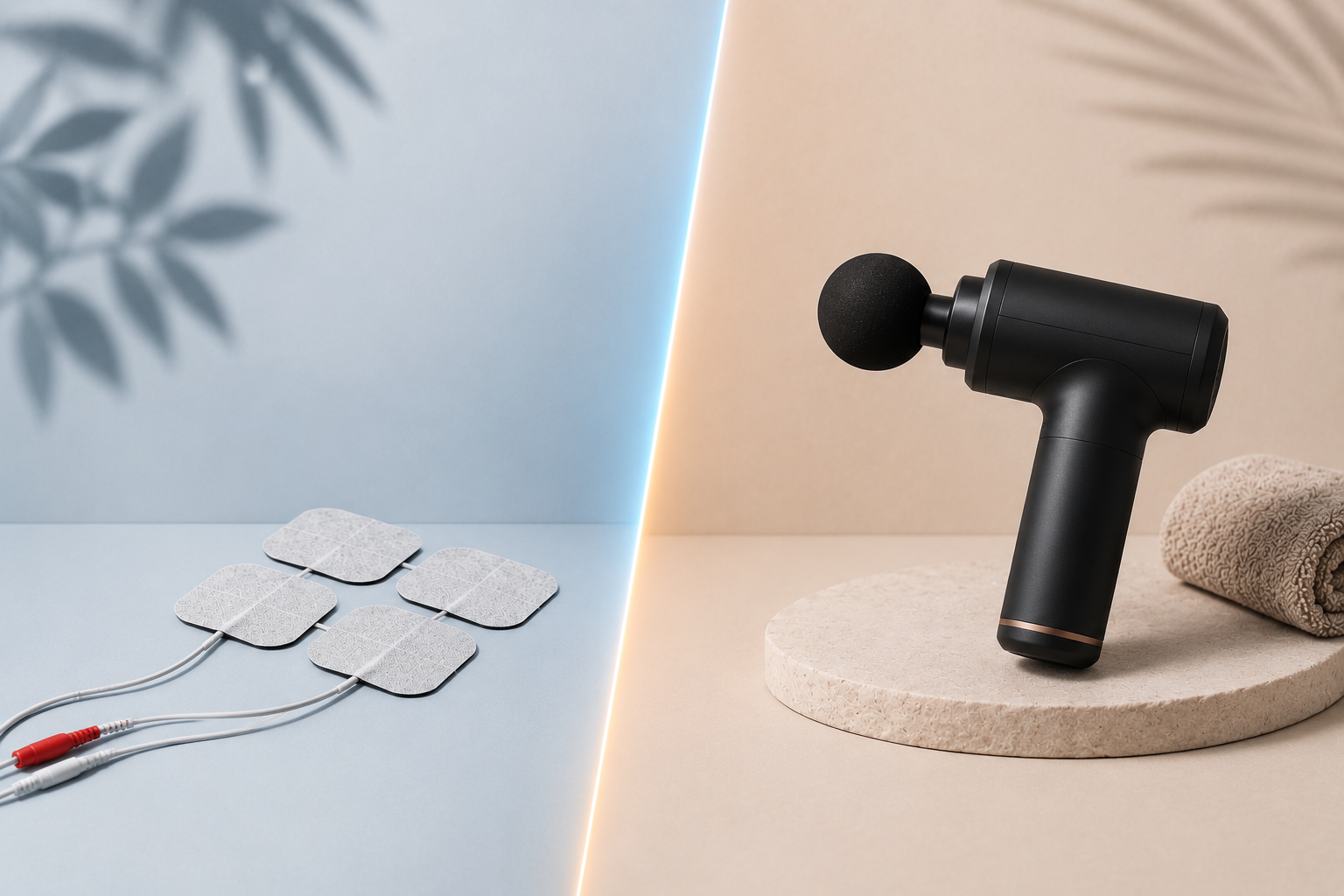
TENS vs Massage Gun: Which Is Better for Pain Relief?
Quick Answer: TENS vs Massage Gun
If you are comparing TENS vs massage gun, the main difference is how each device works. A TENS machine uses mild electrical impulses delivered through electrodes on the skin to influence how pain signals are processed. A massage gun uses rapid mechanical pulses to work on muscles and surrounding soft tissue.
Neither option is automatically better. TENS may be more relevant when the main goal is temporary pain relief, while a massage gun may be more appropriate for muscle-focused massage, temporary flexibility work or exercise recovery. Evidence for both approaches is mixed, so neither should be presented as a guaranteed solution.
TENS vs Massage Gun: At a Glance
| Feature | TENS | Massage Gun |
| Main technology | Electrical nerve stimulation | Mechanical percussion |
| Primary purpose | Temporary pain relief | Muscle-focused massage/recovery |
| Electrodes required | Yes | No |
| Electrical current | Yes | No |
| Muscle tightness | May help with pain perception | Often more directly suited |
| Flexibility/range of motion | Not its primary purpose | May provide short-term improvements |
| Portable home use | Yes | Yes |
| Evidence | May provide temporary relief for some people | Potential short-term effects; evidence remains developing |
What You Need to Know About TENS vs Massage Gun
TENS and massage guns use completely different technologies
A TENS machine, or transcutaneous electrical nerve stimulation device, sends a weak electrical current through electrodes attached to the skin. The sensation is normally a comfortable tingling rather than a painful shock. The NHS explains that TENS can provide temporary pain relief and does not work for everyone.
A massage gun uses a motor to deliver repeated percussive movements to soft tissue. It may temporarily affect flexibility, range of motion and perceived muscle discomfort. Research is still developing, and systematic reviews have highlighted limitations in the available evidence.
Think about the goal before choosing the device
The most useful question is not which device is stronger, but which technology matches what you are trying to achieve.
How Does TENS Work?
TENS uses electrical nerve stimulation
TENS stands for transcutaneous electrical nerve stimulation. A small battery-powered unit sends electrical pulses to electrodes attached to the skin. The exact mechanisms are not completely understood, but electrical stimulation can affect the transmission and perception of pain signals.
Electrode placement matters
TENS electrodes are positioned on the skin around the painful area according to the instructions supplied with the machine. Correct placement can influence comfort and the usefulness of a session. The NHS recommends clean skin, appropriate spacing between pads and gradually increasing intensity.
How Does a Massage Gun Work?
Massage guns apply mechanical percussion
A massage gun has a motorised head that repeatedly moves against the body. Different attachments and speed settings can change the sensation and the area that can be treated comfortably.
Massage guns are not simply stronger versions of TENS
TENS primarily provides electrical stimulation through the skin. A massage gun provides mechanical percussion to soft tissue. They are therefore not interchangeable technologies.
TENS vs Massage Gun for Different Situations
For temporary pain relief
TENS may be the more directly relevant option if your primary objective is temporary pain relief. The NHS states that TENS can help with certain types of short-term and long-term pain, although it does not work for everyone.
For muscle tightness
A massage gun may be more appealing if your main concern is the feeling of tight or stiff muscles. Research suggests percussive therapy can produce short-term improvements in flexibility and range of motion.
For exercise recovery
Massage guns are widely used before and after exercise. Research suggests possible short-term effects on flexibility and some recovery measures, but results are not consistent across studies.
How Should Beginners Use TENS vs Massage Gun?
Beginner TENS use
1. Switch the machine off before attaching pads.
2. Clean and dry the skin.
3. Attach electrodes according to the manufacturer’s guidance.
4. Keep electrodes separated.
5. Turn the machine on.
6. Increase intensity gradually until the sensation is noticeable but comfortable.
7. Stop if the sensation becomes painful or the skin becomes irritated.
Beginner massage-gun use
1. Choose a comfortable attachment.
2. Start at a low speed.
3. Keep the device moving rather than aggressively pressing into one spot.
4. Use it only on appropriate soft-tissue areas.
5. Stop if you experience sharp pain or unusual symptoms.
6. Follow the manufacturer’s instructions.
Who Should Avoid TENS vs Massage Gun?
TENS has important safety limitations
The NHS advises that TENS should not be used by people with epilepsy or a pacemaker, or during pregnancy unless a doctor or midwife has advised that it is appropriate. It should not be used on irritated, broken, infected or numb skin, or around the neck, mouth or eyes.
Massage guns also have situations where they may be unsuitable
Percussive therapy may be inappropriate around recent fractures, open wounds, bruising, skin infections, blood-clotting conditions and certain sensitive areas. If you are recovering from an injury or have a medical condition, ask a healthcare professional before use.
Common Mistakes to Avoid
Mistake 1: Assuming stronger treatment is better
With TENS, excessive intensity can be uncomfortable. With a massage gun, pressing harder or using the device for longer does not necessarily produce better results.
Mistake 2: Ignoring the manufacturer’s instructions
Different devices have different settings, electrode configurations, attachments and recommended use times. Always follow the instructions supplied with your specific product.
Mistake 3: Using either device on unexplained pain
Pain is a symptom, not a diagnosis. Severe, persistent, worsening or unexplained pain should be assessed rather than repeatedly treated with a home device.
Mistake 4: Using TENS on unsuitable areas
Do not improvise electrode placement around sensitive areas. Follow the device instructions and NHS guidance.
Mistake 5: Using a massage gun directly over vulnerable areas
Avoid inappropriate body areas and follow the manufacturer’s guidance on bones, joints, spine and sensitive regions.
How to Choose Between TENS and a Massage Gun
Choose TENS if pain management is your priority
A TENS machine may be worth considering if you want a portable, non-invasive option designed around electrical nerve stimulation and temporary pain relief.
Choose a massage gun if muscle work is your priority
A massage gun may be more appropriate if your main objective is to massage muscles, temporarily improve flexibility or support an exercise routine.
Consider having both for different purposes
There does not have to be a strict either/or decision. However, each device should be used for its intended purpose and only when suitable for you.
Does TENS vs Massage Gun Work?
Both may help, but neither is guaranteed to work for everyone
TENS can provide temporary pain relief for some people, but the NHS explicitly states that it does not work for everyone. Massage-gun research suggests potential short-term effects on flexibility, range of motion and some recovery-related outcomes, but the evidence remains limited and inconsistent.
When Should You Speak to a Healthcare Professional?
Get advice if your symptoms are persistent, severe or unexplained
Consider seeking medical or physiotherapy advice if pain is severe or worsening, continues without an obvious explanation, follows a significant injury, or is accompanied by unusual weakness, numbness or other concerning symptoms. Professional advice is also appropriate if you are unsure whether a device is safe for you.
TENS vs Massage Gun: Buying Checklist
| Before buying a TENS machine | Before buying a massage gun |
| Is temporary pain relief your main goal? | Is muscle-focused massage your main goal? |
| Does the device have clear instructions? | Does it offer comfortable speed settings? |
| Are replacement electrode pads available? | Are attachments suitable for intended areas? |
| Can you adjust intensity comfortably? | Is it easy to hold and control? |
| Does it have the settings you need? | Are suitable and unsuitable areas clearly explained? |
| Is it appropriate for UK use? | Does it provide appropriate safety information? |
| Have you checked whether TENS is suitable for you? | Have you checked whether percussive therapy is suitable for you? |
Frequently Asked Questions
Is TENS better than a massage gun for pain?
Not necessarily. TENS is specifically designed for electrical nerve stimulation and may provide temporary pain relief. A massage gun mechanically stimulates soft tissue and may be more useful for muscle tightness, flexibility or exercise recovery.
Can I use a TENS machine and massage gun together?
There is no general rule that everyone should combine them. They work differently, and suitability depends on your circumstances. Follow each device’s instructions and ask a healthcare professional if you have an injury, medical condition or safety concern.
Does a massage gun provide the same type of pain relief as TENS?
No. A massage gun uses mechanical percussion, whereas TENS uses electrical stimulation through electrodes. They are not interchangeable technologies.
Who should avoid TENS?
People with certain conditions or circumstances may need to avoid TENS. The NHS specifically advises against TENS for people with epilepsy or a pacemaker, and during pregnancy unless advised by a doctor or midwife.
Who should avoid a massage gun?
People with certain injuries, medical conditions or vulnerable tissues may need to avoid percussive therapy. When in doubt, ask a healthcare professional.
How should beginners use TENS vs massage gun?
Start conservatively. For TENS, use clean skin, correct electrode placement and a comfortable intensity. For a massage gun, begin at a low setting, use appropriate soft-tissue areas and avoid aggressive pressure.
Recommended Internal Links for TensLeads
| Anchor text | URL | Suggested placement |
| TENS machine | https://tensleads.com/ | Introduction / first product mention |
| TENS electrode pads | https://tensleads.com/products/ | Electrode placement section |
| TENS electrode compatibility | https://tensleads.com/product/tens-electrode-leads-male-plug-2-5mm-with-2-0mm-pin-tens-pad-connection-one-pair/ | Compatibility discussion |
| Butterfly-shaped TENS electrode pads | https://tensleads.com/product/butterfly-shaped-tens-electrode-pads-1-pair-reusable-self-adhesive-2mm-pin-electrodes/ | Electrode examples |
| TENS and EMS Machines | https://tensleads.com/products/ | Buying section and CTA |
Next Step
If you are looking for an electrical stimulation device for home use, compare the available options in the TENS and EMS Machines range.
Explore TENS and EMS Machines →
Medical Sources
NHS — Transcutaneous electrical nerve stimulation (TENS)
Cleveland Clinic — Transcutaneous Electrical Nerve Stimulation (TENS)
Cambridge University Hospitals — Advice on using a TENS machine
Systematic review of percussive therapy / massage guns
PubMed — Systematic review of percussive therapy
PubMed — 2026 systematic review and meta-analysis
Safety Disclaimer
This article is for general information only and is not a substitute for medical advice, diagnosis or treatment. TENS machines and massage guns are not suitable for everyone. Always read the manufacturer’s instructions and seek advice from a GP, physiotherapist, pharmacist or other qualified healthcare professional if you are unsure whether a device is appropriate for you.