
TENS Frequency Guide: How to Choose the Right Setting for Pain Relief
Choosing a TENS frequency can feel confusing when your device offers several programmes, pulse rates and intensity controls
The right setting depends on the type and location of your pain, how your body responds and the instructions supplied with your machine.
In general, conventional TENS uses a higher frequency with a comfortable, non-painful tingling sensation. Lower-frequency programmes may produce a stronger pulsing sensation and, in some cases, mild muscle twitching. However, there is no single TENS frequency that works for everyone. Research has not established a clear overall advantage of high-frequency over low-frequency TENS, and individual responses can vary.
This guide explains how TENS frequency works, how beginners can approach the settings, common mistakes to avoid and when professional advice is appropriate.
Safety disclaimer: This article provides general information and is not a diagnosis or substitute for medical advice. Always read your device instructions. Speak to a GP, physiotherapist, pain specialist or other qualified healthcare professional if you are unsure whether TENS is suitable for you, particularly if you have a medical condition, use an implanted electronic device or are pregnant.
What is TENS frequency?
TENS stands for transcutaneous electrical nerve stimulation. It uses a small, battery-powered device to deliver pulsed electrical currents through electrodes placed on the skin. The purpose is generally to stimulate peripheral nerves and help modulate pain signals.
Frequency refers to how many electrical pulses are delivered per second. It is usually measured in hertz, written as Hz. A higher frequency delivers pulses more rapidly, while a lower frequency delivers pulses more slowly.
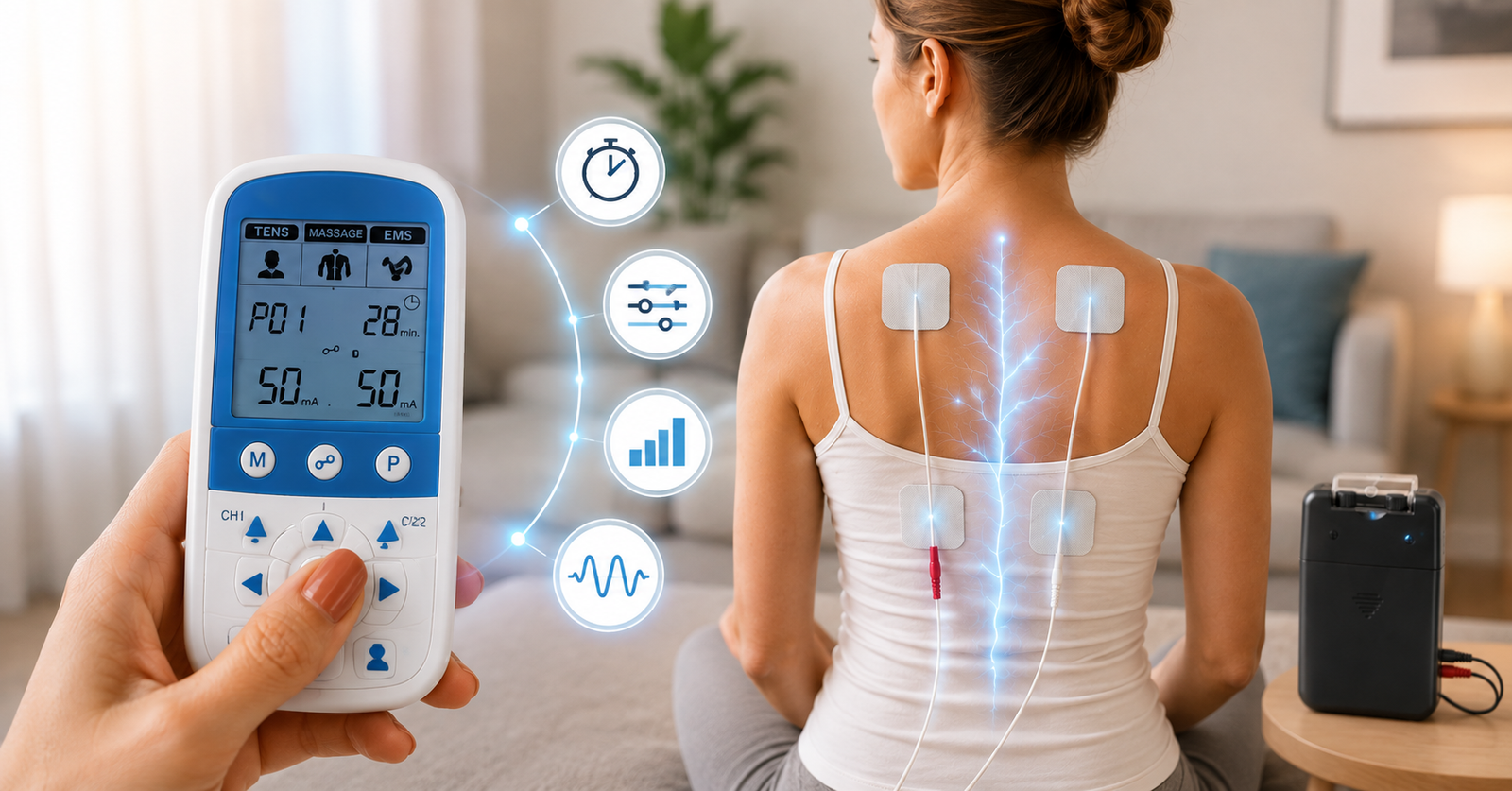
TENS machines may also allow you to adjust:
- Intensity: how strong the electrical stimulation feels.
- Pulse width: the duration of each individual pulse.
- Mode or programme: the pattern in which stimulation is delivered.
- Treatment duration: how long the device operates.
- Electrode placement: where the pads are positioned around the painful area.
Frequency should not be considered in isolation. A setting that feels appropriate at one frequency may feel too strong or too weak at another intensity or pulse width.
How does TENS work?
The exact effects of TENS can differ according to the frequency, intensity, pulse width, electrode position and duration of use. Broadly, electrical stimulation activates sensory nerves, which may influence how pain signals are processed by the nervous system.
With conventional TENS, the aim is usually to produce a strong but comfortable tingling or buzzing sensation without pain. This type of stimulation is commonly described as low-intensity, high-frequency TENS. Another approach, often called acupuncture-like TENS, uses a higher intensity and lower frequency and may cause a noticeable pulsing sensation or mild muscle twitching.
TENS does not repair every underlying cause of pain, and it should not be viewed as a guaranteed cure. Some people experience useful temporary relief, while others notice little or no benefit. TENS is often used as one part of a wider pain-management plan that may include movement, physiotherapy, medication or advice about activity.
Evidence for TENS varies between pain conditions. A Cochrane overview found that the available evidence was not strong enough to confidently determine whether TENS consistently relieves chronic pain compared with sham TENS, usual care or no treatment. It also found no reliable evidence that one delivery mode, including a particular frequency, is generally more effective than another.
TENS frequency settings explained
The frequency ranges below are general descriptions used in clinical literature. Your device may use different labels, presets or available ranges, so follow the manufacturer’s instructions rather than changing settings beyond the machine’s capabilities.
| TENS approach | General frequency description | Typical sensation | Practical starting point |
|---|---|---|---|
| Conventional or high-frequency TENS | Generally above 50 Hz; conventional TENS is often described as 50–100 Hz | Continuous tingling or paraesthesia, usually without muscle contraction | Often considered first when a comfortable sensory sensation is the aim |
| Low-frequency or acupuncture-like TENS | Generally below 10 Hz; some clinical descriptions use 1–8 Hz | Slower, stronger pulses that may produce mild muscle twitching | Consider only if appropriate for your device and guidance |
| Burst or modulated TENS | Burst delivers high-frequency pulses in low-frequency bursts; modulated modes vary one or more parameters | A changing or pulsing sensation | Useful when a device programme or clinician recommends it |
The ranges in this table are not a prescription. The response to a setting can be highly individual, and studies have not shown a definitive overall winner between high and low frequencies. One review described adequate high-frequency TENS as 25–150 Hz and adequate low-frequency TENS as 1–8 Hz in the context of specific research criteria, but these figures should not be treated as universal instructions for home use.
High-frequency TENS
High-frequency TENS delivers pulses rapidly. It is commonly used with an intensity that produces a strong, non-painful tingling sensation. Conventional TENS is often the first approach because it does not normally aim to create a muscle contraction.
You may notice that the tingling becomes less noticeable during a session. This can happen as you become accustomed to the sensation. If the stimulation fades but remains comfortable, you may be able to increase the intensity gradually, provided your device instructions allow this and the sensation does not become painful.
Low-frequency TENS
Low-frequency TENS delivers pulses more slowly. It may feel like distinct taps, pulses or contractions rather than a continuous tingling. Some programmes are designed to produce mild muscle twitching.
This setting is not automatically better for deep, severe or long-term pain. It may be uncomfortable for some users, and it may not be suitable for every person or every body area. If you are unsure how to use a low-frequency or muscle-stimulation programme, ask a healthcare professional for guidance.
Burst and modulated programmes
Burst TENS combines rapid pulses into slower bursts. Modulated programmes automatically vary one or more features of the stimulation. These modes may be useful if a steady sensation becomes less effective or uncomfortable, but the best option remains individual.
Do not assume that a named programme has the same settings on every machine. Check the manual for your specific model, particularly where a device combines TENS and EMS functions.
Does a TENS frequency guide work?
A TENS frequency guide can help you understand the controls, but it cannot guarantee a particular result. Frequency is only one part of the overall treatment dose. Electrode placement, intensity, pulse width, timing and the type of pain may all affect the experience.
Research suggests that stimulation intensity can be important: TENS is generally intended to create a strong but non-painful sensation rather than a barely noticeable current. Even so, “strong” does not mean painful. Increase the intensity slowly and reduce it if you feel sharp, burning or unpleasant discomfort.
It is sensible to judge TENS by practical outcomes rather than by the number displayed on the machine. For example, ask whether you can move more comfortably, complete a daily task or rest more easily while using it. Keep expectations realistic, and stop if your symptoms worsen.
For chronic pain, the evidence is particularly mixed. Reviews have reported variation in frequency, intensity, electrode placement and treatment duration, making it difficult to determine which combination is most effective. This is why experimenting cautiously within the manufacturer’s instructions may be more useful than searching for one “best” frequency.
How should beginners use a TENS frequency guide?
If you are new to TENS, use the following general process.
1. Read the instructions first
Check the manual for:
- Compatible electrodes and lead wires.
- Available TENS and EMS programmes.
- Recommended electrode positions.
- Contraindications and warnings.
- Instructions for cleaning and replacing pads.
- How to connect and disconnect the leads safely.
If you have bought a dual-purpose TENS and EMS machine, make sure you have selected the correct function. EMS programmes may be intended to stimulate muscles and may feel different from conventional TENS.
2. Check your skin and electrode pads
Use intact, clean and dry skin. Do not place electrodes over broken, irritated, infected or damaged skin. Avoid applying creams, oils or lotions immediately before attaching the pads, as they may affect adhesion and conductivity.
Inspect the electrodes and leads before use. Do not use damaged wires, cracked pads or equipment that appears faulty.
3. Place the electrodes around, rather than directly on, the painful area
Follow the instructions supplied with your machine or the advice of your clinician. Electrodes are commonly positioned so the stimulation covers or surrounds the painful region, but placement depends on the body area and the reason for using TENS.
Avoid placing electrodes across the front of the neck, across the head or directly over the eyes. Do not place them across the chest unless a qualified healthcare professional has specifically advised you to do so.
Never attach or remove electrodes while the device is switched on. Turn the intensity down and switch the unit off before adjusting the pads.
4. Begin with a comfortable programme
Many beginners start with a conventional or high-frequency TENS programme because it is designed to create sensory tingling without requiring a muscle contraction. Start at a low intensity and increase it gradually until the sensation is clear but comfortable.
The stimulation should not feel sharp, burning or painful. If you experience discomfort, reduce the intensity, reposition the electrodes after switching the device off, or stop the session.
5. Note your response
A simple record can help you identify whether TENS is useful. You could note:
- The programme or frequency used.
- Where the electrodes were positioned.
- Whether the sensation was comfortable.
- What activity you were doing.
- Whether your pain or movement changed.
- Whether your skin looked normal afterwards.
This is not a substitute for clinical assessment, but it can help you discuss your experience with a healthcare professional and avoid repeatedly using a setting that does not help.
Common TENS frequency mistakes
Choosing a setting because it has the highest number
A higher frequency is not automatically more powerful or more effective. The number on the screen describes pulse delivery, not a guaranteed level of pain relief.
Turning the intensity up too quickly
TENS should not be painful. Rapidly increasing the intensity may cause discomfort, muscle twitching or skin irritation. Adjust it gradually and remain within the device’s instructions.
Using TENS on numb skin
If you cannot reliably feel the stimulation, you may be less able to detect excessive intensity or skin irritation. Ask a healthcare professional for advice before using TENS in an area with reduced sensation.
Leaving electrodes in the same position indefinitely
Move or remove the pads according to the instructions. Repeated use in one place may irritate the skin, especially if the electrodes are old, dirty or no longer adhering properly.
Assuming TENS replaces medical assessment
Pain that is new, severe, unexplained or progressively worsening should be assessed appropriately. TENS may temporarily alter the sensation of pain without addressing its cause.
Confusing TENS with EMS
TENS is primarily associated with sensory nerve stimulation for pain modulation. EMS is generally used to stimulate muscles. A combined device may include both, but the programmes are not interchangeable.
Who should avoid TENS or seek advice first?
Do not use TENS over an implanted cardiac pacemaker or implantable cardioverter-defibrillator unless the relevant medical specialist has specifically confirmed that it is safe. Electrical stimulation may interfere with electronic implants.
Seek professional advice before using TENS if you:
- Are pregnant or trying to use TENS during pregnancy.
- Have epilepsy.
- Have an active tumour or malignancy.
- Have deep-vein thrombosis.
- Have frail, fragile or damaged skin.
- Have reduced sensation in the area.
- Have an unexplained pain problem.
- Have another implanted electronic or medical device.
- Are unsure where electrodes can safely be positioned.
These precautions do not mean that every person in these groups will always be unable to use TENS. They do mean that suitability and electrode placement should be considered by an appropriate healthcare professional.
Do not use TENS while driving or operating machinery. Keep the device and small components away from children and follow the product’s storage instructions.
When should you seek professional advice?
Speak to a GP or another qualified healthcare professional if your pain is unexplained, persistent, worsening or interfering significantly with sleep and daily activities. You should also seek advice if TENS causes a rash, burning, prolonged irritation, dizziness, unusual symptoms or an increase in pain.
A physiotherapist or pain specialist may be able to advise on:
- Whether TENS is appropriate for your condition.
- Electrode placement.
- Which programme to try first.
- How to combine TENS with movement or rehabilitation.
- Whether a TENS or EMS function is suitable.
- When to stop using the device.
TENS may be used alongside other treatments, but do not change prescribed medication or discontinue clinical treatment without speaking to the relevant professional.
How to choose a TENS machine for home use
When comparing TENS machines in the UK, consider more than the maximum frequency. Look for:
- Clear, easy-to-use controls.
- Adjustable intensity.
- Suitable pre-set and manual programmes.
- Secure electrode connections.
- Replacement electrode availability.
- A clear instruction manual.
- A design that suits your intended use.
- Reliable customer and product support.
Compatibility is also important. Replacement pads and lead wires need to match the machine. If you are comparing options, you can explore TENS and EMS Machines and review the available product information before making a decision.
For general information about TENS and NHS guidance, visit the NHS overview of transcutaneous electrical nerve stimulation. You can also learn more about pain-relief topics through the TensCare pain-relief blog.
Frequently asked questions
Does TENS frequency guide work?
It can help you understand how different programmes are described, but it cannot predict exactly which setting will relieve your pain. High- and low-frequency modes have different sensations, and individual responses vary. Current evidence does not establish that one frequency is universally superior.
Who should avoid TENS frequency guide advice?
General online guidance should not replace professional advice for people with pacemakers, implantable cardioverter-defibrillators, pregnancy, epilepsy, active malignancy, deep-vein thrombosis, damaged skin or reduced sensation. If any of these apply to you, seek advice before using TENS.
How should beginners use a TENS frequency guide?
Beginners should read the machine instructions, check the skin and pads, place electrodes correctly, start with a comfortable programme and increase intensity gradually. The sensation should be strong enough to notice but not painful. Turn the device off before moving or removing electrodes.
What is the best TENS frequency for pain relief?
There is no single best frequency for everyone. Conventional TENS is commonly associated with higher frequencies and a comfortable tingling sensation, while low-frequency programmes produce slower pulses and may cause mild muscle twitching. Your response, the pain problem and professional advice should guide your choice.
Can TENS make pain worse?
It can be uncomfortable if the intensity is too high, the pads are poorly positioned or the skin reacts to the electrodes. Stop using the machine if it causes pain, burning, significant irritation or unusual symptoms. If your pain continues to worsen, arrange an appropriate clinical assessment.
Should TENS feel painful?
No. TENS may feel noticeable, strong or unusual, but it should not feel sharply painful or burning. Reduce the intensity or stop the device if it becomes painful.
Final guidance
The most useful TENS frequency is not necessarily the highest or lowest setting. Start with the instructions for your machine, use a comfortable intensity, position the electrodes safely and pay attention to how your symptoms respond. Frequency is only one part of TENS use, and the available evidence does not support a universal setting for every type of pain.
TENS may offer temporary support for some people, but it is not guaranteed to work and should not delay assessment of unexplained or worsening symptoms. If you are ready to compare suitable options, explore TENS and EMS Machines and choose a device with clear controls, compatible accessories and instructions that you can follow confidently.