
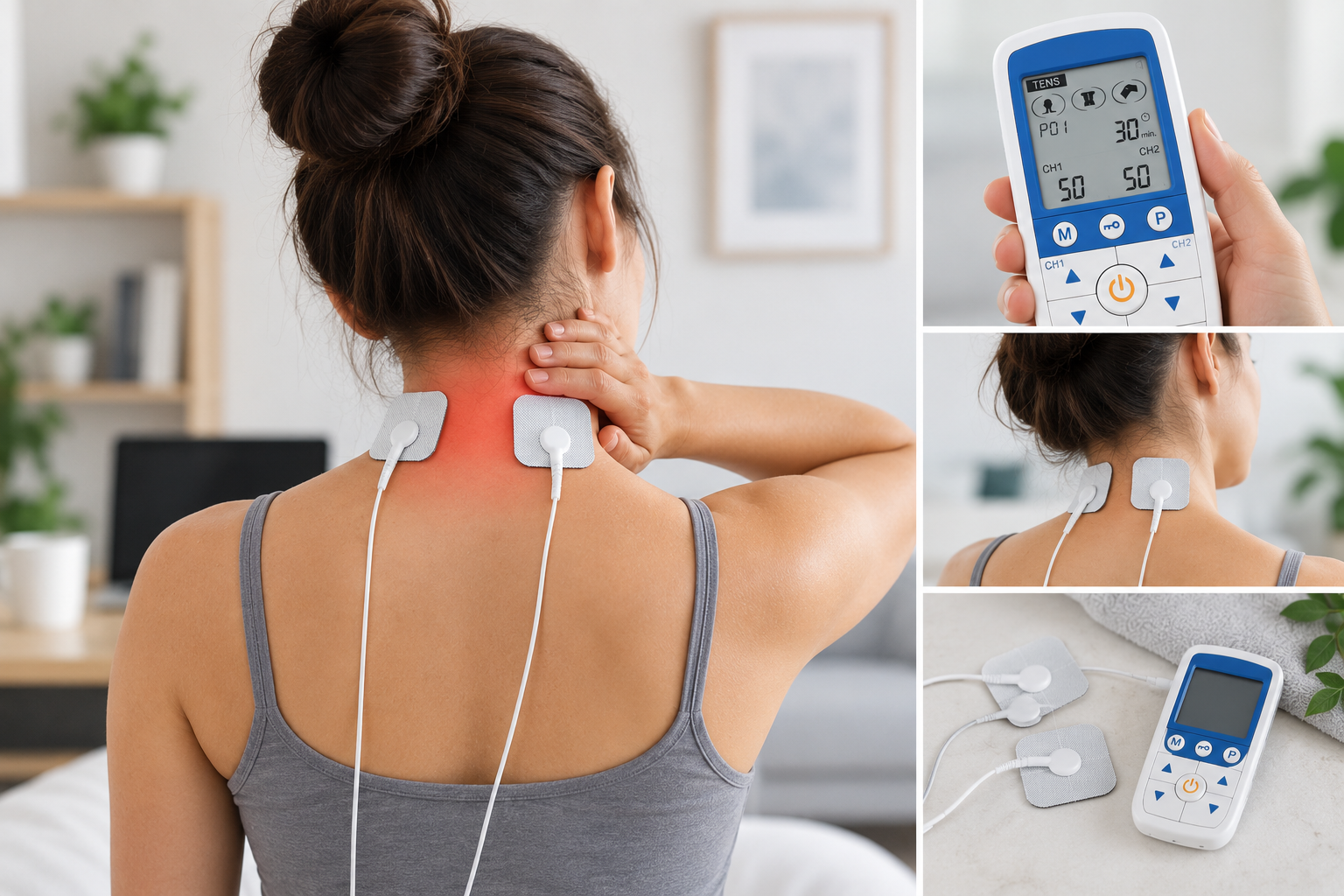
TENS for Neck Pain: Does It Help and How to Use It Safely
Neck pain can make everyday activities uncomfortable, particularly when sitting at a desk, turning your head, sleeping or carrying out normal household tasks. If you are looking for non-drug options for neck pain pain relief, you may have come across TENS machines.
TENS stands for transcutaneous electrical nerve stimulation. A TENS machine delivers mild electrical stimulation through electrodes placed on the skin. Some people use TENS for temporary pain relief, and the NHS explains that it can help with certain types of short- and long-term pain. However, it does not work for everyone.
There is an especially important safety consideration when the problem is located in the neck. The NHS advises not to use TENS on the neck, mouth or eyes. Cambridge University Hospitals likewise advises that electrodes should not be placed on the front of the neck and should not be placed over the spinal cord, near the eyes or in the mouth or throat.
This means you should not simply take a standard TENS machine and place the electrode pads directly over your neck because that is where you feel pain.
If TENS has been recommended or demonstrated to you by a healthcare professional, follow their specific instructions. Otherwise, this guide explains what TENS is, what the evidence means, the important neck-specific safety considerations, how the device works, what to look for when buying one and when professional advice is more appropriate.
Does TENS Help Neck Pain?
The short answer is: TENS may provide temporary pain relief for some people, but it should not be assumed to be a proven treatment for every type of neck pain.
The NHS states that TENS can provide temporary pain relief but does not work for everyone. Some NHS musculoskeletal services also describe TENS as one possible pain-relief approach for mechanical neck pain, although suitability and electrode positioning need to be considered carefully.
The important distinction is between managing the sensation of pain and treating its underlying cause.
Neck pain can have different causes, including awkward sleeping positions, prolonged desk work, injuries such as whiplash and nerve-related problems. The NHS notes that most neck pain lasts only a few weeks, but recommends medical advice if it does not go away or is accompanied by symptoms such as pins and needles or a cold arm.
Therefore, a TENS machine for neck pain should not be presented as something that diagnoses, repairs or cures the cause of neck pain.
If TENS is appropriate for you, its potential role is better understood as temporary symptom management.
Why Is TENS on the Neck Different?
The neck is not an area where you should experiment with ordinary TENS pad placement.
The NHS gives a clear instruction not to use TENS on the neck. Cambridge University Hospitals also states that electrodes should not be placed on the front of the neck or over the spinal cord.
This is why online diagrams showing electrode placement for other body areas should not automatically be adapted for neck pain.
The fact that a TENS machine is low-powered does not mean that every location on the body is suitable for electrodes.
There is also an important distinction between a conventional TENS machine and specialist forms of electrical stimulation. NICE has separate guidance for transcutaneous stimulation of the cervical branch of the vagus nerve for cluster headache and migraine, but that is a specific procedure using a dedicated device under special clinical arrangements. It should not be confused with placing ordinary TENS pads on your neck for everyday neck pain.
Where Should TENS Pads Go for Neck Pain?
This is one of the most important questions to answer correctly.
For a standard TENS machine, do not place the electrode pads directly on the front or sides of the neck. The NHS explicitly advises against using TENS on the neck.
Cambridge University Hospitals additionally advises that electrodes should not be placed:
- On the front of the neck.
- Over the spinal cord.
- Near the eyes.
- In the mouth or throat.
- Near or over the heart.
Because of these restrictions, there is no responsible one-size-fits-all “neck pain pad placement” diagram that should tell every reader exactly where to attach ordinary TENS electrodes.
If a physiotherapist or other healthcare professional has assessed you and specifically demonstrated an alternative placement around the shoulder or upper back, follow the placement they have given you.
Suggested Diagram: Safe TENS Guidance for Neck Pain
For this article, an educational diagram would be more useful than a conventional “put the pads here” illustration.
The diagram could show:
- A rear view of the head, neck, shoulders and upper back.
- The neck clearly marked as an area where standard TENS pads should not be placed.
- The front and sides of the neck marked “Do not place TENS electrodes here”.
- The eyes and mouth marked as areas to avoid.
- A separate note explaining that a healthcare professional may demonstrate an appropriate alternative placement depending on the individual situation.
- A reminder to follow the instructions supplied with the particular TENS machine.
This would provide useful visual information without encouraging readers to experiment with potentially unsafe neck placement.
How Does TENS Work?
A TENS machine uses a small control unit connected to adhesive electrode pads. The pads sit against the skin and deliver electrical impulses.
The sensation is usually described as tingling, buzzing or pulsing.
TENS is thought to influence how pain signals are processed. NHS guidance explains that it may encourage the release of natural painkillers called endorphins and may interfere with pain messages travelling through nerves.
Cambridge University Hospitals similarly describes mechanisms involving the modulation of painful impulses and stimulation of the body’s natural pain-relieving chemicals.
These explanations describe how TENS may influence pain perception. They should not be interpreted as evidence that TENS corrects the underlying cause of neck pain.
What Should TENS Feel Like?
When TENS is used appropriately, the sensation is generally a noticeable tingling.
It should not be painful.
Cambridge University Hospitals advises adjusting the intensity so that the stimulation feels strong but not unpleasant.
The NHS similarly recommends gradually turning the intensity up until a tingling sensation is felt and states that it should not be painful.
A common mistake is to assume that stronger stimulation must provide greater neck pain pain relief.
That is not a safe assumption.
If the stimulation becomes painful, sharply uncomfortable or feels like burning, switch the machine off and reassess the setup. If you are using TENS under professional guidance, contact the clinician who advised you if the problem persists.
TENS Settings for Neck Pain
TENS machines can have several adjustable controls, including intensity, frequency, pulse width and preset programmes.
However, there is no single combination of settings that can responsibly be described as the universally “best” TENS setting for neck pain.
Intensity
Intensity controls how strong the electrical stimulation feels.
Start low and increase gradually if your instructions allow you to use the device. The aim is a strong but comfortable sensation, not the highest possible number on the display.
Frequency
Frequency controls how frequently electrical pulses are delivered. Changing it can make the sensation feel faster or slower.
Cambridge University Hospitals notes that changing frequency alters the sensation produced by TENS.
Pulse Width
Pulse width refers to the duration of each individual electrical pulse. Changing this control can also change how the stimulation feels.
Programmes
Some machines have preset programmes that automatically alter combinations of stimulation parameters.
More programmes do not necessarily mean better pain relief. If your machine has several options, follow the manufacturer’s instructions rather than assuming that a programme labelled for “neck”, “shoulder” or “muscle pain” is medically superior.
For more information about adjusting TENS controls, see our guide to Best TENS Settings for Lower Back Pain. The principles of understanding frequency, pulse width and intensity are useful, but neck-specific placement restrictions still apply.
How to Use a TENS Machine Safely
If TENS has been recommended for you and you have been shown where the electrodes can safely go, follow a consistent setup routine.
1. Check your device
Inspect the machine, leads and electrode pads before use.
Do not use damaged wires, damaged connectors or visibly deteriorated electrodes.
2. Check your skin
The skin should be clean and dry.
Do not place electrodes on broken, infected, irritated or numb skin. The NHS specifically advises against using TENS on these areas.
3. Switch the machine off
Always switch the device off before applying or removing the electrode pads.
4. Apply the electrodes only where advised
For neck-related symptoms, this point is particularly important.
Do not improvise by placing ordinary TENS pads directly onto the neck. If a healthcare professional has shown you an alternative placement, reproduce that placement carefully.
5. Start at a low intensity
Once the pads are in position and the device is switched on, gradually increase the intensity.
The sensation should remain comfortable.
6. Check your skin afterwards
If your skin becomes itchy, irritated or red, switch the machine off and remove the pads. The NHS specifically advises this approach if skin irritation develops.
Why Pad Quality Matters
If you have been advised to use TENS in an appropriate area, the condition of the electrodes can affect your experience.
Reusable pads gradually lose their adhesive properties. When a pad no longer sticks properly, contact with the skin can become inconsistent.
This may make stimulation feel:
- Weak.
- Uneven.
- Intermittent.
- Uncomfortable.
- Different from one session to another.
A weak sensation does not automatically mean you need to increase the intensity.
First check whether the electrode is worn, whether the skin is clean and dry and whether the lead connection is secure.
Our TensLeads guide Why Does a TENS Machine Feel Weak? Causes, Fixes and What to Check explains several common reasons a TENS device may feel weaker than expected.
Choosing Electrode Pads for Neck Pain
When buying electrode pads for neck pain, compatibility should come before marketing claims.
A pad should not be chosen simply because its product description mentions neck pain.
Check:
- Connector type.
- Pin or stud size.
- Pad dimensions.
- Machine compatibility.
- Whether the electrodes are reusable.
- Adhesive quality.
- Manufacturer instructions.
Most importantly, an electrode being technically compatible with your machine does not mean it is appropriate to place on the neck.
Placement and safety instructions always take priority over the product description.
Wired vs Wireless TENS Machines
Both wired and wireless TENS machines can have practical advantages.
Wired TENS machines
These connect the control unit to the electrode pads through lead wires.
Potential advantages include straightforward operation, flexible pad positioning and easily replaceable leads on some models.
The downside is that wires can become inconvenient, particularly if you are moving around.
Wireless TENS machines
Wireless devices reduce the need for cables between the control unit and electrodes.
This can make the system more compact and convenient.
However, wireless operation does not change where electrodes can safely be positioned.
A wireless TENS machine should never be used as an excuse to place electrodes on the neck or another prohibited area.
What Features Should You Look for in a TENS Machine?
If TENS is appropriate for you, practical features can make the device easier to operate.
Consider:
- Adjustable intensity.
- Clear controls.
- Easy-to-read display.
- Useful preset programmes.
- Suitable timer functions.
- Portable design.
- Reliable electrode connections.
- Readily available replacement pads.
- Compatible replacement leads where applicable.
- Clear safety instructions.
- Appropriate CE or UKCA marking where applicable.
You do not necessarily need the machine with the greatest number of programmes.
For many users, straightforward controls and easy-to-find compatible accessories are more valuable than a long list of complicated settings.
Our guide Best TENS Machine Features: What to Look For Before You Buy explains the practical features worth comparing before purchasing a device.
Should You Use TENS Directly on Neck Muscles?
This is where online advice can become confusing.
Some NHS musculoskeletal services describe TENS being used for mechanical neck pain, including electrodes applied to neck muscles. At the same time, the NHS’s general TENS guidance says not to use TENS on the neck, and Cambridge University Hospitals specifically says electrodes should not be placed on the front of the neck or over the spinal cord.
Because of this variation in clinical practice and the potential safety implications, readers should not interpret a generic online article as permission to place ordinary TENS electrodes directly on their neck.
If a healthcare professional has assessed you and specifically demonstrated a placement, follow that individual guidance.
If nobody has shown you where to place the electrodes, the safer choice is to avoid experimenting with neck placement and ask a qualified healthcare professional first.
When Should You Speak to a Healthcare Professional?
You should not automatically treat every episode of neck pain as something to manage with a TENS machine.
The NHS advises seeing a GP if neck pain or stiffness does not go away after a few weeks, if painkillers have not helped or if you are worried about the pain. It also recommends medical advice if symptoms such as pins and needles or a cold arm occur.
Professional advice is especially useful if:
- The pain is new or unexplained.
- You have recently had an injury or whiplash.
- You have numbness or altered sensation.
- You have weakness in an arm or hand.
- You are unsure where electrodes can safely go.
- You have a pacemaker or other implanted electrical device.
- You have epilepsy.
- You are pregnant.
- TENS produces unexpected pain or skin irritation.
The NHS advises against TENS if you have epilepsy or a pacemaker and says pregnancy should be discussed with a doctor or midwife before use.
TENS Safety: Areas and Situations to Avoid
For standard TENS use, NHS guidance says:
- Do not use TENS on the neck.
- Do not use TENS on the mouth or eyes.
- Do not use it on irritated, broken, infected or numb skin.
- Do not use it on the chest and back at the same time.
- Do not use it while sleeping.
- Do not use it in the bath or shower.
- Do not use it while driving or operating tools or machinery.
Cambridge University Hospitals additionally advises avoiding the front of the neck, spinal cord, eyes, mouth or throat and areas near or over the heart.
These are not optional suggestions to improve comfort. They are important safety precautions.
How Long Can TENS Be Used for Neck Pain?
There is no universal session length that should be applied to everyone with neck pain.
Cambridge University Hospitals advises beginning with shorter periods of around 30–60 minutes and increasing use if needed. Another NHS TENS guide states that some people may use TENS for longer periods depending on their circumstances.
These differences demonstrate why you should follow the instructions for your particular device and any advice given by your healthcare professional.
Do not sleep while wearing a TENS machine.
If you are using a device under professional guidance, ask the clinician who recommended it how long your sessions should be.
Does TENS Help Neck Pain?
TENS may provide temporary pain relief for some people, but it does not work for everyone and should not be presented as a cure for neck pain. The NHS describes TENS as providing temporary pain relief.
There is also no reason to assume that buying a more expensive machine, increasing the intensity or using more programmes will necessarily produce better neck pain pain relief.
The goal, if TENS is appropriate for you, is comfortable symptom management rather than trying to overpower the pain with increasingly strong stimulation.
If the device does not help, stop and reconsider rather than continually increasing the intensity.
Where Should TENS Pads Go for Neck Pain?
For standard TENS use, the NHS advises not placing electrodes on the neck. Cambridge University Hospitals also advises against electrode placement on the front of the neck or over the spinal cord.
Because some clinical services may use electrical stimulation for neck-related conditions under professional guidance, placement should not be copied from a generic internet diagram.
If a physiotherapist or other qualified professional has demonstrated an appropriate alternative electrode position for you, follow their instructions exactly.
If you have not been shown where to put the pads, ask for professional advice rather than experimenting on the neck.
How Long Can TENS Be Used for Neck Pain?
The appropriate duration depends on the device and individual circumstances.
Cambridge University Hospitals suggests beginning with 30–60 minute periods and increasing use if helpful. Your own machine may have different instructions, so always follow the manufacturer’s guidance and any advice from your healthcare professional.
Never sleep with TENS switched on, and do not use it in the bath or shower or while driving.
TENS for Neck Pain: Quick Safety Checklist
| Check | What to do |
| Neck placement | Do not place standard TENS pads directly on the neck |
| Skin | Use clean, dry and intact skin |
| Pads | Check that electrodes are not worn or damaged |
| Spacing | Keep electrodes separated according to device instructions |
| Intensity | Start low and increase gradually if appropriate |
| Sensation | Aim for comfortable tingling, not pain |
| Leads | Check wires and connectors for damage |
| Medical conditions | Check suitability if you have relevant conditions or implants |
| Environment | Never use TENS in water |
| Driving | Do not use TENS while driving |
| Sleep | Do not sleep with the device switched on |
| Unexplained pain | Seek appropriate professional advice |
Key Takeaways
- TENS may provide temporary pain relief for some people, but it does not work for everyone.
- The NHS advises not using standard TENS on the neck.
- Do not place ordinary TENS electrode pads on the front or sides of the neck.
- Cambridge University Hospitals also advises avoiding the spinal cord, eyes, mouth and throat.
- Do not copy a neck-pad diagram from the internet without professional guidance.
- If a healthcare professional has demonstrated a specific placement, follow their instructions.
- Start TENS at a low intensity and increase gradually when appropriate.
- TENS should feel noticeable and comfortable, not painful.
- Worn pads and damaged leads can cause poor or inconsistent stimulation.
- Replacement electrodes must be compatible with your machine.
- Do not use TENS on broken, infected, irritated or numb skin.
- Do not use TENS while sleeping, driving, bathing or showering.
- Speak with a healthcare professional if your neck pain is persistent, worsening, unexplained or associated with neurological symptoms.
- TENS should be viewed as a possible pain-management tool, not a cure for the underlying cause of neck pain.
Frequently Asked Questions
Does TENS help neck pain?
TENS may provide temporary pain relief for some people, but it does not work for everyone. The NHS describes TENS as a treatment that can provide temporary pain relief. Some NHS musculoskeletal services also describe TENS as a possible pain-relief option for mechanical neck pain. However, this does not mean that standard TENS is appropriate for everyone or that it treats the underlying cause of neck pain.
Where should TENS pads go for neck pain?
For standard TENS, the NHS advises not placing electrodes on the neck. Cambridge University Hospitals specifically advises against placing electrodes on the front of the neck or over the spinal cord. If a healthcare professional has assessed you and demonstrated a specific alternative placement, follow their instructions rather than copying a generic online diagram.
How long can TENS be used for neck pain?
There is no universal session length. Cambridge University Hospitals suggests beginning with periods of around 30–60 minutes and increasing use if helpful. Follow your particular device’s instructions and any advice provided by your healthcare professional. Never sleep with TENS switched on.
Products
TENS Machines
A practical TENS machine should have clear controls, adjustable intensity and suitable programmes that are easy to understand. Depending on your preferences, useful features may also include portability, a timer and reliable electrode connections.
Remember that features do not determine whether electrodes can safely be placed on the neck. Always follow the manufacturer’s safety instructions and professional guidance where applicable.
Replacement Electrode Pads
Replacement electrode pads are an important part of maintaining a TENS setup. As reusable pads become worn, they may lose their adhesive properties and provide less reliable skin contact.
Before buying replacement pads, check the connector, dimensions and compatibility with your machine.
Explore TENS Machines; Replacement Electrode Pads
Explore the TensLeads range of TENS Machines and Replacement Electrode Pads to find compatible options for your TENS setup.
Safety Disclaimer
This article is for general information only and does not constitute medical advice, diagnosis or treatment. The NHS advises not using standard TENS on the neck. TENS is not suitable for everyone, and electrode placement should follow the instructions for your specific device and any guidance provided by a qualified healthcare professional. If your neck pain is new, unexplained, persistent, worsening or associated with symptoms such as numbness, weakness or pins and needles, seek appropriate medical advice rather than relying on TENS alone.