
Dual-Channel TENS Machines: A UK Guide
If you want to treat more than one suitable area during the same session, a dual-channel TENS machine can offer useful flexibility. Unlike a single-channel device, a dual-channel model has two separate channels that can connect to separate electrode sets. Depending on the machine, each channel may be controlled independently, allowing different intensity settings for two treatment areas. TENS stands for transcutaneous electrical nerve stimulation. It uses mild electrical impulses delivered through electrodes placed on the skin and can provide temporary pain relief for some people. The NHS notes that TENS does not work for everyone and should be used according to appropriate safety guidance. (nhs.uk) If you’re new to TENS, our TENS Machine Guide for Beginners explains the basics before you start comparing different machine types. Safety disclaimer: This article is for general educational purposes and isn’t a substitute for personalised medical advice. Always follow the instructions supplied with your specific device. If you have a pacemaker or other implanted electrical device, epilepsy, are pregnant, or have another relevant medical condition, seek appropriate professional advice before using TENS.
Quick Answer: What Is a Dual-Channel TENS Machine?
A dual-channel TENS machine has two independent electrical stimulation channels. In a traditional four-electrode setup, each channel can typically connect to one pair of electrodes: Channel 1 → Electrode pair 1 Channel 2 → Electrode pair 2 This can allow two appropriate areas to be treated during the same session. For example, depending on the device and electrode-placement instructions, someone may want to treat discomfort around the back with one channel and another suitable area with the second. The main advantage is flexibility and independent control, rather than necessarily providing stronger treatment.
How Does a Dual-Channel TENS Machine Work?
The basic principle is the same as any other TENS machine. The device generates electrical pulses that travel through electrode pads attached to the skin. You may experience:
Tingling
Pulsing
Buzzing
A tapping sensation
The NHS explains that TENS may help by affecting pain signals travelling through nerves and encouraging the release of endorphins. (nhs.uk) A dual-channel device simply provides two channels of stimulation instead of one. Some models allow each channel to have its own intensity control. More advanced devices may also allow different programmes or settings for each channel. For a more detailed explanation of TENS itself, read How Does a TENS Machine Work?.
What Does “Dual Channel” Actually Mean?
The term can be confusing for beginners. A dual-channel TENS machine does not necessarily mean that it produces twice as much power. Instead, it means the device can operate through two separate output channels.
Single-channel example
You connect: Machine → Channel 1 → two electrodes → one treatment area
Dual-channel example
You connect: Machine → Channel 1 → two electrodes → Area A Machine → Channel 2 → two electrodes → Area B The two channels can potentially be adjusted separately, depending on the machine. This is particularly useful when the two areas require different stimulation intensities.
Why Choose a Dual-Channel TENS Machine?
1. Treat Two Areas in One Session
The biggest advantage is convenience. Instead of completing one TENS session and then repositioning the electrodes for another area, a dual-channel device may allow both suitable areas to be treated simultaneously. For example, a user might need stimulation around:
Back and leg
Shoulder and knee
Two separate areas of muscle discomfort
The exact electrode placement must always follow the device’s instructions and appropriate professional guidance.
2. Independent Intensity Control
One of the most useful features of a true dual-channel machine is independent control. Suppose one treatment area is more sensitive than another. You may be able to use:
Channel 1: lower intensity
Channel 2: higher intensity
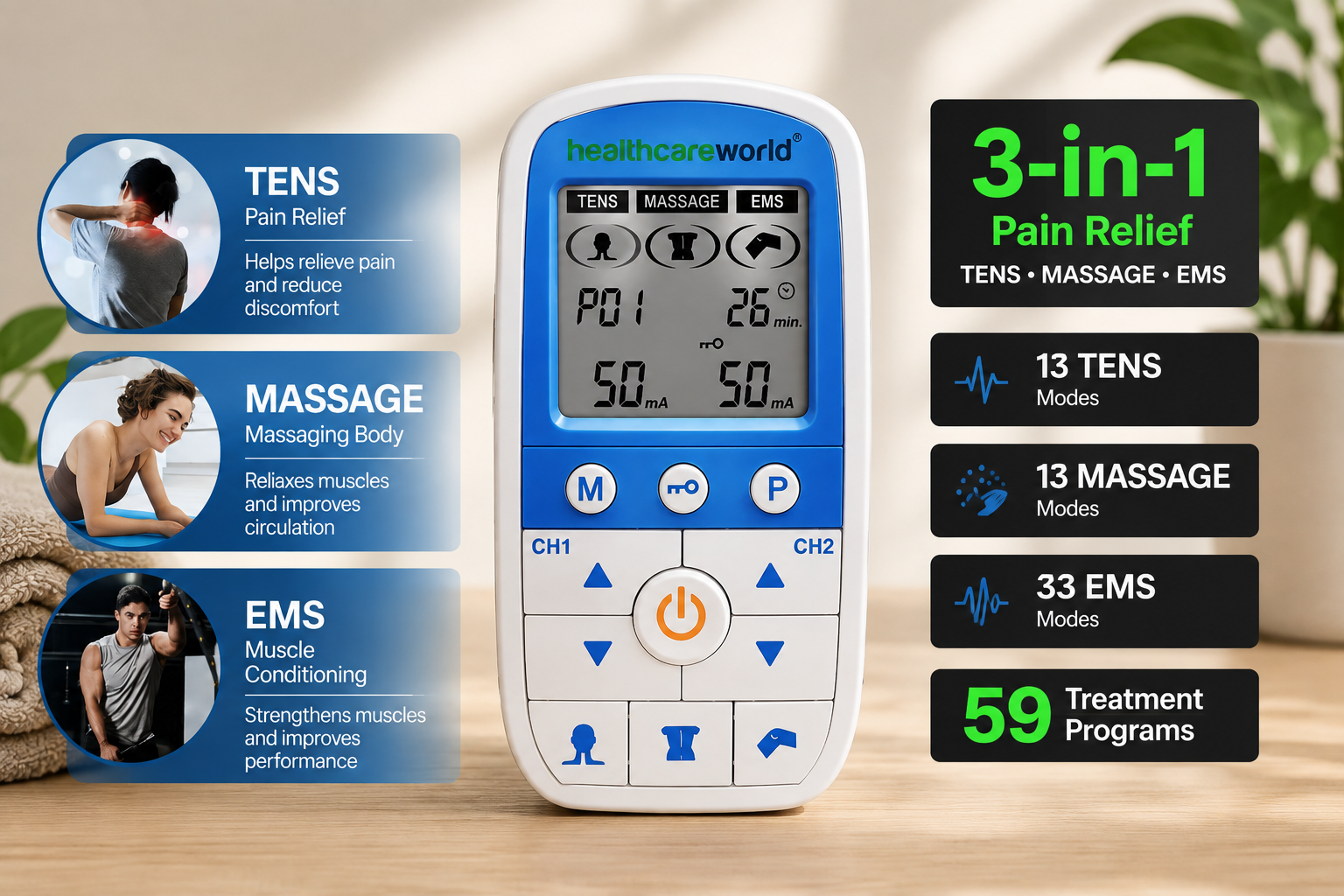
This allows more individualised control than a device where every electrode receives exactly the same setting. The Healthcare World 3-in-1 Digital TENS and EMS Machine supplied for this project specifically provides independent control of CH1 and CH2.
3. More Efficient Sessions
If you need to treat two suitable areas, dual-channel operation can potentially save time. Rather than: Area A → session → Area B → session you may be able to use: Area A + Area B → one session provided the machine’s instructions support the arrangement.
4. Greater Flexibility
Dual-channel machines can also be useful if your treatment needs change. You can use:
One channel only
Both channels
Different intensities
Different appropriate electrode positions
depending on the machine. This means you aren’t required to use four electrodes simply because the machine has two channels.
Dual-Channel vs Single-Channel TENS
| Feature | Single-Channel TENS | Dual-Channel TENS |
|---|---|---|
| Output channels | 1 | 2 |
| Typical electrode capacity | 2 electrodes | Up to 4 electrodes |
| Treat two areas simultaneously | Usually no | Often possible |
| Independent intensity | Limited to one channel | Often available |
| Flexibility | Simpler | Greater |
| Controls | Usually simpler | Can be more advanced |
| Suitable for beginners | Yes | Yes, with proper instructions |
| Main advantage | Simplicity | Multiple-area treatment |
| A dual-channel machine isn’t necessarily better for everyone. If you only ever treat one area at a time, a simpler single-channel device may be sufficient. |
Dual-Channel TENS vs Two Separate TENS Machines
It may seem logical to buy two single-channel machines if you want to treat two areas. Usually, a dual-channel device is more convenient. One dual-channel machine
One control unit
One battery/power source
One set of controls
Multiple electrode connections
Easier storage
Two single-channel machines
Two control units
Two power sources
More equipment
More accessories to store
A dual-channel device therefore provides a practical middle ground for users who want multiple-area treatment without carrying two separate machines.
How Many Electrodes Does a Dual-Channel TENS Machine Use?
This depends on the device. A common configuration is:
Channel 1 = 2 electrodes
Channel 2 = 2 electrodes
That gives a total of four electrodes. For example, the Healthcare World 3-in-1 Digital TENS and EMS Machine supplied for this project comes with four self-adhesive electrodes and two output cables. However, don’t assume every dual-channel TENS machine has identical connections. Always check the manufacturer’s instructions.
Can You Use Only One Channel?
Yes, on many dual-channel devices. You don’t necessarily need to use both channels every time. You could use: Channel 1 → one treatment area and leave: Channel 2 → unused This can be useful when you want the flexibility of a dual-channel machine but only need to treat one area during a particular session. Check the instructions for your specific model before using it this way.
Can Each TENS Channel Have a Different Intensity?
On machines with independent channel controls, yes. This is one of the main reasons people choose dual-channel TENS. For example:
| Channel | Treatment area | Example intensity |
|---|---|---|
| These are only examples—not recommended settings. The correct intensity depends on the individual, the machine and the treatment programme. The NHS advises starting low and gradually increasing the current until you feel a tingling sensation that isn’t painful. (nhs.uk) |
Can Each Channel Use a Different Programme?
This depends entirely on the machine. Some advanced dual-channel devices allow independent programme and intensity selection. Others may use the same programme across both channels while allowing separate intensity control. For example, the Healthcare World 3-in-1 machine supplied for this project provides independent CH1 and CH2 control. Before buying, check whether the product provides:
Independent intensity
Independent modes
Independent frequency
Independent pulse width
if these features matter to you.
Dual-Channel TENS Machines With EMS
Some dual-channel devices combine TENS and EMS. EMS stands for electrical muscle stimulation and is designed to stimulate muscle contractions. A combination machine can therefore provide different functions from the same control unit. The Healthcare World 3-in-1 Digital TENS and EMS Machine supplied for this project is an example. It combines:
TENS
EMS
Massage functionality
Dual channels
Multiple therapy modes
Adjustable intensity
This can be attractive if you want more than a TENS-only device. However, TENS and EMS aren’t the same therapy. Always use each function according to the manufacturer’s instructions. Explore TENS and EMS Machines for more options.
Three Dual-Channel TENS Machines to Consider
The three machines you’ve provided for this project demonstrate different approaches to dual-channel or multi-area TENS.
Healthcare World 3-in-1 Digital TENS and EMS Machine
This is the clearest example of a dual-channel TENS/EMS machine in the supplied product information.
Key features
Dual independent channels
TENS
EMS
Massage functionality
28 therapy modes listed 40 intensity levels Four self-adhesive electrodes Two output cables
Portable design
Why choose it?
It may appeal to users who want:
Two treatment areas
Independent channel controls
TENS and EMS functionality
A larger selection of settings
Totally TENS TPN-Type Analogue Dual Channel Machine
This model is designed around a more traditional dual-channel TENS setup.
Key features
Dual independent channels
Burst mode
Normal mode
Modulation mode
Adjustable intensity
Pulse width from 30–260 µs
30- and 60-minute timer options
Battery-powered design
Why choose it?
It may suit users who want:
Dual-area treatment
Independent channel control
Traditional TENS functionality
Adjustable pulse settings
Healthcare World Wireless TENS Machine
The wireless model uses a different approach. Its supplied specifications include:
15 automated TENS programmes
16 intensity levels
Wireless remote control
Rechargeable battery
Digital display
Adhesive electrodes
Portable design
Its design prioritises wireless convenience and portability rather than the traditional dual-channel wired format. For users who care more about eliminating cables than treating two areas independently, this type of machine may be appealing. Note: Product specifications above are based on the information supplied for this project and may change. Verify current specifications before purchase.
What Should You Look for in a Dual-Channel TENS Machine?
Don’t choose a dual-channel machine simply because it has four electrode sockets. Look at the actual controls.
Independent Channel Control
This is one of the most important features. Check whether you can adjust CH1 and CH2 separately.
Number of Intensity Levels
More levels can provide finer control, but a larger number doesn’t automatically mean better treatment.
Independent Programmes
If you want different settings for each area, check whether the machine supports this.
Timer
A timer makes it easier to manage sessions.
Clear Display
A good display should make it easy to see:
Channel
Intensity
Programme
Battery
Treatment time
Battery Type
Consider whether you prefer:
Replaceable batteries
Rechargeable power
Wireless or Wired
Dual-channel devices are commonly wired, but design varies.
Electrode Availability
Replacement pads are essential for long-term use. Check the size and type of compatible electrodes before purchasing.
How to Use a Dual-Channel TENS Machine
The basic procedure is similar to using other TENS machines.
Step 1: Read the Instructions
Understand: Channel controls Electrode connections Programmes Intensity controls
Recommended treatment times
Step 2: Make Sure TENS Is Appropriate
The NHS advises against TENS if you have epilepsy or a pacemaker and recommends speaking with a doctor or midwife before use during pregnancy. (nhs.uk) For a more detailed overview, read TENS Contraindications.
Step 3: Switch the Machine Off
Always make sure the device is switched off before applying or removing electrodes. (Cambridge University Hospitals)
Step 4: Prepare Your Skin
The skin should be clean, dry and intact. Don’t apply electrodes over broken, infected, irritated or numb skin. (nhs.uk)
Step 5: Connect Channel 1
Connect the first electrode pair to CH1.
Step 6: Connect Channel 2
If you are using the second channel, connect its electrode pair to CH2.
Step 7: Apply the Electrodes
Position the pads according to your device’s instructions or professional guidance. Leave an appropriate gap between electrodes.
Step 8: Turn the Machine On
Activate the required channel or channels.
Step 9: Start at Low Intensity
Gradually increase each channel until the stimulation feels noticeable but comfortable.
Step 10: Monitor Both Channels
If CH1 feels comfortable but CH2 feels too strong, adjust CH2 separately if your device allows independent control.
Step 11: Turn the Machine Off
Switch the machine off before removing the electrodes.
Where Should You Put Dual-Channel TENS Pads?
This is an area where more electrodes means more responsibility for correct placement. You should not simply put four pads wherever you feel pain. The NHS advises placing electrodes on clean skin near the painful area and leaving a gap between them. It also advises against using TENS on the neck, mouth or eyes, on broken/irritated/infected/numb skin, and on the chest and back at the same time. (nhs.uk) Cambridge University Hospitals advises keeping electrodes at least 2 cm apart and avoiding placement near or over the heart. (Cambridge University Hospitals)
Example
If you’re treating two suitable areas, you might have: CH1: two pads around Area A CH2: two pads around Area B But the actual placement should follow the instructions for your machine and, where necessary, guidance from a healthcare professional.
Can You Treat Two Different Types of Pain at Once?
Potentially, yes, if both areas are suitable for TENS and your device supports the required configuration. For example, a user might want to treat:
Back discomfort + knee discomfort
Shoulder discomfort + leg discomfort
Two separate areas of muscle discomfort
But dual-channel operation doesn’t mean every combination of body areas is safe. For example, the NHS specifically advises against placing TENS on the chest and back simultaneously. (nhs.uk) When in doubt, ask a healthcare professional about electrode placement.
Common Dual-Channel TENS Mistakes
Using two channels introduces a few additional things to watch.
Using Four Pads Without Checking Placement
Four electrodes don’t mean you can place them anywhere. Follow the manufacturer’s instructions.
Setting Both Channels Too High
Each channel should be adjusted to a comfortable level. Don’t assume both sides should have the same intensity.
Forgetting Which Channel Controls Which Area
When treating two areas, make sure you know which control corresponds to which electrode pair.
Putting Pads Too Close Together
The electrodes need appropriate spacing. Cambridge University Hospitals advises keeping electrodes at least 2 cm apart. (Cambridge University Hospitals)
Connecting Electrodes While the Machine Is On
Switch the machine off before applying or removing electrodes. (Cambridge University Hospitals)
Using Different Settings Without Understanding Them
Advanced dual-channel devices can have many settings. Don’t randomly change frequency, pulse width or programme settings simply because they’re available.
Treating the Chest and Back Simultaneously
Don’t do this. NHS guidance specifically advises against it. (nhs.uk)
Assuming Dual Channel Means Twice the Pain Relief
It doesn’t. The purpose is independent or simultaneous treatment, not automatically greater effectiveness.
Are Dual-Channel TENS Machines Better?
Not necessarily. A dual-channel device is more flexible, but that doesn’t mean it is automatically the right choice. A dual-channel model may suit you if: You regularly treat two suitable areas. You want independent intensity control. You want four electrodes. You want more flexibility. You want TENS and EMS in one device. A single-channel model may suit you if: You only treat one area. You want simple controls. You don’t need multiple electrode pairs. You prefer a smaller number of settings. Think about how you’ll actually use the machine, rather than choosing based on specifications alone.
Dual-Channel TENS vs Wireless TENS
These features solve different problems. Dual channel Focuses on: Multiple treatment areas + independent control Wireless Focuses on: Freedom from cables + portability Some users may prioritise one over the other. The Healthcare World 3-in-1 machine is particularly focused on dual-channel versatility, while the Healthcare World Wireless model focuses on cordless portability.
How Long Should You Use a Dual-Channel TENS Machine?
There isn’t one treatment duration that applies to every dual-channel machine. Different NHS guidance uses different schedules depending on the device and clinical situation. For example, Cambridge University Hospitals says TENS can initially be used for 30–60 minutes, with use increased to several hours if helpful. (Cambridge University Hospitals) University Hospitals of Leicester provides different instructions for its specific dual-channel device, demonstrating why you should follow the instructions for your own machine rather than copying another device’s schedule. (UH Leicester) For more information, read How Long Should You Use a TENS Machine?.
Can You Use a Dual-Channel TENS Machine Every Day?
Some people use TENS regularly, including daily use, when appropriate. However, the appropriate frequency depends on: Your circumstances The machine The programme Electrode placement Skin tolerance If you use TENS frequently, check the skin under the electrodes regularly. Cambridge University Hospitals recommends checking for redness or soreness and moving the electrode position if necessary. (Cambridge University Hospitals) Read Can You Use TENS Every Day? for more information.
Can You Sleep With a Dual-Channel TENS Machine?
No. Having two channels doesn’t change the safety advice. The NHS advises against using TENS while sleeping. (nhs.uk) If you use TENS before bed, switch it off before falling asleep. Read Can You Sleep with a TENS Machine?.
Can You Use a Dual-Channel TENS Machine While Driving?
No. The NHS advises against using TENS while driving or operating machinery. (nhs.uk) This applies whether you’re using:
One channel
Two channels
Wired TENS
Wireless TENS
Use the machine only when you’re safely able to focus on the session.
Are Dual-Channel TENS Machines Safe?
For suitable users, TENS is generally considered a non-invasive treatment, but it isn’t appropriate for everyone. The NHS advises against TENS if you have epilepsy or a pacemaker and recommends professional advice during pregnancy. (nhs.uk) You should also avoid using electrodes on:
Broken skin
Infected skin
Irritated skin
Numb areas
The neck
Mouth
Eyes
The NHS also advises against using TENS on the chest and back simultaneously. (nhs.uk) RNOH warns that burns and significant skin damage can occur if electrical current is too high, electrodes are incorrectly positioned or too close together, or TENS is used for long periods without appropriate breaks. (Royal National Orthopaedic Hospital) Read Is TENS Safe? for more information.
Dual-Channel TENS Machine Buying Checklist
Before buying, check:
✓ Two independent channels
Can CH1 and CH2 actually be controlled separately?
✓ Suitable intensity range
Can you make small adjustments comfortably?
✓ Multiple programmes
Does the machine offer the settings you actually need?
✓ Timer
Can you easily control session duration?
✓ Four compatible electrodes
Are the necessary electrodes included?
✓ Replacement pads
Can you easily buy replacements?
✓ Clear display
Can you see each channel’s settings?
✓ Battery type
Would rechargeable or replaceable batteries suit you better?
✓ Easy controls
Can you understand which button controls which channel?
✓ Portable design
Will you actually be comfortable carrying it?
Dual-Channel TENS Machine Comparison
| Feature | Healthcare World 3-in-1 | Totally TENS TPN-Type | Healthcare World Wireless |
|---|---|---|---|
| Independent channel control | ✓ | ✓ | |
| — | EMS | ✓ | |
| Product information includes EMS/TENS functionality | — | Intensity levels | |
| 40 | Adjustable | 16 | |
| Modes/programmes | 28 therapy modes listed | Burst, Normal, Modulation | |
| 15 automated programmes | Electrodes | 4 | |
| Included | Adhesive electrodes | Wireless | |
| — | — | ✓ | |
| Rechargeable | Not specified as rechargeable | Battery powered | |
| ✓ | Display | Digital | |
| LED | Digital | Best-known strength | |
| TENS + EMS + dual channel | Traditional dual-channel control | Wireless portability | |
| Product note: This table uses the product information supplied for this project. Features, specifications and availability can change, so verify current manufacturer information before purchase. |
Who Should Buy a Dual-Channel TENS Machine?
A dual-channel TENS machine may be particularly useful if you regularly want to treat two suitable areas during the same session. It may also appeal if you want:
Independent intensity control
Four electrodes
TENS and EMS functionality
More flexible treatment configurations
A machine you can use for different situations
If you only treat one area and prefer simple controls, however, you may not need dual-channel functionality.
FAQs
What is a dual-channel TENS machine?
It’s a TENS machine with two separate electrical output channels, allowing multiple electrode pairs to be connected and, on suitable models, independently controlled.
Can I use four pads with a dual-channel TENS machine?
Many dual-channel machines are designed for four electrodes, but check your specific model’s instructions.
Can I treat two areas at once?
Often, yes, provided both areas are suitable for TENS and your device supports that configuration.
Can each channel have a different intensity?
Many dual-channel machines allow independent intensity adjustment. Check the specifications of your model.
Can each channel use a different programme?
Some advanced models allow this, while others may not. Check the manufacturer’s instructions.
Is dual-channel TENS more powerful?
Not necessarily. Dual channel refers to the number of independent output channels, not automatically to greater electrical power.
Is dual-channel TENS better than single-channel?
It is more flexible, but whether it’s better depends on how you plan to use it.
Can I use one channel only?
Many dual-channel machines can be used with one channel, but follow your specific device’s instructions.
Can I use dual-channel TENS every day?
Some people use TENS daily, but the appropriate schedule depends on the individual and machine. Read Can You Use TENS Every Day?.
Can I sleep with dual-channel TENS?
No. NHS guidance advises against using TENS while sleeping. (nhs.uk)
Can I drive while using dual-channel TENS?
No. TENS should not be used while driving or operating machinery. (nhs.uk)
Can I use dual-channel TENS in the shower?
No. TENS should not be used in the bath or shower. (nhs.uk)
How far apart should TENS electrodes be?
Spacing depends on the device and treatment area. Cambridge University Hospitals advises at least 2 cm between electrodes. (Cambridge University Hospitals)
Can I put one channel on my chest and one on my back?
No. NHS guidance specifically advises against using TENS on the chest and back at the same time. (nhs.uk)
Can I use TENS if I have a pacemaker?
The NHS advises against using TENS if you have a pacemaker. (nhs.uk)
Can TENS electrodes be placed on the neck?
The NHS advises against placing TENS electrodes on the neck. (nhs.uk)
The Bottom Line: Are Dual-Channel TENS Machines Worth It?
A dual-channel TENS machine can be a useful choice if you want the flexibility to treat two appropriate areas during one session. The biggest advantages are:
Two output channels
Potentially independent intensity control
Multiple electrode pairs
More treatment flexibility
Potentially shorter overall treatment time
TENS and EMS options on some models
But dual channel doesn’t automatically mean better pain relief. If you only need to treat one area, a simpler machine may be all you need. If you regularly want to treat two suitable areas, independent channels can make the device much more practical. When comparing models, look beyond the phrase “dual channel”. Check: Independent controls + intensity range + programmes + timer + electrode availability + battery + ease of use. And always follow the manufacturer’s electrode-placement and safety instructions. Ready to compare available models? Explore TENS and EMS Machines. For more practical information, visit the TENS Education Hub.
Related TensLeads Guides
TENS Machine Guide for Beginners
What Is a TENS Machine?
How Does a TENS Machine Work?
Portable TENS Machines
Rechargeable TENS Machines
How Long Should You Use a TENS Machine?
Can You Use TENS Every Day?
Can You Sleep with a TENS Machine?
TENS Contraindications
TENS Side Effects
TENS vs Heat Therapy
Medical Sources
NHS — TENS guidance
Cambridge University Hospitals — TENS for pain relief
Cambridge University Hospitals — TENS usage advice
Royal National Orthopaedic Hospital — TENS patient guide
Leeds Teaching Hospitals — TENS for pain control
Safety Disclaimer
This article is for general educational purposes only and does not provide medical diagnosis or personalised treatment advice. TENS is not suitable for everyone and does not guarantee pain relief. Always read and follow the instructions supplied with your device. If you have an implanted electrical device, epilepsy, are pregnant, have reduced sensation or have unexplained or persistent pain, consult an appropriate healthcare professional before using TENS.