
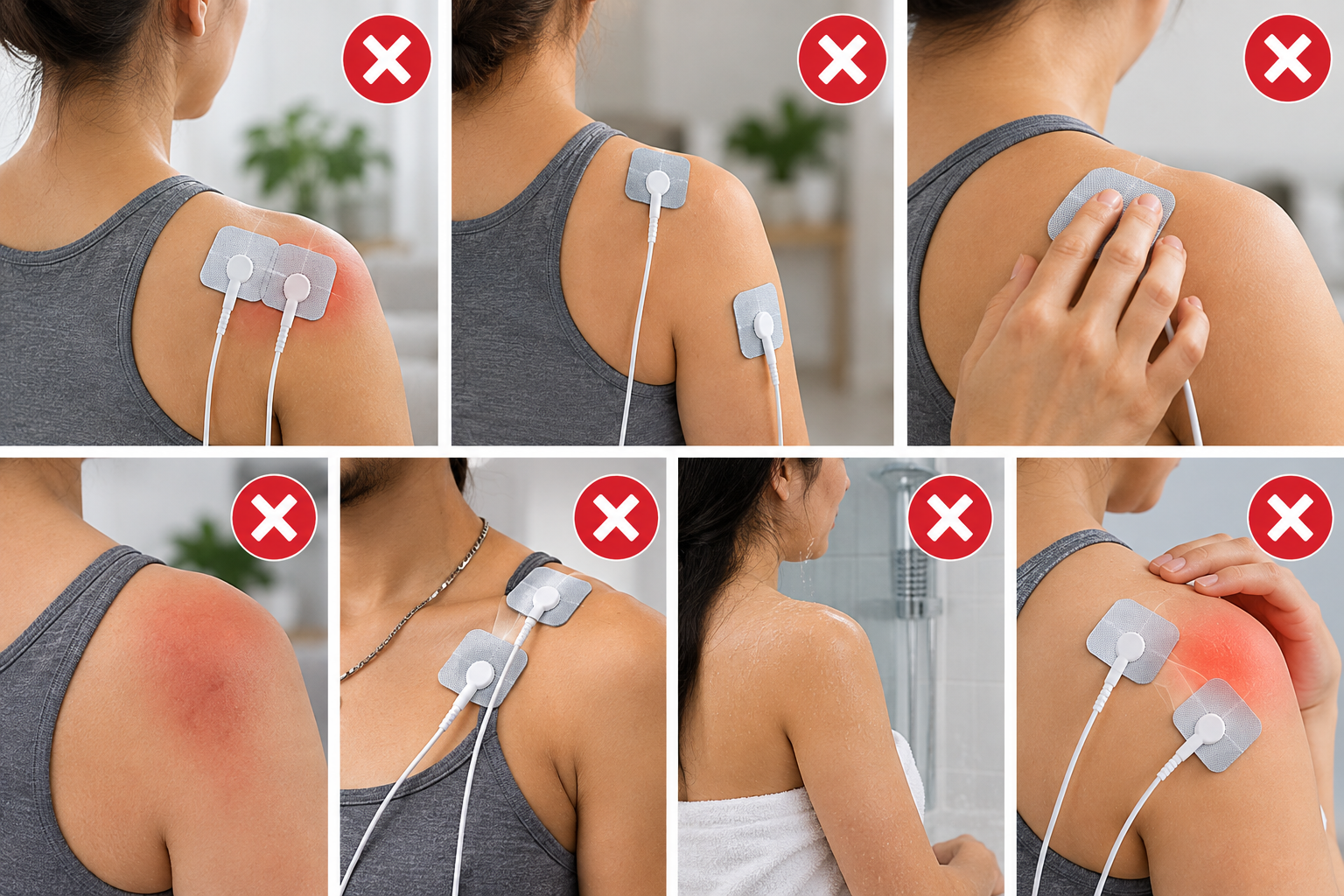
Common Mistakes When Using TENS for Shoulder Pain: What to Avoid
If you are using a TENS machine for shoulder pain, getting the basics right matters. Poor electrode placement, excessive intensity, worn-out pads, damaged leads and unrealistic expectations can all make TENS less comfortable or less useful. In some situations, continuing to use TENS without seeking appropriate medical advice can also delay assessment of a shoulder problem that needs attention.
The most common TENS mistakes for shoulder pain are usually avoidable. The safest approach is to follow your machine’s instructions, place electrodes only where appropriate, begin with a low intensity and increase it gradually, keep pads and leads in good condition, and treat TENS as a way of managing pain rather than as a cure. The NHS notes that TENS may provide temporary pain relief for some people, but it does not work for everyone.
Quick answer: What are the biggest TENS mistakes for shoulder pain?
The main mistakes include:
- Putting electrode pads too close together or in an inappropriate location.
- Placing standard TENS pads directly on the neck.
- Turning the intensity up too quickly or making the stimulation painful.
- Continuing to use worn or poorly adhesive electrode pads.
- Ignoring damaged leads, loose connections or battery problems.
- Assuming stronger stimulation automatically means better pain relief.
- Using TENS for too long or in situations where it should not be used.
- Expecting TENS to fix the underlying cause of shoulder pain.
- Continuing self-treatment when symptoms are persistent, worsening or unusually severe.
- Choosing a machine without checking electrode and lead compatibility.
Avoiding these mistakes can make shoulder pain TENS therapy more practical and comfortable, while helping you recognise when TENS is not the right solution.
Mistake 1: Placing the electrode pads incorrectly
Correct electrode placement is one of the most important parts of using a TENS machine for shoulder pain.
It can be tempting to put a pad directly on the exact point that hurts. However, TENS electrodes are generally positioned on or around the painful area, rather than simply placing every pad wherever the pain feels strongest. Cambridge University Hospitals recommends positioning electrodes on or around the area of pain and notes that a healthcare professional can demonstrate appropriate placement.
For shoulder pain, this requires particular care because the shoulder is close to the neck and chest.
Do not place standard TENS pads directly on the neck.
The NHS specifically advises against using TENS on the neck, mouth or eyes.
If you are unsure about positioning around your shoulder, ask a healthcare professional to demonstrate an appropriate arrangement rather than experimenting with areas that should be avoided.
For more detailed guidance, see our article on Best TENS Pad Placement for Shoulder Pain.
Mistake 2: Putting pads too close together
Electrodes should not touch each other.
NHS hospital guidance commonly recommends leaving a gap between electrodes, with some guidance specifying around 2 cm or more.
When treating a relatively compact area such as the shoulder, it can be tempting to squeeze several pads into a small space. This can make positioning less effective and may produce an uncomfortable sensation.
Before switching the machine on, check that:
- The pads are separated.
- They are firmly attached to clean, dry skin.
- They are not positioned on prohibited areas.
- They are not placed over broken or irritated skin.
- The arrangement follows your machine’s instructions or professional advice.
If you are using four electrodes, make sure you have enough space to position them appropriately rather than forcing them into a very small area.
Mistake 3: Putting TENS pads on the neck because the pain feels close to it
This deserves separate attention because shoulder and neck discomfort can overlap.
If pain extends towards the top of the shoulder or shoulder blade, you may assume that moving the pads higher towards the neck will provide better coverage. That is not a safe assumption.
The NHS advises not to use TENS on the neck. The Royal National Orthopaedic Hospital also advises avoiding the front and sides of the neck.
Standard TENS should therefore not be used by simply placing electrodes across the neck to treat shoulder symptoms.
If your pain extends into the neck, speak to a healthcare professional about whether TENS is appropriate and, if so, where the electrodes can safely be positioned.
Mistake 4: Turning the intensity up too quickly
One of the most common TENS mistakes for shoulder pain is assuming that more electrical stimulation must mean more pain relief.
It does not.
The NHS recommends starting at a low intensity and gradually increasing it until you feel a tingling sensation that is not painful.
NHS pain services commonly describe the desired sensation as strong but comfortable.
A sensible approach is:
- Start at a low intensity.
- Increase it gradually.
- Allow yourself time to get used to the sensation.
- Stop increasing when the tingling is clear and comfortable.
- Reduce the intensity if it becomes painful or unpleasant.
You should not feel that you have to tolerate painful stimulation to make TENS work.
If the stimulation produces strong or uncomfortable muscle contractions, reduce the intensity and check the electrode placement.
Mistake 5: Assuming the highest setting is the best setting
TENS machines often provide many intensity levels, but the highest number is not a target.
The appropriate intensity depends on the individual, the electrode position and the particular machine. NHS guidance recommends gradually increasing the intensity until you feel stimulation without pain.
If you turn the intensity up simply because you believe a stronger current must be more effective, you may make the treatment uncomfortable without gaining additional benefit.
Think comfortable and clearly noticeable, rather than as strong as possible.
Our guide to TENS settings for shoulder pain explains frequency, pulse width, intensity and gradual adjustment in more detail.
Mistake 6: Using worn-out electrode pads
Electrode pads do not last indefinitely.
With repeated use, reusable adhesive pads can gradually lose their stickiness and ability to maintain good contact with the skin. Leeds Teaching Hospitals advises checking whether pads are still sticking properly and replacing them when they lose their effectiveness.
Worn pads can cause several problems:
- They may not stay securely attached.
- Stimulation may feel inconsistent.
- The machine may seem weaker than usual.
- You may be tempted to increase the intensity unnecessarily.
- Poor contact can make the session less comfortable.
Before assuming that your TENS machine has developed a fault, inspect the electrode pads.
If they are no longer sticking properly, replacing them may solve the problem.
Mistake 7: Using dirty or poorly prepared skin
Good skin contact matters.
Cambridge University Hospitals recommends applying electrodes to clean, dry, unbroken skin.
Creams, oils, sweat and other substances can interfere with electrode adhesion and contact.
Before applying electrode pads for shoulder pain:
- Make sure your skin is clean.
- Dry the area thoroughly.
- Avoid applying creams or oils underneath the electrodes.
- Check for irritation or broken skin.
- Make sure the pads themselves are clean and in usable condition.
Never place electrodes over irritated, infected, broken or otherwise unsuitable skin. NHS guidance specifically advises against using TENS on irritated, broken or infected skin.
Mistake 8: Ignoring damaged leads or loose connections
The machine itself is not the only component that can cause problems.
If the leads are damaged, the connection is loose or the plug does not properly match the machine or electrodes, stimulation may be weak or inconsistent.
Check:
- The leads are firmly connected.
- There is no visible damage.
- The connector matches the machine.
- The electrode connection is secure.
- The battery has sufficient charge or power.
If your TENS machine suddenly feels weak, do not automatically increase the intensity. First check the pads, leads, connections and battery.
Our guide to why a TENS machine can feel weak and what to check provides a useful troubleshooting checklist.
Mistake 9: Changing every setting at once
Many modern TENS machines allow adjustments to frequency, pulse width, intensity and programme.
That flexibility can be useful, but changing everything simultaneously makes it difficult to understand what works for you.
A better approach is to change one variable at a time.
For example, if the intensity feels comfortable but the stimulation does not suit you, make a modest change to the programme or another available setting. Give yourself time to assess the new sensation before making another change.
There is no single universally correct combination of frequency and pulse width for shoulder pain. NHS guidance includes different settings across different services, which is another reason not to treat one numerical setting as a prescription.
Mistake 10: Using TENS for too long or in the wrong situations
How long you use TENS should follow your device instructions and any professional advice you have received.
Cambridge University Hospitals suggests starting with around 30–60 minutes and increasing use if helpful, while the Royal National Orthopaedic Hospital gives guidance of up to 60 minutes at a time, usually up to three times a day.
Because guidance varies, do not assume that longer sessions are automatically better.
There are also situations where TENS should not be used. NHS guidance says not to use it:
- While sleeping.
- In the bath or shower.
- While driving.
- While operating machinery.
- On the neck, mouth or eyes.
- On irritated, broken or infected skin.
- On numb areas.
The NHS also advises against TENS if you have a pacemaker or epilepsy, and says pregnancy requires advice from a doctor or midwife before use.
Mistake 11: Expecting TENS to cure shoulder pain
TENS is a pain-management tool, not a guaranteed solution to the underlying cause of shoulder pain.
The NHS describes TENS as providing temporary pain relief and states that it does not work for everyone.
This distinction is important.
If TENS reduces your discomfort temporarily, that may be useful. But it does not necessarily mean that the underlying reason for the shoulder pain has been resolved.
Shoulder problems can have different causes and may require approaches such as activity modification, exercises, physiotherapy or medical assessment depending on the situation. NHS shoulder guidance recommends seeking medical advice when pain is worsening, has not improved after two weeks or makes movement very difficult.
Do not use temporary relief from TENS as evidence that an ongoing shoulder problem no longer needs attention.
Mistake 12: Ignoring symptoms that need medical advice
This is arguably the most important mistake to avoid.
TENS can be convenient for self-management, but it should not replace appropriate assessment.
According to NHS guidance, you should seek medical advice for shoulder pain that is worsening, has not improved after two weeks or makes movement very difficult. More urgent assessment may be needed for sudden or very severe pain, inability to move the arm, changes in the shape of the shoulder, significant swelling, persistent pins and needles or loss of feeling, or symptoms following an injury.
If you are unsure what is causing your pain, the NHS recommends speaking with a healthcare professional before using TENS.
Mistake 13: Buying a machine without checking pad compatibility
It is easy to focus entirely on the TENS machine and forget about the electrodes.
However, electrode pads are a consumable part of the system. You need to know that compatible replacements will be available when the original pads eventually need changing.
Before buying a TENS machine for shoulder pain, check:
| What to check | Why it matters |
| Connector type | Ensures the pads fit your machine |
| Number of channels | Determines how many electrode pairs you can use |
| Intensity levels | Allows gradual adjustment |
| Programmes | Gives you different stimulation options |
| Pad size | Affects positioning flexibility |
| Replacement-pad availability | Important for continued use |
| Replacement-pad price | Determines ongoing cost |
| Lead compatibility | Helps avoid connection problems |
| Timer | Useful for controlled sessions |
| CE/UKCA marking | Important when purchasing in the UK |
A machine that is inexpensive initially may become less economical if compatible replacement pads are difficult or expensive to obtain.
How to avoid common TENS mistakes
A simple routine can prevent many problems.
Before a session
- Read your machine’s instructions.
- Check the electrode pads.
- Inspect the leads.
- Clean and dry your skin.
- Position the pads correctly.
- Make sure the pads are separated.
- Confirm that you are not placing electrodes on a prohibited area.
During a session
- Switch the machine on after the electrodes are in position.
- Start at low intensity.
- Increase gradually.
- Aim for strong but comfortable tingling.
- Reduce the intensity if it becomes painful.
- Stop if your skin becomes significantly irritated.
After a session
- Turn the machine off before removing the electrodes.
- Remove the pads gently.
- Return reusable pads to their storage backing as directed.
- Check the skin for irritation.
- Store the machine and leads safely.
The NHS specifically advises switching the machine off before applying or removing the pads.
TENS mistakes checklist for shoulder pain
Before using your machine, ask:
- Are my pads positioned appropriately?
- Are the electrodes separated?
- Am I avoiding the neck?
- Is my skin clean, dry and intact?
- Are my pads still sticky and in good condition?
- Are the leads undamaged and properly connected?
- Have I started the intensity low?
- Is the stimulation strong but comfortable rather than painful?
- Am I following the recommended session duration?
- Am I avoiding TENS while sleeping, bathing, driving or using machinery?
- Am I using a compatible replacement pad if the originals need changing?
- Have I sought medical advice if the shoulder pain is persistent, worsening or unusual?
If the answer to all of these is yes, you have removed many of the common practical problems associated with TENS use.
Choosing better equipment for shoulder pain
If your existing machine is difficult to control, has limited intensity adjustment or uses hard-to-find electrode pads, upgrading the equipment may make regular TENS use more convenient.
For shoulder pain, look for a machine that offers:
- Adjustable intensity.
- Useful TENS programmes.
- Easy-to-read controls.
- Suitable channel configuration.
- Portable design.
- A timer.
- Readily available replacement electrodes.
- Clearly specified pad and lead compatibility.
You can also read our Best TENS Machine Features: What to Look For Before You Buy guide for a broader buying checklist.
TENS Machines; Replacement Electrode Pads
TensLeads offers TENS Machines; Replacement Electrode Pads for people looking for a complete TENS setup or replacement accessories.
The range includes portable TENS machines and reusable electrode pads in different sizes and designs. Some options are intended for broader areas, while others provide a more compact electrode footprint. Always check the connector specification and compatibility before ordering replacement pads or leads.
Good-quality, compatible replacement pads can help maintain reliable skin contact as your original electrodes become worn through regular use.
Explore TENS Machines; Replacement Electrode Pads
Explore TENS Machines; Replacement Electrode Pads
Frequently Asked Questions
Does TENS help shoulder pain?
TENS may provide temporary pain relief for some people, but it does not work for everyone and should not be considered a cure. The NHS states that TENS may help certain short- and long-term pain, while shoulder pain itself can have different causes requiring different forms of management.
Where should TENS pads go for shoulder pain?
TENS pads are generally positioned on or around the painful area using clean, dry and intact skin, with a gap between electrodes. Exact placement depends on the location of the pain and the instructions for your device. Standard TENS pads should not be placed on the neck, mouth or eyes.
How long can TENS be used for shoulder pain?
Usage varies according to the machine and individual guidance. Cambridge University Hospitals suggests beginning with around 30–60 minutes, while the Royal National Orthopaedic Hospital gives guidance of up to 60 minutes at a time, usually up to three times daily. Follow your particular machine’s instructions and do not sleep with TENS switched on.
Why does my TENS machine feel weak on my shoulder?
Check the electrode pads, skin contact, leads, connections and battery before increasing the intensity. Worn pads or poor contact can make stimulation feel weaker. If the pads are no longer sticking properly, replacing them may help.
Should TENS feel painful?
No. NHS guidance recommends gradually increasing the intensity until you feel tingling without pain. If stimulation becomes painful or unpleasant, reduce the intensity or stop the session.
Can I put TENS pads on my neck for shoulder pain?
Standard TENS should not be placed directly on the neck. The NHS advises against using TENS on the neck, and NHS hospital guidance specifically warns against the front and sides of the neck.
When should I stop using TENS for shoulder pain?
Stop if the stimulation becomes painful, your skin becomes significantly irritated, or you experience an unusual reaction. You should also seek appropriate medical advice if your shoulder pain is worsening, persistent, severely restricting movement or associated with symptoms such as loss of feeling or persistent pins and needles.
Key Takeaways
- The most common TENS mistakes for shoulder pain involve incorrect placement, excessive intensity and poorly maintained equipment.
- Do not assume that stronger stimulation provides better pain relief.
- Start at a low intensity and gradually work towards a strong but comfortable tingling sensation.
- Keep electrode pads separated and apply them to clean, dry and intact skin.
- Do not place standard TENS electrodes directly on the neck.
- Replace electrode pads when they lose their adhesion or no longer provide reliable contact.
- Check leads, connectors and batteries before assuming your machine is faulty.
- Follow your machine’s instructions for session length rather than assuming longer use is better.
- Never use TENS while sleeping, bathing, driving or operating machinery.
- TENS provides temporary pain relief for some people and does not treat every cause of shoulder pain.
- Persistent, worsening or severe shoulder symptoms should be assessed by an appropriate healthcare professional.
Safety Disclaimer
This article provides general information and is not a substitute for medical diagnosis or individual treatment advice. TENS does not work for everyone. The NHS advises against TENS for people with a pacemaker or epilepsy and recommends medical advice during pregnancy. Do not use TENS on the neck, mouth or eyes, or on broken, infected, irritated or numb skin. Do not use it while sleeping, bathing, driving or operating machinery. Always follow your TENS machine manufacturer’s instructions and speak to a qualified healthcare professional if you are unsure whether TENS is suitable for you or if your shoulder pain is persistent, worsening or severe.