
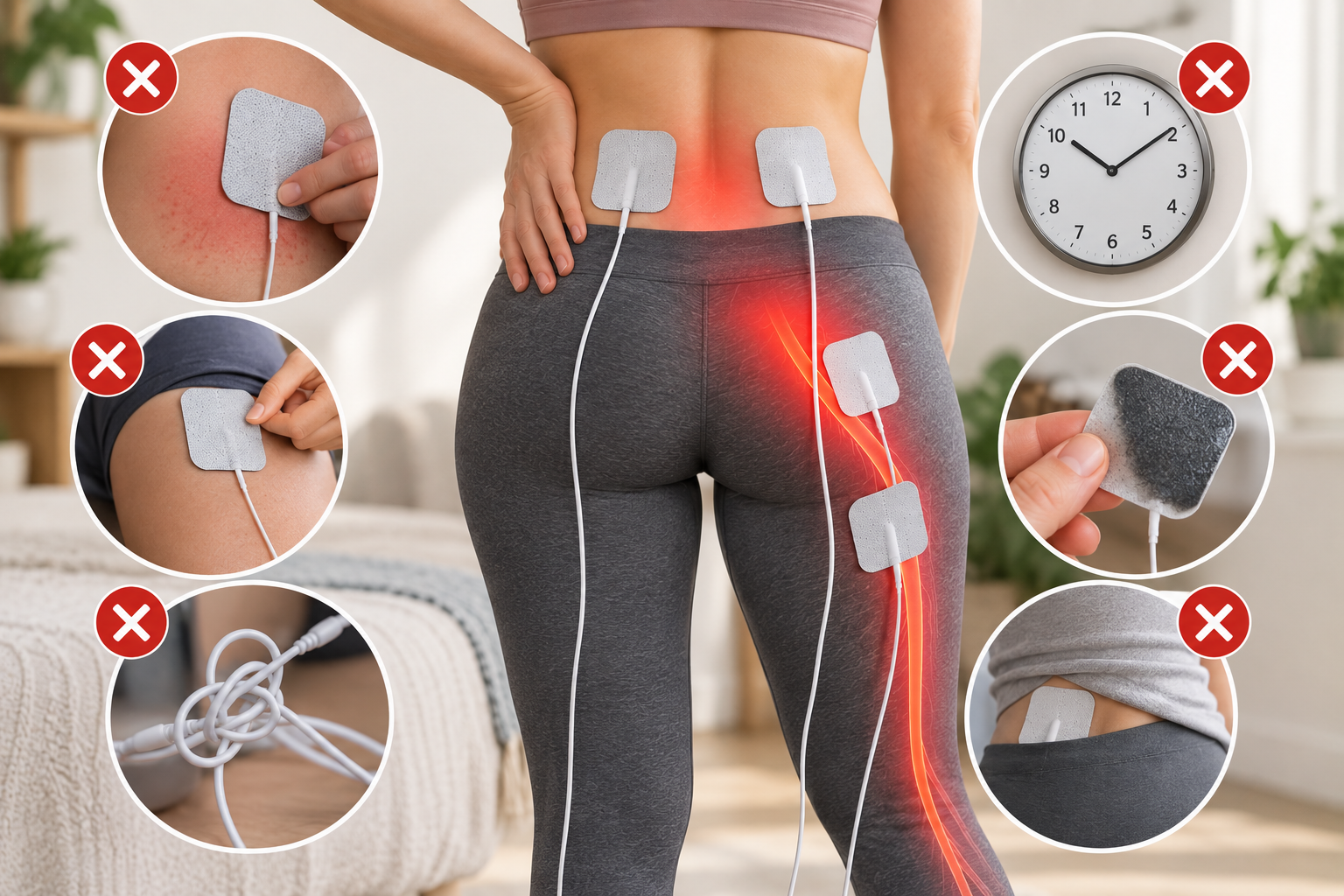
Common Mistakes When Using TENS for Sciatica
If you’re using a TENS machine for sciatica, small mistakes can affect comfort, usability and your overall experience with the device. Problems such as poor electrode placement, using an unnecessarily high intensity, relying on worn pads or damaged leads, and expecting TENS to cure sciatica can all lead to disappointment or inappropriate use.
The most important point is that there is no guaranteed TENS approach for sciatica. TENS may provide temporary pain relief for some people, but it does not treat the underlying cause of sciatic symptoms. NICE currently recommends not offering TENS for managing low back pain with or without sciatica because its evidence review found insufficient evidence of clinical benefit. (NICE)
If you nevertheless choose to use a TENS machine as part of your personal pain-management routine, using it correctly and understanding its limitations is important. This guide covers the most common TENS mistakes for sciatica, how to avoid them and when it is better to seek professional advice.
What You Need to Know
TENS (Transcutaneous Electrical Nerve Stimulation) is a non-invasive treatment that delivers a weak electrical current through electrode pads attached to the skin. The NHS explains that TENS can provide temporary pain relief for some types of pain, although it does not work for everyone. (NHS)
When using a TENS machine for sciatica, the aim should be safe and comfortable use rather than finding the strongest possible electrical stimulation.
Common mistakes include:
- Placing electrode pads incorrectly.
- Putting pads on unsuitable or numb skin.
- Using an intensity that is too high.
- Assuming stronger stimulation means better results.
- Leaving worn electrode pads in use for too long.
- Continuing to use damaged or faulty leads.
- Changing several TENS settings without understanding what they do.
- Using the machine for longer than recommended.
- Expecting TENS to cure sciatica.
- Using TENS instead of seeking medical advice when symptoms require assessment.
Understanding these mistakes can help you use your equipment more responsibly and recognise when a problem may be with the machine or accessories rather than the treatment itself.
Mistake 1: Placing TENS Pads in the Wrong Position
Electrode placement is one of the most common areas where new TENS users need guidance.
If you’re asking “where should TENS pads go for sciatica?”, there is no single position that is appropriate for every person. Placement depends on where your symptoms are experienced and the instructions provided with your particular machine.
The NHS recommends placing TENS pads on clean skin near the painful parts of the body and leaving a gap between the pads. (NHS)
For sciatic-type symptoms, this may mean areas around the lower back, buttock or affected leg, depending on the individual and the manufacturer’s guidance.
Do not assume that placing the pads directly over the point where pain is strongest is always appropriate.
How to Avoid Poor Placement
Before applying the pads, make sure:
- The skin is clean and dry.
- The skin is intact and free from irritation.
- There is an appropriate gap between the electrode pads.
- The placement follows the manufacturer’s instructions.
- You are not placing electrodes on numb areas.
- You are not placing electrodes on the front or sides of the neck.
- You are not placing electrodes near the eyes or in the mouth.
- You are not placing electrodes across the chest.
For a more detailed explanation of positioning, see our guide to Best TENS Pad Placement for Sciatica.
Mistake 2: Using TENS on Damaged or Numb Skin
It can be tempting to position the pads directly where you feel the most discomfort, but this is not always safe.
The NHS advises against using TENS on irritated, broken, infected or numb areas of skin. (NHS)
Reduced sensation is particularly important. If an area is numb, you may not be able to accurately judge how strong the stimulation feels.
Check the skin before every session, particularly if you use your TENS machine regularly.
Mistake 3: Turning the Intensity Up Too High
Another common TENS mistake for sciatica is assuming that stronger stimulation will automatically produce greater pain relief.
It will not necessarily do so.
The NHS advises gradually increasing the intensity until you feel a tingling sensation and states that it should not be painful. (NHS)
Royal National Orthopaedic Hospital guidance similarly recommends starting at a low setting and gradually increasing the strength until the sensation is strong but comfortable. If the sensation becomes painful or uncomfortable, the intensity should be reduced. (RNOH)
What the Correct Sensation Should Feel Like
The stimulation should generally feel like:
- A noticeable tingling.
- Strong enough for you to feel clearly.
- Comfortable rather than painful.
- Consistent with the instructions supplied with your device.
You should not feel that you have to tolerate pain to make the treatment effective.
If the stimulation suddenly becomes painful, switch the machine off and check the electrode placement, pads and leads.
Mistake 4: Assuming More Programmes Mean Better Treatment
Modern TENS machines can include a variety of programmes, modes and adjustable settings. It can be tempting to assume that a machine with more programmes must provide better results.
That is not necessarily the case.
Frequency, pulse width and other stimulation parameters affect the sensation produced by TENS, but there is no universally proven combination that can be recommended as the best setting for everyone with sciatica.
If your machine provides pre-set programmes, start with the manufacturer’s recommended instructions. If you manually adjust settings, make gradual changes and avoid constantly switching between multiple programmes.
For more information, read our guide to Best TENS Settings for Sciatica.
Mistake 5: Using Worn-Out Electrode Pads
Electrode pads do not last indefinitely.
Repeated use, handling and exposure to air can cause the adhesive surface to deteriorate. Once pads become dry or lose their ability to stick securely to the skin, electrical contact may become less consistent.
This can make the stimulation feel weaker, uneven or different from what you experienced when the pads were new.
If you’re experiencing weaker stimulation, do not immediately assume that the TENS machine itself has stopped working.
Signs Your Electrode Pads May Need Replacing
Look for:
- Pads that no longer stick firmly to clean skin.
- Dry or deteriorated gel surfaces.
- Pads that repeatedly lift at the edges.
- Uneven stimulation.
- A noticeable reduction in stimulation despite the same machine settings.
- Visible wear or damage.
If your pads are worn, replacing them with compatible Replacement Electrode Pads may help restore reliable skin contact.
Mistake 6: Continuing to Use Damaged Leads
The leads connect the TENS machine to the electrode pads, so damage to the wires or connectors can affect the system.
Repeated bending, pulling or twisting can eventually damage lead wires. A damaged connection may cause intermittent stimulation, inconsistent output or a machine that appears not to be working correctly.
What to Check
Before assuming that your machine has developed a fault, inspect:
- The lead wires for visible damage.
- The connectors for signs of wear.
- The connection between the leads and electrode pads.
- The connection between the leads and the TENS unit.
- Whether both channels are functioning correctly, if your device has multiple channels.
If your machine suddenly feels weaker or one side is not working correctly, our TENS Machine Troubleshooting guide can help you work through some common equipment-related problems.
Do not continue using visibly damaged electrical accessories.
Mistake 7: Expecting TENS to Cure Sciatica
This is one of the most important mistakes to avoid.
TENS is designed to provide electrical stimulation through the skin and may offer temporary pain relief for some people. It does not remove the underlying cause of sciatic symptoms.
NICE recommends not offering TENS for low back pain with or without sciatica because its evidence review found insufficient evidence of clinical benefit. (NICE)
This means claims that a TENS machine can cure sciatica, permanently repair a damaged nerve or eliminate the underlying cause should be treated with caution.
A more realistic expectation is that TENS may or may not provide temporary symptom relief.
Does TENS Help Sciatica?
The answer to “does TENS help sciatica?” is not a straightforward yes.
The NHS says TENS can provide temporary pain relief for some people, but it does not work for everyone. (NHS)
However, NICE’s evidence review found no clinical benefit for TENS compared with sham TENS or usual care in the mixed population it assessed and concluded that the evidence was insufficient to support its use for low back pain or sciatica. (NICE)
Therefore, you should not continue increasing intensity, duration or frequency simply because you expect TENS to eliminate sciatic symptoms.
Mistake 8: Using TENS for Too Long
Another common question is “how long can TENS be used for sciatica?”
There is no single session duration that is appropriate for everyone. Different TENS machines and clinical services may provide different instructions.
Follow the manufacturer’s recommendations for your particular device. Some clinical TENS guidance describes sessions ranging from shorter periods to several hours depending on the circumstances, which demonstrates why a universal duration should not be assumed. (CUH)
Do not use TENS while sleeping, driving or operating machinery. The NHS also advises against using it in the bath or shower. (NHS)
Mistake 9: Ignoring Skin Irritation
Electrode pads are designed to sit directly against the skin, but some users may develop irritation from the adhesive or prolonged contact.
Check your skin regularly, especially if you use TENS frequently.
The NHS advises switching the machine off and removing the pads if the skin becomes itchy, irritated or red. (NHS)
Royal National Orthopaedic Hospital guidance also recommends checking the skin and avoiding repeatedly applying electrodes to exactly the same spot every day. (RNOH)
Mistake 10: Not Checking the Machine When Stimulation Feels Weak
A TENS machine that suddenly feels weak does not necessarily have an electrical fault.
Several simple factors can affect the sensation.
Check the Electrode Pads
Worn or poorly adhering pads may not maintain good contact with the skin.
Check the Leads
Loose or damaged leads can interrupt the connection between the machine and electrodes.
Check the Battery
A low battery can affect the operation of some TENS machines.
Check the Skin
Creams, oils or excessive moisture can affect electrode contact.
Check the Intensity
Make sure the intensity has not been accidentally reduced.
For a more detailed troubleshooting process, see Why Does a TENS Machine Feel Weak? Causes, Fixes and What to Check.
Mistake 11: Applying Pads Too Close Together
Electrode placement is not just about choosing the right general area. The distance between pads also matters.
NHS clinical guidance advises leaving a gap between electrodes. Cambridge University Hospitals recommends electrodes be placed at least 1 inch, or approximately 2 cm, apart. (CUH)
Follow the specific spacing instructions supplied with your TENS machine.
If you’re uncertain about placement, a physiotherapist or other healthcare professional can demonstrate appropriate positioning.
Mistake 12: Using TENS on Unsafe Areas
Some areas of the body should be avoided when using TENS.
The NHS advises not using TENS on:
- The front or sides of the neck.
- The mouth.
- The eyes.
- Irritated, broken or infected skin.
- Numb skin.
- The chest and back at the same time.
It also advises against using TENS while sleeping, driving, operating machinery or in the bath or shower. (NHS)
Always read the full safety information supplied with your machine because individual devices may have additional precautions.
Mistake 13: Using TENS Without Checking Whether It Is Suitable
TENS is not appropriate for everyone.
The NHS advises against using TENS if you have epilepsy or a pacemaker, and advises pregnant people to consult their doctor or midwife before use. (NHS)
Royal National Orthopaedic Hospital guidance also recommends obtaining medical advice before using TENS if you have a pacemaker or another electrical or metal implant, are pregnant, have epilepsy or a heart problem, or have areas of numbness or sensory change. (RNOH)
If you’re uncertain, check with a qualified healthcare professional before using the device.
Mistake 14: Using TENS Instead of Seeking Medical Advice
TENS should not become a reason to delay assessment of persistent, worsening or unexplained symptoms.
Sciatic-type symptoms can have different causes, and not every type of back or leg pain should automatically be assumed to be sciatica.
If your symptoms are new, worsening or significantly affecting your normal activities, speak with a GP, physiotherapist or another appropriate healthcare professional.
Red-Flag Symptoms
Some symptoms require urgent medical attention.
Seek urgent medical assessment if you develop new bladder or bowel problems, significant or worsening weakness, or numbness around the genital or anal area.
Do not attempt to manage these symptoms solely with TENS.
TENS Mistakes: Quick Comparison
| Common Mistake | Why It Can Be a Problem | What to Do Instead |
| Poor pad placement | May affect comfort and stimulation | Follow the machine’s placement instructions |
| Pads on numb skin | You may not accurately feel the stimulation | Avoid numb areas |
| Excessive intensity | Can cause pain or skin problems | Increase gradually to a comfortable level |
| Worn pads | May reduce reliable skin contact | Replace when they deteriorate |
| Damaged leads | Can cause inconsistent stimulation | Inspect and replace damaged accessories |
| Excessive treatment time | May increase skin irritation or discomfort | Follow device guidance |
| Expecting a cure | Creates unrealistic expectations | Treat TENS as optional symptom management |
| Ignoring worsening symptoms | Could delay appropriate assessment | Seek professional medical advice |
| Using unsafe body areas | May create avoidable risks | Follow safety instructions |
| Ignoring weak stimulation | Equipment may not work correctly | Check pads, leads, battery and connections |
A Pre-Session TENS Safety Checklist
Before using your TENS machine for sciatica, take a moment to check the following:
- The machine and leads appear undamaged.
- The battery is sufficiently charged or has adequate power.
- The electrode pads are clean and in good condition.
- Your skin is clean and dry.
- Your skin is not broken, infected or irritated.
- You do not have reduced sensation where the pads will be placed.
- The electrode pads are positioned according to the manufacturer’s instructions.
- The pads are appropriately spaced.
- You have selected a suitable programme.
- The intensity starts at a low, comfortable level.
- You know how to switch the machine off quickly.
- You are not planning to sleep, drive or operate machinery while using it.
How to Use TENS More Responsibly for Sciatica
If you decide to use TENS despite the limitations of the evidence, a simple approach can help you avoid many common mistakes.
Start Conservatively
Begin with the manufacturer’s recommended programme and a low intensity.
Prioritise Comfort
The stimulation should be noticeable but comfortable rather than painful.
Check Your Pads
Make sure the electrodes are sticking properly and have not become excessively worn.
Monitor Your Skin
Remove the pads and stop if you develop significant irritation, itching, soreness or redness.
Do Not Chase Stronger Sensations
Increasing the intensity simply to make the stimulation stronger is not necessarily beneficial.
Continue Appropriate Care
TENS should not replace professional assessment or other approaches recommended for your individual circumstances.
Frequently Asked Questions
Does TENS help sciatica?
TENS may provide temporary pain relief for some people, but it does not work for everyone and evidence specifically for sciatica is limited. NICE recommends not offering TENS for low back pain with or without sciatica because there is insufficient evidence of clinical benefit. (NICE)
Where should TENS pads go for sciatica?
Pads should generally be placed on clean, intact skin around the painful area according to your machine’s instructions. Depending on your symptoms, this may include areas around the lower back, buttock or affected leg. Avoid numb, broken, irritated or infected skin and unsafe areas such as the front or sides of the neck, eyes and mouth. (NHS)
How long can TENS be used for sciatica?
There is no universal session duration specifically for sciatica. Follow the instructions for your particular TENS machine and any advice provided by your healthcare professional. Do not use TENS while sleeping, driving, operating machinery or in the bath or shower. (NHS)
Why does my TENS machine feel weak?
Weak stimulation can have several possible causes, including worn electrode pads, poor skin contact, damaged leads, a low battery or incorrect settings. Check the machine and accessories before assuming that the device itself is faulty. Our Why Does a TENS Machine Feel Weak? guide covers common causes and checks.
Should TENS feel painful?
No. TENS should generally produce a noticeable but comfortable tingling sensation. If the stimulation becomes painful or uncomfortable, reduce the intensity or stop the treatment. (RNOH)
Can I use old electrode pads?
If pads have lost their stickiness, become dry, damaged or difficult to attach securely, they should be replaced. Poor-quality contact can affect how consistently the stimulation is delivered.
Can I use TENS every day for sciatica?
There is no universal daily schedule for TENS specifically for sciatica. Follow your device instructions and seek professional advice if you are relying on TENS regularly for ongoing symptoms.
What should I do if TENS makes my skin red?
Switch the machine off and remove the electrode pads. If irritation persists, stop using the pads and seek appropriate advice. The NHS recommends stopping TENS if the skin becomes itchy, irritated or red. (NHS)
Key Takeaways
The most common TENS mistakes for sciatica are usually avoidable. Poor electrode placement, excessive intensity, worn pads, damaged leads and inappropriate settings can all affect your experience with a TENS machine.
Start with the manufacturer’s instructions, position electrode pads carefully and use a comfortable intensity rather than assuming stronger stimulation is better. Check your electrode pads and leads regularly, particularly if the machine suddenly feels weaker or the stimulation becomes inconsistent.
It is equally important to maintain realistic expectations. TENS may provide temporary pain relief for some people, but it is not a cure for sciatica, and NICE currently recommends not offering TENS for low back pain with or without sciatica because evidence of clinical benefit is insufficient. (NICE)
If symptoms are persistent, worsening or accompanied by concerning neurological symptoms, seek appropriate medical advice rather than continuing to increase TENS treatment.
Explore TENS Machines and Replacement Electrode Pads
Looking for a TENS machine or replacement accessories for your pain-management routine?
Explore our range of TENS Machines to find devices with different controls, programmes, channels and designs. Whether you prefer a straightforward wired machine or a more portable option, consider the features that are genuinely useful for your needs rather than choosing based solely on the number of settings.
You can also browse Replacement Electrode Pads for compatible pads when your existing electrodes become worn or lose their adhesive properties.
Explore TENS Machines; Replacement Electrode Pads and find the equipment that suits your preferred TENS setup.
Safety Disclaimer
This article is intended for general informational purposes only and should not be considered medical advice. TENS may not be suitable for everyone, and results can vary between individuals. Always read the manufacturer’s instructions before using a TENS machine and speak with a qualified healthcare professional if you have an underlying medical condition, an implanted electrical device, epilepsy, are pregnant, have reduced sensation or are unsure whether TENS is appropriate for you.
If you develop new bladder or bowel problems, significant or worsening weakness, or numbness around the genital or anal area, seek urgent medical attention rather than relying on TENS.