
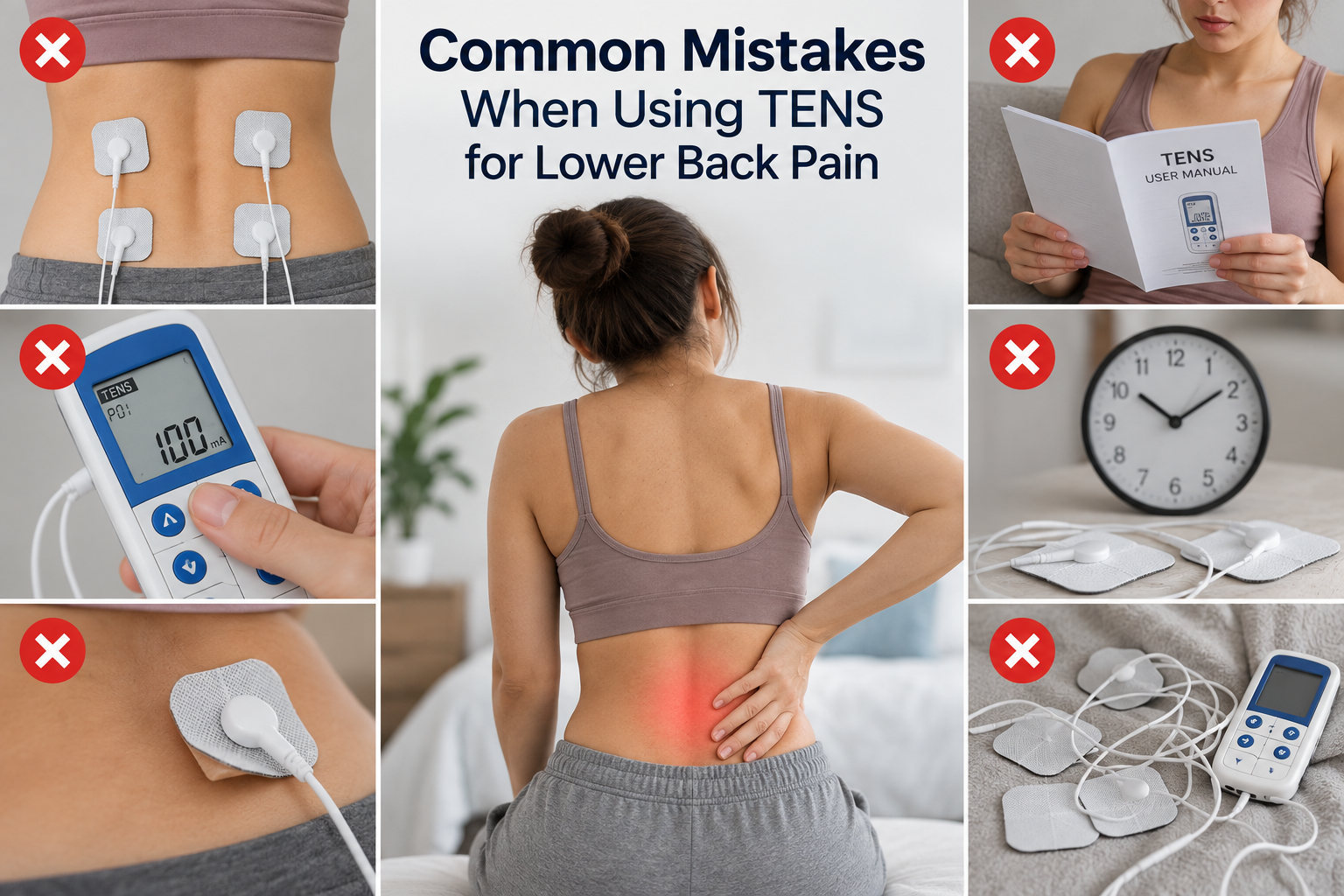
Common Mistakes When Using TENS for Lower Back Pain
If you are using a TENS machine for lower back pain, getting the basic technique right matters. Poor electrode placement, excessive intensity, worn pads, damaged leads and unrealistic expectations can all make your experience less comfortable or less useful.
TENS, or transcutaneous electrical nerve stimulation, delivers mild electrical impulses through adhesive electrode pads placed on the skin. The NHS describes TENS as a treatment that can provide temporary pain relief, although it does not work for everyone.
There is also an important limitation to understand before relying on lower back pain TENS therapy. NICE recommends that TENS should not be offered for managing low back pain, with or without sciatica, because the evidence is insufficient to support a clinical benefit.
That means TENS should not be viewed as a cure for lower back pain or a replacement for appropriate medical assessment. If you choose to use a TENS machine, the priority should be safe application, comfortable stimulation and sensible expectations.
This guide covers the most common TENS mistakes for lower back pain, including incorrect pad placement, turning the intensity up too far, continuing to use worn electrodes and failing to seek advice when symptoms need professional assessment.
Mistake 1: Placing the Electrode Pads Incorrectly
One of the most important parts of using a TENS machine is positioning the electrodes correctly.
For lower back use, a general approach is to place the pads on or around the painful area while following the placement instructions supplied with your machine. RNOH guidance advises positioning pads either side of the painful area and keeping them at least 2.5 cm (1 inch) apart.
However, lower back pain is not identical for everyone, so there is no single placement pattern that should automatically be used by every person.
Common placement problems include:
- Putting pads too close together.
- Allowing the pads to touch.
- Applying electrodes to irritated or broken skin.
- Placing pads over numb areas.
- Positioning electrodes in an unsafe area.
- Moving the pads to an unfamiliar location simply because the original position feels weak.
- Applying pads before switching the machine off.
The NHS advises switching the machine off before applying or removing electrodes.
For more detailed guidance, see our article on Best TENS Pad Placement for Lower Back Pain.
Suggested Diagram: Correct vs Incorrect Pad Placement
A useful visual for this section could show a simple back view with:
- A shaded lower-back area representing the general painful region.
- Pads positioned on either side of the area.
- A clear gap between electrodes.
- A “do not place here” indicator over unsafe areas.
- A note reminding readers to follow their individual device instructions.
The diagram should illustrate general principles rather than suggest that one exact placement is suitable for every person.
Mistake 2: Putting Pads on Damaged or Numb Skin
Another common mistake is concentrating only on where the pain is and forgetting to check the condition of the skin.
TENS electrodes should not be placed over broken, infected, irritated or numb areas. The NHS specifically advises against using TENS on these types of skin.
Numbness is particularly important because normal sensation helps you recognise when electrical stimulation feels excessively strong or uncomfortable.
Before applying your electrode pads for lower back pain, check the skin carefully.
Avoid applying pads over:
- Open wounds.
- Broken skin.
- Active infection.
- Significant irritation or inflammation.
- Areas with reduced or absent sensation.
- Varicose veins where your clinical guidance advises against placement.
If the skin becomes itchy, irritated or red during use, switch the machine off and remove the pads.
Do not simply move the electrodes a few centimetres away and continue if you are experiencing a significant skin reaction.
Mistake 3: Turning the Intensity Up Too High
More intensity does not automatically mean more pain relief.
A common beginner mistake is to assume that the strongest possible electrical sensation must be the most effective. In practice, NHS and hospital guidance recommends gradually increasing the intensity until the stimulation feels strong but comfortable rather than painful.
You should normally feel a noticeable tingling sensation.
If it becomes painful, sharply uncomfortable or feels like burning, reduce the intensity or switch the device off and reassess the electrode placement.
A useful rule is:
Noticeable + strong + comfortable = reasonable target
Painful + burning + unpleasant = stop and reassess
The numerical intensity level on your machine should not be treated as a universal standard. Level 8 on one device does not necessarily produce the same sensation as level 8 on another.
For a deeper explanation of intensity, frequency and pulse width, see our guide to Best TENS Settings for Lower Back Pain.
Mistake 4: Assuming the Highest Setting Is the Best Setting
This mistake is closely related to excessive intensity but deserves separate attention.
TENS machines may offer numerous intensity levels, which can make it tempting to keep increasing the number during a session.
However, the purpose of adjustable intensity is to allow you to find a comfortable level. It is not a competition to reach the highest setting.
RNOH guidance recommends starting low and gradually increasing the strength until the sensation feels strong but comfortable.
If you become accustomed to the sensation, you may find that a small adjustment is comfortable. That does not mean you should continually increase the intensity.
If stimulation becomes painful, reduce it.
Mistake 5: Ignoring Worn Electrode Pads
Your TENS machine can be functioning correctly while the electrode pads are no longer performing well.
Reusable pads gradually lose their adhesive properties. A worn electrode may fail to maintain consistent contact with the skin, which can make stimulation feel weak, uneven or uncomfortable.
If your machine suddenly seems less effective, check the pads before assuming the problem is the machine.
Signs that your pads may need replacing include:
- They no longer stick securely.
- The edges repeatedly lift from the skin.
- The gel surface has become visibly worn or dry.
- The stimulation feels inconsistent.
- You need to reposition the pad repeatedly.
- The machine feels weaker despite the same settings.
Do not try to compensate for poor electrode contact by continually increasing the intensity.
Good skin preparation and suitable replacement electrodes can help maintain more consistent contact.
Mistake 6: Using Incompatible Replacement Pads
Not every electrode pad works with every TENS machine.
Connector types, pin sizes, dimensions and attachment systems can differ between devices. Buying a pad because it looks similar to your existing one is not enough.
Before purchasing replacement electrode pads, check:
- Connector type.
- Pin or stud size.
- Pad dimensions.
- Whether the pads are reusable.
- Compatibility information supplied by the manufacturer.
The same principle applies to replacement leads.
If you use a wired TENS machine, a damaged or incompatible lead can also affect electrical connection and stimulation.
TensLeads offers replacement electrodes and leads in different configurations, so checking the product specifications before ordering is essential.
Mistake 7: Continuing to Use Damaged Leads
Electrode pads are not the only component that can wear.
Lead wires can become damaged through repeated bending, pulling or poor storage. A loose connection can result in intermittent or weak stimulation.
Before each session, inspect your leads and connectors.
Look for:
- Visible damage.
- Fraying.
- Loose connectors.
- Bent or damaged connection points.
- Unusual changes in stimulation.
- Connections that repeatedly disconnect.
If a lead appears damaged, do not continue using it simply because the TENS machine itself switches on.
Replace the damaged component with a compatible one according to the manufacturer’s instructions.
Mistake 8: Using TENS on Unsafe Areas
Correct pad placement is about more than finding the painful area.
The NHS advises not using TENS on irritated, broken, infected or numb skin, the neck, mouth or eyes, or the chest and back at the same time. It also advises against using TENS while sleeping, bathing or showering, driving, or using tools or machinery.
RNOH additionally advises against electrode placement over the front or sides of the neck, temples, mouth or eyes, and warns against using electrodes over numb, broken, infected or inflamed skin.
Do not improvise with electrode placement simply to find a stronger sensation.
If you are unsure whether an area is suitable, check your machine’s instructions or ask a healthcare professional.
Mistake 9: Applying Pads While the Machine Is Switched On
This is an easy mistake to avoid.
Always switch the machine off before attaching or removing electrode pads.
Cambridge University Hospitals specifically advises ensuring the machine is switched off before applying or removing electrodes.
A simple routine can help:
Machine OFF → apply pads → connect leads if required → switch ON → increase intensity gradually
At the end:
Reduce intensity → switch OFF → remove pads
Following the same sequence each time can reduce avoidable errors.
Mistake 10: Expecting TENS to Cure Lower Back Pain
This may be the most important mistake from an expectations perspective.
TENS should not be presented as a treatment that repairs the underlying cause of lower back pain.
RNOH describes TENS as providing short-term relief while the machine is on and explicitly states that it is not a cure.
The NHS similarly describes TENS as providing temporary pain relief.
More importantly, NICE recommends not offering TENS for managing low back pain, with or without sciatica. Its evidence review found insufficient evidence of clinical benefit.
Therefore, buying a more expensive machine, increasing the intensity or trying increasingly complicated programmes should not be treated as a way of overcoming the limitations of the evidence.
If TENS provides some temporary relief for you, that is different from saying that it treats the underlying cause.
Mistake 11: Thinking More Programmes Mean Better Results
Modern TENS machines can include several preset programmes and adjustable controls.
It is easy to assume that a device with more programmes must provide better lower back pain pain relief.
That conclusion does not follow.
Programmes may simply vary characteristics such as frequency, pulse width or stimulation pattern. Different settings can feel different, but there is no universally established TENS programme that should be presented as the best treatment for lower back pain.
If your machine has several modes, start with the manufacturer’s recommended approach and choose a setting that feels comfortable.
You do not need to use every programme simply because your device offers them.
Mistake 12: Using the Machine for Too Long Without Checking Your Skin
TENS usage recommendations vary between devices and clinical settings.
Cambridge University Hospitals advises starting with shorter periods of around 30–60 minutes and increasing use if helpful, while its guidance notes that some people may use TENS for much of the day.
Other NHS guidance may give different recommendations. This is why your machine’s instructions and professional advice should take priority over a generic online time limit.
Regardless of duration, check your skin regularly.
RNOH warns that TENS can cause burns or skin damage if the current is too high, electrodes are incorrectly positioned or too close together, or the device is used for prolonged periods without appropriate breaks.
Never sleep with TENS switched on.
Mistake 13: Using TENS While Driving
A portable TENS machine can be convenient, but portability does not mean it is safe to use in every situation.
The NHS advises not using TENS while driving or using tools or machinery.
Even if you are comfortable with the sensation, adjusting controls or dealing with unexpected stimulation could distract you.
Use TENS only in situations where you can operate the device safely and pay attention to how your body and skin respond.
Mistake 14: Assuming TENS Is Suitable for Everyone
TENS is not appropriate for everyone.
The NHS advises against using TENS if you have epilepsy or a pacemaker and says pregnancy should be discussed with a doctor or midwife before use.
RNOH also advises seeking medical advice before use if you have a pacemaker or another electrical or metal implant, are pregnant, have epilepsy or a heart problem, or have areas of numbness or sensory change.
Leeds Teaching Hospitals similarly advises against TENS in people with a pacemaker, epilepsy, implanted defibrillator or implanted metallic/electronic device and advises caution where there is no feeling in the painful area.
If any of these circumstances apply to you, do not rely on a general online guide. Ask a suitable healthcare professional whether TENS is appropriate.
Mistake 15: Ignoring New, Persistent or Worsening Back Pain
One of the biggest risks is treating every episode of lower back pain as something that can simply be managed at home.
If you do not know what is causing your pain, the NHS advises seeking advice from a healthcare professional before using TENS.
Leeds Teaching Hospitals also advises against using TENS for a new pain that has not been discussed with a doctor.
TENS should therefore not become a reason to delay appropriate assessment.
Speak to a healthcare professional if your symptoms are persistent, worsening, unusually severe or affecting your normal activities, or if you are uncertain about the cause.
Mistake 16: Treating TENS as a Replacement for Appropriate Care
Even if someone finds TENS comfortable, it should not automatically replace other approaches recommended for their individual circumstances.
For low back pain specifically, NICE provides management recommendations that include appropriate assessment and non-invasive approaches rather than recommending TENS.
If a GP, physiotherapist or other qualified professional has recommended a particular approach for your back pain, follow that advice.
TENS, where used, should be considered within the wider context of managing your symptoms rather than as the sole answer.
Common TENS Mistakes: Quick Comparison
| Mistake | What can happen | Better approach |
| Pads too close together | Uncomfortable or inconsistent stimulation | Keep appropriate separation |
| Pads on damaged skin | Increased irritation or skin problems | Use clean, intact skin |
| Intensity too high | Painful or unpleasant sensation | Increase gradually |
| Worn electrodes | Poor skin contact and weaker stimulation | Replace when necessary |
| Damaged leads | Intermittent or unreliable stimulation | Inspect and replace damaged leads |
| Unsafe pad placement | Increased safety risk | Follow device guidance |
| Expecting a cure | Unrealistic expectations | Think of TENS as temporary symptom management |
| Too many programme changes | Difficult to know what feels comfortable | Change settings gradually |
| Excessive duration | Greater opportunity for skin irritation | Follow device guidance and monitor skin |
| Using while driving | Distraction and safety risk | Use only when stationary and safe |
| Ignoring new symptoms | Possible delay in appropriate assessment | Seek professional advice when needed |
A Pre-Session TENS Checklist for Lower Back Pain
Before switching your machine on, run through this quick checklist:
- Skin: Is the skin clean, dry and intact?
- Pads: Are the electrodes still in good condition?
- Placement: Are they positioned according to your device instructions?
- Spacing: Are the electrodes separated appropriately?
- Leads: Are the wires and connectors undamaged?
- Machine: Is the device functioning normally?
- Intensity: Have you started low?
- Sensation: Is the stimulation strong but comfortable?
- Environment: Are you somewhere safe and stationary?
- Suitability: Is there any medical reason you have been advised not to use TENS?
- Symptoms: Is this an established problem that you have appropriately assessed?
If everything looks appropriate, you can follow the operating instructions supplied with your machine.
What to Do If Your TENS Machine Feels Weak
A weak sensation does not automatically mean that you should increase the intensity.
First check the basics.
Check the electrode pads: Worn adhesive surfaces may not make good contact.
Check the skin: Clean, dry skin generally provides better contact than skin covered with creams or oils.
Check the leads: Make sure connections are secure and there is no visible damage.
Check the battery: A low battery can affect device operation depending on the machine.
Check the programme: Different programmes can produce different sensations.
Check placement: If the pads have moved, the stimulation may feel different.
The TensLeads guide Why Does a TENS Machine Feel Weak? Causes, Fixes and What to Check covers these troubleshooting steps in greater detail.
Do not automatically increase intensity to compensate for a technical or electrode problem.
How Long Can TENS Be Used for Lower Back Pain?
There is no single duration that applies to every person or every machine.
Cambridge University Hospitals advises beginning with shorter periods of around 30–60 minutes and increasing use if it is helpful. RNOH provides different, more specific guidance for its patient population, which demonstrates why the instructions for your own device and clinical circumstances matter.
Always follow your manufacturer’s instructions and any advice from your healthcare professional.
Never sleep with the device switched on, and do not use TENS in the bath or shower or while driving.
Does TENS Help Lower Back Pain?
TENS may provide temporary pain relief for some people, but the evidence for using it specifically for low back pain is not strong enough for NICE to recommend it.
NICE states that TENS should not be offered for managing low back pain, with or without sciatica. Its evidence review found insufficient evidence of clinical benefit to support a recommendation.
The NHS also explains that TENS does not work for everyone and describes it as providing temporary pain relief.
Consequently, if you use a tens machine for lower back pain, keep expectations realistic. Do not assume that stronger stimulation, more programmes or more expensive equipment will necessarily provide better results.
Where Should TENS Pads Go for Lower Back Pain?
For general lower-back use, electrodes are commonly positioned on or around the painful area, with pads separated appropriately. RNOH guidance recommends positioning pads either side of the painful area and keeping them at least 2.5 cm apart.
The machine should be switched off while pads are applied or removed, and electrodes should only be placed on clean, dry and intact skin.
Do not place pads on broken, infected, irritated or numb skin, or on areas such as the front or sides of the neck, mouth or eyes.
If you are unsure about placement, ask a physiotherapist, GP or other appropriate healthcare professional for guidance.
How Long Can TENS Be Used for Lower Back Pain?
Usage varies according to the device and individual circumstances. Cambridge University Hospitals recommends beginning with sessions of around 30–60 minutes and increasing use if helpful, while other clinical guidance may use different schedules.
The safest approach is to follow the instructions supplied with your machine and any advice given by your healthcare professional.
Do not sleep with TENS switched on and do not use it in water or while driving.
Key Takeaways
- Incorrect electrode placement is one of the most common TENS mistakes for lower back pain.
- Place pads only on clean, dry and intact skin.
- Keep electrodes appropriately separated and follow your machine’s placement instructions.
- Do not place TENS pads on broken, infected, irritated or numb skin.
- Never assume that maximum intensity is the best intensity.
- Start low and gradually increase stimulation to a strong but comfortable sensation.
- Worn electrode pads can cause poor contact and inconsistent stimulation.
- Damaged leads can also affect performance and should be replaced when necessary.
- More TENS programmes do not automatically mean better pain relief.
- Do not use TENS while sleeping, bathing, showering, driving or operating machinery.
- TENS is not a cure for lower back pain.
- NICE does not recommend offering TENS for managing low back pain.
- Do not use TENS to delay assessment of new, persistent or worsening symptoms.
- If you are unsure whether TENS is appropriate for you, speak with a healthcare professional.
Frequently Asked Questions
Does TENS help lower back pain?
TENS may provide temporary pain relief for some people, but it does not work for everyone. NICE recommends that TENS should not be offered for managing low back pain, with or without sciatica, because the evidence is insufficient to support a clinical benefit.
Where should TENS pads go for lower back pain?
When TENS is appropriate, pads are generally positioned on or around the painful area, often on either side of it. RNOH guidance recommends keeping pads at least 2.5 cm (1 inch) apart. Electrodes should only be applied to clean, dry and intact skin and should not be placed on numb, broken, infected or irritated areas.
How long can TENS be used for lower back pain?
There is no universal session length. Cambridge University Hospitals advises beginning with periods of around 30–60 minutes and increasing use if helpful, while the instructions for your particular device may differ. Always follow the manufacturer’s guidance and professional advice. Never sleep with TENS switched on.
Products
TENS Machines
A suitable TENS machine should provide clear controls and adjustable intensity so that stimulation can be increased gradually. Depending on your preferences, useful features may include multiple programmes, a timer, portability and single- or dual-channel operation.
When choosing a device, focus on practical functionality and compatibility rather than assuming a larger number of programmes means better results for lower back pain.
Replacement Electrode Pads
Electrode pads are an important part of any TENS setup. As reusable pads become worn, they may lose adhesion and provide less consistent skin contact.
Choose replacement pads that match your machine’s connector type, dimensions and manufacturer’s compatibility requirements.
Explore TENS Machines; Replacement Electrode Pads
Explore the TensLeads range of TENS Machines and Replacement Electrode Pads to find suitable options for your TENS setup.
Safety Disclaimer
This article is for general information only and does not constitute medical advice, diagnosis or treatment. NICE does not recommend offering TENS for managing low back pain. TENS is not suitable for everyone. If you have unexplained, new, persistent or worsening lower back pain, or if you have a pacemaker, implanted electronic device, epilepsy, pregnancy or another condition that may affect TENS use, seek appropriate professional advice before using a TENS machine. Always follow the instructions supplied with your specific device.