
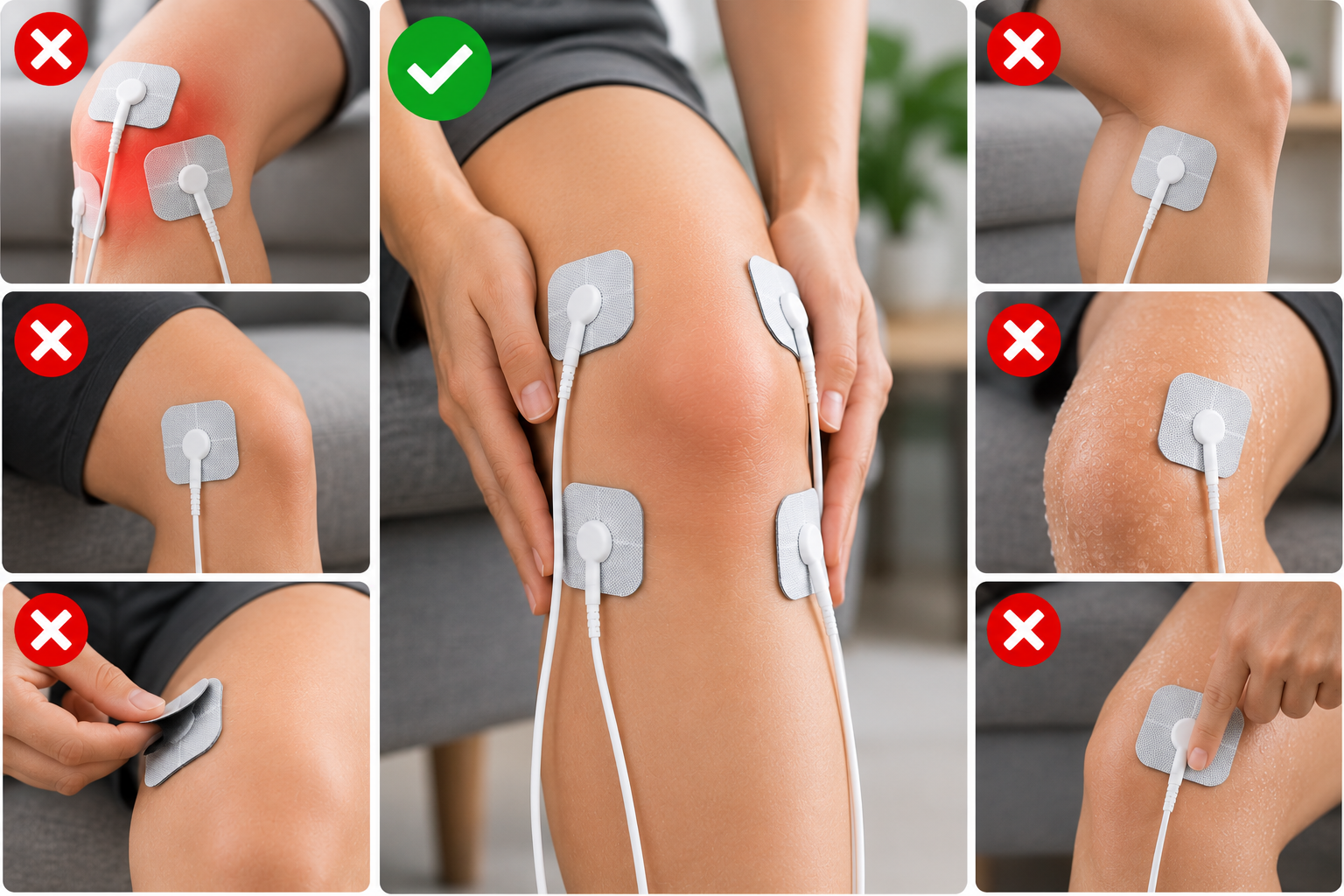
Common Mistakes When Using TENS for Knee Pain: What to Avoid
Using a TENS machine for knee pain can be straightforward, but small mistakes with electrode placement, intensity, equipment or expectations can make the experience less comfortable and may reduce the usefulness of the treatment.
The most common TENS mistakes for knee pain include putting electrode pads in unsuitable positions, turning the intensity up too quickly, continuing to use worn pads, overlooking damaged leads, using TENS for too long or expecting it to fix the underlying cause of knee pain.
TENS provides temporary pain relief for some people, but it does not work for everyone. The NHS describes TENS as a treatment that can help certain types of short- and long-term pain, while NICE does not recommend TENS as a routine treatment for osteoarthritis because the evidence for electrotherapy is insufficient.
If you choose to try TENS, the goal should be safe, comfortable and appropriate use, rather than finding the strongest possible electrical stimulation.
Quick Answer: What Are the Most Common TENS Mistakes for Knee Pain?
The main mistakes to avoid are:
- Placing electrodes too close together or in an unsuitable position.
- Applying pads to broken, irritated, infected or numb skin.
- Turning the intensity up too quickly or assuming maximum intensity is best.
- Continuing to use electrodes after they have become worn or difficult to stick.
- Ignoring damaged, loose or unreliable leads.
- Changing several settings at once without understanding what they do.
- Using TENS while sleeping, bathing, showering, driving or operating machinery.
- Expecting TENS to cure knee pain or treat its underlying cause.
- Continuing to self-manage unexplained or worsening knee pain without seeking advice.
- Ignoring skin irritation or other uncomfortable symptoms.
The NHS recommends switching the machine off before applying or removing pads, using clean skin, leaving a gap between electrodes and gradually increasing the intensity until a tingling sensation is felt. The sensation should not be painful.
Mistake 1: Putting TENS Pads in the Wrong Position
Electrode placement is one of the most important parts of knee pain TENS therapy.
TENS pads should generally be positioned on or around the painful area according to the instructions for your machine or guidance from a healthcare professional. NHS guidance provides an example of pads positioned above and below the knee, with a gap between them.
Other NHS TENS guidance recommends positioning pads either side of the painful area and keeping them separated. The exact arrangement can depend on the location of your symptoms, the size of the electrodes and the machine being used.
A common mistake is assuming that there is one perfect electrode position for every type of knee pain.
Instead, think about appropriate placement around the painful area and follow your device instructions.
Do not allow electrodes to touch each other. RNOH recommends positioning pads at least 2.5 cm apart, while other NHS guidance recommends approximately 2–3 cm or more depending on the setup.
If you are unsure where to place your pads, ask a physiotherapist or other qualified healthcare professional to demonstrate suitable positioning.
Mistake 2: Applying Pads to Irritated or Damaged Skin
TENS electrodes should be applied to clean, dry, intact skin.
Do not place them over skin that is:
- Broken
- Infected
- Inflamed or significantly irritated
- Numb
- Otherwise unsuitable according to your machine’s instructions
The NHS specifically advises against using TENS on irritated, broken, infected or numb areas of skin.
Before applying your electrode pads for knee pain, check the skin.
If you notice redness, itching or irritation after using TENS, switch the machine off and remove the electrodes. NHS guidance recommends stopping when the skin becomes itchy, irritated or red.
It can also be useful to vary the exact electrode position slightly when appropriate rather than repeatedly placing the electrodes on precisely the same patch of skin. RNOH advises avoiding applying electrodes to the exact same spot every day.
Mistake 3: Turning the Intensity Up Too Quickly
One of the biggest mistakes when using a TENS machine for knee pain is assuming that stronger automatically means better.
It does not.
The NHS recommends starting at a low intensity and gradually turning the control up until you feel a tingling sensation. The stimulation should not be painful.
RNOH similarly advises increasing the intensity gradually until the stimulation feels strong but comfortable. It warns that excessively high current, incorrect electrode positioning or prolonged use without breaks can cause burns or significant skin damage.
A useful rule is:
Start low → increase gradually → stop at strong but comfortable stimulation.
You should not deliberately turn the intensity up until it becomes painful.
If you feel burning, sharp discomfort, an unpleasant shock or an unwanted strong muscle contraction, reduce the intensity and reassess the setup.
Mistake 4: Assuming One TENS Setting Works for Everyone
Another common mistake is copying somebody else’s exact frequency, pulse width or programme and assuming that it must also be the best option for your knee.
TENS machines vary, and people can experience the same electrical stimulation differently.
NHS guidance from Leeds Teaching Hospitals gives 70 Hz, 150 microseconds and continuous mode as an example setup, but explicitly notes that users can change the settings because different settings may be more helpful.
The Kent Centre for Pain Medicine similarly notes that settings can vary depending on electrode placement and suggests that people may find changing the pulse rate useful for comfort.
That means there is no single universal answer to the question, “What are the best TENS settings for knee pain?”
If you want to understand frequency, pulse width, intensity and gradual adjustment in more detail, read our guide to Best TENS Settings for Knee Pain.
Mistake 5: Using Worn-Out Electrode Pads
Electrode pads do not last forever.
With repeated use, reusable pads can gradually lose their adhesive properties and may no longer make consistent contact with the skin.
Poor electrode contact can result in:
- Weak or inconsistent stimulation
- Uncomfortable sensations
- Difficulty getting the expected tingling
- The temptation to turn the intensity up unnecessarily
- Poor adhesion during a session
Clinical patient guidance highlights the importance of ensuring that electrodes are firmly attached. Poor contact can produce poor stimulation and unpleasant sensations.
If your TENS machine suddenly feels much weaker than usual, do not immediately assume that you need a higher intensity.
First check the electrode pads.
If they are visibly worn, no longer sticking properly or have deteriorated, replacing them may be the simplest solution.
Mistake 6: Ignoring Damaged or Loose Leads
For wired TENS machines, leads are just as important as the electrodes.
Check the leads regularly for:
- Cuts
- Cracks
- Exposed or damaged covering
- Loose connectors
- Intermittent connections
- Signs that the plug is not fitting securely
If a lead is damaged, do not continue using it simply because the machine still appears to switch on.
Great Ormond Street Hospital guidance advises checking leads and replacing a broken lead rather than continuing to use it.
If you need replacement components, make sure the lead matches your particular machine and electrode connection.
For example, TensLeads supplies different lead configurations, so connector compatibility should be checked before ordering.
Mistake 7: Changing Too Many Settings at Once
If your machine allows adjustments to frequency, pulse width, mode and intensity, it can be tempting to change everything at once.
That makes it difficult to understand what is actually affecting the sensation.
A more sensible approach is to change one variable at a time.
For example:
- Start with the manufacturer’s recommended programme.
- Find a comfortable intensity.
- If your machine allows it, adjust the frequency.
- Reassess the sensation.
- Only then consider changing another setting.
This approach is particularly useful if you are trying to work out why one programme feels more comfortable than another.
For a detailed explanation of the different controls, see Best TENS Settings for Knee Pain.
Mistake 8: Using Maximum Intensity Because the Knee Still Hurts
TENS intensity and pain severity are not the same thing.
If your knee is particularly painful, you might assume that you need to turn the machine up further.
That is not necessarily the case.
The aim of TENS is to provide a comfortable electrical stimulation. Increasing the intensity until it becomes painful does not make it a better treatment.
NHS guidance specifically says the sensation should not be painful, while RNOH recommends a strong but comfortable level.
If TENS is not providing the expected relief, consider checking:
- Electrode placement
- Electrode condition
- Lead connections
- Machine settings
- Skin contact
- Whether TENS is appropriate for your particular situation
Do not simply keep increasing the intensity.
Mistake 9: Expecting TENS to Cure Knee Pain
This is one of the most important mistakes to avoid.
TENS is a form of pain management. It is not a guaranteed cure for knee pain.
RNOH describes TENS as providing short-term relief while the machine is switched on rather than curing pain.
The NHS similarly describes TENS as providing temporary pain relief and makes clear that it does not work for everyone.
If your knee pain is caused by an underlying condition, changing the TENS settings does not necessarily address that condition.
This is particularly important for people considering TENS for osteoarthritis. NICE does not recommend TENS as a routine treatment for osteoarthritis because the evidence does not demonstrate sufficient benefit.
TENS can therefore be considered a possible pain-management option, rather than something that should be promoted as a cure.
Mistake 10: Using TENS Instead of Seeking Advice About Persistent Knee Pain
A TENS machine can make symptoms feel more manageable, but that should not become a reason to ignore persistent or unexplained knee pain.
The NHS recommends seeking medical advice when knee pain is very painful, the knee cannot be moved or weight cannot be put on it, or the knee is badly swollen or has changed shape.
You should also seek appropriate medical advice if your symptoms are persistent or interfering significantly with everyday activities.
If you do not know what is causing your knee pain, the NHS advises speaking to a healthcare professional before using TENS.
TENS should not be used simply to mask a problem indefinitely.
Mistake 11: Using TENS in the Wrong Situations
Even if the electrode placement looks correct, there are situations where TENS should not be used.
The NHS advises against TENS:
- If you have epilepsy
- If you have a pacemaker
- During pregnancy unless advised by a doctor or midwife
- On irritated, broken, infected or numb skin
- On the neck, mouth or eyes
- While sleeping
- In the bath or shower
- While driving or using tools or machinery
Leeds Teaching Hospitals also lists additional precautions, including implanted defibrillators and other implanted metallic or electronic devices.
Always check the instructions supplied with your particular machine because safety guidance can vary according to the device.
Mistake 12: Using TENS While Sleeping
It can be tempting to use TENS in bed if knee pain is interfering with your evening routine.
However, NHS guidance says not to use TENS while sleeping, and RNOH specifically warns users not to fall asleep with the machine switched on.
If you become tired while using TENS, switch the machine off and remove it rather than allowing yourself to fall asleep with the electrodes connected.
Mistake 13: Using TENS in Water
TENS machines are electrical devices and should not be used in water.
Do not use a TENS machine:
- In the bath
- In the shower
- In a swimming pool
- Where the machine or electrical components could become wet
The NHS and Cambridge University Hospitals both specifically advise against using TENS in the bath or shower.
If you need to bathe or shower, switch the machine off and remove it first.
Mistake 14: Using TENS While Driving
Even a small TENS machine can be distracting if the stimulation changes unexpectedly.
The NHS advises against using TENS while driving or operating tools and machinery.
Cambridge University Hospitals similarly advises that TENS should not be worn while driving or operating machinery.
If you are travelling by car, switch the device off before driving.
Mistake 15: Ignoring the Skin After a TENS Session
Checking your skin after removing the electrodes takes only a few seconds but can help you identify irritation early.
Look for:
- Persistent redness
- Itching
- Burning
- Soreness
- Rash
- Unusual sensitivity
If your skin becomes irritated or red, stop the session and remove the pads. NHS guidance specifically recommends this approach.
If irritation continues, speak to a healthcare professional.
Mistake 16: Assuming More TENS Use Means More Pain Relief
Another common misconception is that a longer session or more frequent use must produce better results.
There is no universal duration that applies to every person or machine.
Cambridge University Hospitals advises beginning with around 30–60 minutes and increasing the duration if helpful, while RNOH provides a more specific general recommendation of a maximum of 60 minutes at a time, usually up to three times per day. These differences show why the manufacturer’s instructions and any individual clinical advice should take priority.
For a new user, beginning with a shorter session can be a practical way to assess comfort and skin response.
How Long Can TENS Be Used for Knee Pain?
The answer depends on your machine and individual circumstances.
As a general example, Cambridge University Hospitals recommends starting with 30–60 minutes and increasing use if it is helpful. RNOH advises a maximum of 60 minutes at a time and usually up to three times per day.
Do not assume that these timings apply to every TENS machine.
Always check your manufacturer’s instructions.
Does TENS Help Knee Pain?
TENS may provide temporary pain relief for some people. The NHS says it can help certain short- and long-term pain, including pain associated with arthritis, but also makes clear that it does not work for everyone.
There is an important qualification for knee osteoarthritis. NICE’s evidence review found uncertainty around the effectiveness of electrotherapy, and its osteoarthritis guidance does not recommend TENS as a routine treatment.
Therefore, TENS should not be presented as a cure for knee pain or as a replacement for appropriate clinical care.
Where Should TENS Pads Go for Knee Pain?
Pads are generally placed on or around the painful area, with a gap between the electrodes. NHS guidance provides an example of placing pads above and below the knee.
Other clinical guidance suggests positioning electrodes either side of the painful area, while emphasising that placement should be demonstrated by a healthcare professional when necessary.
Do not place electrodes on broken, infected, irritated or numb skin, and never allow the pads to touch.
For a detailed guide, see Best TENS Pad Placement for Knee Pain.
How Long Can TENS Be Used for Knee Pain?
Duration varies between machines and individuals.
A 30–60 minute initial session is suggested by Cambridge University Hospitals, while RNOH recommends up to 60 minutes at a time, usually up to three times a day.
The safest approach is to follow the instructions for your machine and any advice from your healthcare professional.
TENS Mistakes for Knee Pain: Quick Checklist
Before using your TENS machine, check the following:
| Check | What to ask yourself |
| Skin | Is the skin clean, dry and intact? |
| Pads | Are the electrodes still sticky and in good condition? |
| Placement | Are the pads positioned appropriately around the painful area? |
| Spacing | Are the electrodes separated and not touching? |
| Leads | Are the wires and connectors intact and secure? |
| Intensity | Did I start low and increase gradually? |
| Sensation | Does the stimulation feel strong but comfortable? |
| Settings | Am I following the machine’s instructions? |
| Duration | Am I staying within the recommended session time? |
| Safety | Am I avoiding sleep, water, driving and machinery? |
| Symptoms | Do I need medical advice about the knee pain itself? |
What to Do If Your TENS Machine Feels Weak
A weak sensation does not automatically mean you need to increase the intensity.
First check the electrode pads.
If they are old or no longer sticking properly, replace them.
Then check the leads and connectors.
Next, check whether the skin is clean and dry and whether the pads are making good contact.
Finally, check the machine’s programme and settings.
Clinical guidance identifies worn electrodes, poor contact, damaged leads and low battery power among possible reasons for poor or absent stimulation.
If you regularly experience weak stimulation, our guide Why Does a TENS Machine Feel Weak? Causes, Fixes and What to Check provides additional troubleshooting advice.
How to Get More From Your TENS Machine Without Overdoing It
Good TENS use is less about chasing the strongest possible sensation and more about creating a consistent, comfortable setup.
A sensible routine is:
Prepare the skin: Keep the area clean and dry.
Check the equipment: Inspect the pads, leads and connectors.
Position the electrodes: Place them appropriately around the painful area.
Start low: Begin the intensity at a low level.
Increase gradually: Turn the intensity up until the tingling is strong but comfortable.
Monitor your skin: Remove the pads and check for irritation afterwards.
Record what works: If your machine has adjustable settings, note which programme and settings you find comfortable.
Review your symptoms: If the knee pain persists, worsens or remains unexplained, seek appropriate medical advice.
This approach is much more useful than simply turning a machine to its highest setting.
Choosing Better Electrode Pads for Knee Pain
If worn or poorly adhering electrodes are causing problems, replacing the pads may improve the experience.
When choosing electrode pads for knee pain, check:
- Compatibility with your TENS machine
- Connection type
- Pad size
- Shape
- Adhesive quality
- Reusability
- Replacement cost
TensLeads offers a range of reusable electrode pads in different sizes and connection types, so check the product specifications carefully before ordering.
The correct pad is not necessarily the largest one. What matters is whether it is compatible with your machine and suitable for the placement recommended for your setup.
TENS Machines
If your current device lacks useful controls or is difficult to use, it may be worth comparing alternative TENS Machines.
Look for practical features such as adjustable intensity, clear controls, suitable programmes, appropriate channels and readily available replacement electrodes.
You can compare the current TensLeads TENS Machines to find a model that suits your preferred setup.
Replacement Electrode Pads
If the machine itself is working correctly but the pads are worn, you may not need to replace the entire TENS system.
TensLeads offers Replacement Electrode Pads in a variety of sizes and connection types. Always check compatibility with your machine before ordering.
Good pad maintenance can also help extend their useful life. Store reusable electrodes according to the manufacturer’s instructions and return them to their protective sheet after use.
Explore TENS Machines; Replacement Electrode Pads
If you are replacing worn equipment or looking for a more suitable setup, Explore TENS Machines; Replacement Electrode Pads at TensLeads.
Key Takeaways
Poor electrode placement is one of the most common TENS mistakes for knee pain. Position pads around the painful area according to your machine’s instructions or professional guidance, and keep them separated.
Do not turn the intensity straight to maximum. Start low and gradually increase until the stimulation is strong but comfortable. It should not be painful.
Check your electrode pads regularly. Worn or poorly adhering pads can cause weak or inconsistent stimulation.
Do not ignore damaged leads. Replace damaged components rather than continuing to use unreliable wiring.
There is no single perfect TENS setting for every knee. Frequency, pulse width, mode and intensity can vary between machines and individuals.
Do not use TENS on unsuitable skin. Avoid broken, irritated, infected or numb areas.
Do not use TENS while sleeping, bathing, showering, driving or operating machinery.
Do not expect TENS to cure knee pain. It may provide temporary pain relief for some people, but it does not necessarily address the underlying cause.
Do not rely on TENS instead of seeking advice for persistent or unexplained symptoms. The NHS recommends professional advice when you are unsure what is causing your pain.
For osteoarthritis, keep expectations realistic. NICE does not recommend TENS as a routine treatment for osteoarthritis.
Safety Disclaimer
This article provides general information about using TENS for knee pain and is not personalised medical advice or a diagnosis. TENS does not work for everyone and may not be suitable for people with certain medical conditions or implanted devices. The NHS advises against TENS if you have epilepsy or a pacemaker and recommends that pregnant people use it only if advised by a doctor or midwife. Do not use TENS on broken, irritated, infected or numb skin, or while sleeping, bathing, showering, driving or operating machinery.
If your knee pain is new, unexplained, persistent or worsening, or you have significant swelling, difficulty moving the knee or difficulty bearing weight, seek appropriate medical advice rather than relying solely on TENS. Always follow the instructions supplied with your particular TENS machine.