
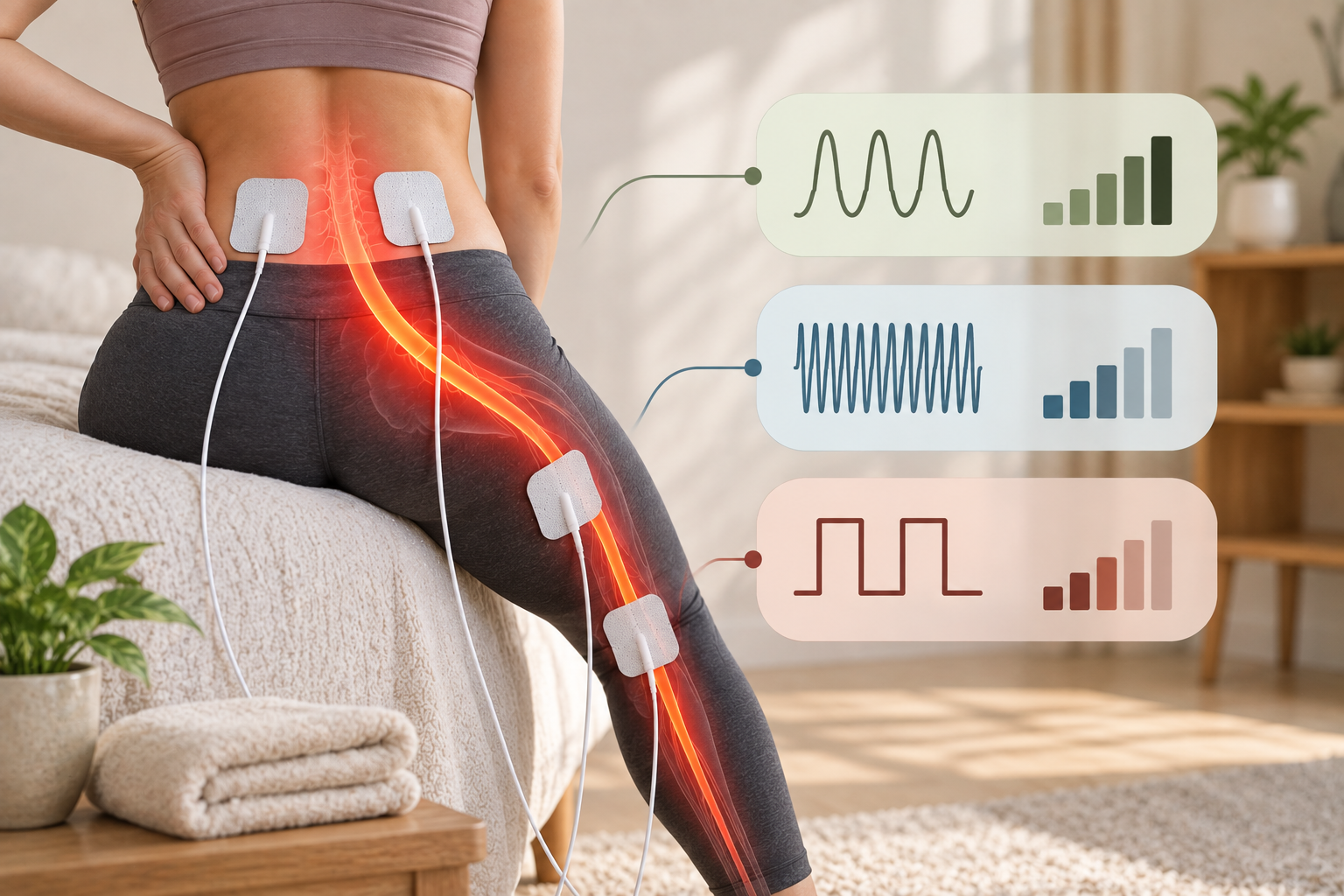
Best TENS Settings for Sciatica
If you’re looking for the best TENS settings for sciatica, there is no single combination of frequency, pulse width and intensity that works for everyone. TENS (Transcutaneous Electrical Nerve Stimulation) settings should be adjusted according to the device instructions, the type of stimulation you find comfortable and how your symptoms respond.
TENS may provide temporary pain relief for some people, but it does not treat the underlying cause of sciatica. NICE currently recommends not offering TENS for managing low back pain with or without sciatica because there is insufficient evidence of clinical benefit. Therefore, TENS should be approached as an optional pain-management method rather than a proven treatment or cure.
This guide explains the main TENS settings, including frequency, pulse width and intensity, and how to adjust them safely when using a TENS machine for sciatic-type pain.
What You Need to Know
TENS machines commonly allow you to adjust settings such as frequency, pulse width and intensity. These controls determine how frequently the electrical impulses are delivered, how long each pulse lasts and how strong the stimulation feels.
When using TENS for sciatica, the aim should not be to find the strongest possible stimulation. Instead, begin conservatively and adjust the settings gradually while keeping the sensation comfortable.
The NHS explains that TENS can provide temporary pain relief for some people, although it does not work for everyone. It also recommends following the instructions supplied with your particular machine. (NHS)
What Are TENS Settings?
Before changing the controls on your TENS machine, it helps to understand what each setting does.
Frequency
Frequency refers to how many electrical pulses are delivered per second. It is usually measured in hertz (Hz).
A higher frequency means that pulses are delivered more frequently, while a lower frequency produces fewer pulses per second.
Pulse Width
Pulse width refers to the duration of each individual electrical pulse. It is usually measured in microseconds (µs).
Changing pulse width can alter how the stimulation feels and how strongly the nerves respond to the electrical impulses.
Intensity
Intensity controls the strength of the electrical stimulation. This is usually the setting you will notice most immediately because increasing it makes the tingling sensation stronger.
The intensity should remain comfortable. TENS should generally feel like a noticeable tingling sensation rather than painful electrical shocks.
Mode or Programme
Many modern TENS machines include pre-set programmes that automatically combine different frequency, pulse width and timing patterns.
If your machine includes pre-set programmes, you may find these easier to use than manually selecting every setting. Always follow the manufacturer’s instructions for the specific programme.
What Are the Best TENS Settings for Sciatica?
There is no universally correct set of TENS settings for sciatica. Although different TENS programmes may use different combinations of frequency and pulse width, research has not established one specific setting as the best option for everyone with sciatic-type pain.
This is particularly important because NICE does not currently recommend TENS for low back pain with or without sciatica due to insufficient evidence of clinical benefit. (NICE)
If you choose to use a TENS machine, a sensible approach is to start with the programme or settings recommended by the manufacturer and make gradual adjustments based on comfort.
Avoid treating numbers on the machine as a prescription. A setting that feels comfortable for one person may feel unpleasant or ineffective for another.
A Simple TENS Settings Checklist
When adjusting your TENS machine for sciatica, keep the following principles in mind:
- Start with the manufacturer’s recommended programme or settings.
- Begin at a low intensity.
- Increase the intensity gradually rather than suddenly.
- Aim for a noticeable but comfortable tingling sensation.
- Do not increase intensity simply because you think stronger stimulation will work better.
- Adjust one setting at a time where possible so you can understand how the change affects the sensation.
- Stop if stimulation becomes painful or causes significant discomfort.
- Follow the instructions supplied with your particular device.
How Should Frequency Be Set for Sciatica?
Frequency is one of the main settings found on TENS machines. Different frequencies produce different sensations, and machines may provide low-frequency, high-frequency or combination programmes.
Higher-frequency stimulation is often experienced as a continuous tingling sensation. Lower-frequency stimulation may feel more like individual pulses or tapping sensations.
Rather than assuming that either high or low frequency is automatically better for sciatica, start with a programme recommended by your device manufacturer. If your machine allows manual adjustment, make changes gradually and pay attention to comfort.
There is not enough evidence to state that one specific frequency is universally the most effective for sciatica.
How Should Pulse Width Be Set?
Pulse width determines how long each electrical pulse lasts. Along with frequency, it influences how the stimulation feels.
A longer pulse width can produce a stronger or deeper sensation at the same intensity, while a shorter pulse width may feel gentler.
Because TENS machines differ in their available ranges, it is best to stay within the manufacturer’s recommended settings rather than attempting to reproduce a specific combination from another device.
The most appropriate setting is not necessarily the one that produces the strongest sensation. Comfort and safe operation should remain the priority.
How Should Intensity Be Adjusted?
Intensity is often the easiest setting to understand because it directly changes the strength of the electrical stimulation.
When beginning a session, start at a low intensity and gradually increase it until you feel a clear but comfortable tingling sensation.
Comfortable Tingling
The stimulation should normally feel noticeable but comfortable. You should not need to tolerate pain in order to use TENS.
Avoid Excessive Intensity
Increasing the intensity as far as possible does not automatically mean that TENS will provide greater pain relief. If the stimulation becomes painful, uncomfortable or causes muscle contractions that you do not want, reduce the intensity.
Adjust Gradually
Small adjustments make it easier to identify a comfortable level. If your machine has separate controls for different channels, adjust each channel carefully rather than increasing everything at once.
Should You Use Continuous or Burst Modes?
Some TENS machines offer continuous, burst or modulation modes. These programmes alter the pattern in which electrical pulses are delivered.
A continuous programme generally delivers pulses at a consistent frequency, while burst or modulation programmes change the pattern of stimulation.
There is no single mode that can be recommended as the best option for everyone with sciatica. If your device includes pre-set programmes, follow the manufacturer’s guidance and choose a programme that produces a comfortable sensation.
If you are experimenting with different modes, change one programme at a time rather than repeatedly changing several settings during the same session.
TENS Settings for Sciatica: What Should You Feel?
Your physical sensation can be a useful guide when adjusting intensity.
A suitable TENS sensation is generally a comfortable tingling. It should be noticeable without becoming painful.
You may notice that the sensation changes slightly during a session. This can happen because your body becomes accustomed to the stimulation or because the electrode contact changes.
If the sensation becomes uncomfortable, reduce the intensity or stop the treatment.
If you develop persistent redness, itching or irritation underneath the electrode pads, stop using the machine. The NHS advises removing the pads if they cause skin irritation. (NHS)
Where Should TENS Pads Go for Sciatica?
Settings are only one part of using a TENS machine. Electrode placement can also affect how the stimulation feels.
If you’re asking “where should TENS pads go for sciatica?”, the general principle is to place them on clean, intact skin around the painful area while following the instructions supplied with your machine.
Depending on where your symptoms are experienced, this may involve areas around the lower back, buttock or affected leg.
Do not place pads on broken, irritated, infected or numb skin. The NHS also advises avoiding areas including the front or sides of the neck, the mouth and eyes. (NHS)
For more detailed guidance, see our guide to TENS Pad Placement for Sciatica.
How Long Can TENS Be Used for Sciatica?
Another common question is “how long can TENS be used for sciatica?” There is no single session duration that is suitable for everyone.
Different machines may recommend different treatment times, so the manufacturer’s instructions should be followed. Some devices may recommend sessions lasting around 20 to 30 minutes, while other treatment protocols may differ.
Do not assume that longer sessions will provide better results. Stop treatment if you experience pain, significant discomfort or skin irritation.
The NHS also advises against using TENS while sleeping, driving, operating machinery or while in the bath or shower. (NHS)
TENS Settings for Sciatica: A Practical Comparison
| Setting | What it controls | How to approach it |
| Frequency | Number of pulses delivered per second | Follow the device programme or manufacturer’s guidance |
| Pulse width | Duration of each electrical pulse | Adjust only within the range recommended for your device |
| Intensity | Strength of the stimulation | Increase gradually to a comfortable tingling |
| Programme | Combination of stimulation parameters | Start with an appropriate pre-set programme where available |
| Session duration | How long the treatment runs | Follow the manufacturer’s recommended duration |
How to Adjust TENS Settings Step by Step
Step 1: Check Your Machine
Read the manufacturer’s instructions before changing any settings. Make sure you understand which controls adjust frequency, pulse width, intensity and programme selection.
Step 2: Position the Electrode Pads
Apply the electrode pads to clean, dry and intact skin according to the instructions. For sciatica, this may mean placing pads around the lower back, buttock or affected leg depending on where symptoms are experienced.
Step 3: Select a Programme
If your TENS machine includes pre-set programmes, begin with the programme recommended for pain management rather than immediately attempting to create a custom combination.
Step 4: Start at a Low Intensity
Switch the machine on and gradually increase the intensity until you notice a comfortable tingling sensation.
Step 5: Give Yourself Time to Assess the Sensation
Allow yourself time to determine whether the stimulation feels comfortable. Avoid repeatedly changing several settings at once.
Step 6: Make Small Adjustments
If your machine allows manual adjustments, change one parameter at a time and remain within the manufacturer’s recommended range.
Step 7: Stop if Treatment Becomes Uncomfortable
TENS should not be painful. If you experience pain, significant discomfort or skin irritation, switch the device off and remove the electrode pads.
Common Mistakes When Choosing TENS Settings
Using the Highest Intensity
One of the most common mistakes is assuming that maximum intensity will produce maximum pain relief. TENS should be comfortable, and stronger stimulation is not automatically better.
Copying Someone Else’s Settings
TENS machines and individual responses vary. A setting that someone else finds comfortable may feel completely different on another person or device.
Changing Too Many Settings at Once
If you alter frequency, pulse width, intensity and programme simultaneously, it becomes difficult to understand which change affected the sensation.
Ignoring the Manufacturer’s Instructions
Different machines have different controls and recommended settings. Always use the instructions supplied with your particular device as the starting point.
Using TENS Instead of Seeking Assessment
TENS should not be used to delay medical assessment when symptoms are persistent, worsening or associated with concerning neurological symptoms.
Does TENS Help Sciatica?
TENS may provide temporary pain relief for some people, but the evidence specifically for sciatica is limited. NICE currently recommends not offering TENS for low back pain with or without sciatica because there is insufficient evidence of clinical benefit. (NICE)
This means there is no evidence-based TENS setting that can be presented as a guaranteed solution for sciatica. If you choose to try a TENS machine, use it as an optional symptom-management approach and maintain realistic expectations.
When Should You Speak to a Healthcare Professional?
Speak with a GP, physiotherapist or another qualified healthcare professional if you’re unsure whether your symptoms are caused by sciatica or whether TENS is appropriate for you.
You should also seek medical advice if pain persists, becomes worse or significantly affects your normal activities.
Some symptoms require urgent assessment rather than home treatment.
Red-Flag Symptoms
Seek urgent medical attention if you develop new bladder or bowel problems, significant or worsening weakness, or numbness around the genital or anal area.
These symptoms can indicate a more serious neurological problem and should not be managed solely with a TENS machine.
Who Should Avoid Using a TENS Machine?
TENS is not suitable for everyone. The NHS advises people with epilepsy or a pacemaker not to use TENS and recommends that pregnant people speak with their doctor or midwife before using it. (NHS)
You should also avoid applying electrode pads to broken, irritated, infected or numb skin.
If you have an implanted electrical device or are uncertain about whether TENS is appropriate for you, seek professional advice before use.
Frequently Asked Questions
What are the best TENS settings for sciatica?
There is no single TENS setting that can be recommended as the best for everyone with sciatica. Frequency, pulse width and intensity can all affect how stimulation feels, and individual responses vary. Start with the manufacturer’s recommended programme or settings and adjust gradually within the device’s recommended range.
Does TENS help sciatica?
TENS may provide temporary pain relief for some people, but evidence specifically for sciatica is limited. NICE currently recommends not offering TENS for low back pain with or without sciatica because evidence of clinical benefit is insufficient. (NICE)
Where should TENS pads go for sciatica?
Pads are generally placed on clean, intact skin around the painful area, following the instructions for your particular machine. Depending on where symptoms are felt, this may include areas around the lower back, buttock or affected leg. Avoid broken, irritated, infected or numb skin and unsafe areas such as the front or sides of the neck, eyes and mouth. (NHS)
How long can TENS be used for sciatica?
There is no universally recommended session length specifically for sciatica. Follow your machine’s instructions and any advice provided by a healthcare professional. Do not use TENS while sleeping, driving, operating machinery or in the bath or shower. (NHS)
Should TENS feel strong for sciatica?
TENS should normally feel like a noticeable but comfortable tingling sensation. It should not be painful. Increasing the intensity as much as possible does not necessarily produce better results.
Can I change TENS settings during a session?
Some machines allow settings to be changed during treatment, but follow the instructions supplied with your device. If you adjust settings, make small changes and avoid increasing the intensity to an uncomfortable level.
Can I use TENS every day for sciatica?
The appropriate frequency depends on the device instructions and your individual circumstances. There is no universal daily schedule for sciatica. Follow the manufacturer’s guidance and speak with a healthcare professional if you are relying on TENS regularly to manage ongoing symptoms.
Key Takeaways
There is no single “best” TENS setting for sciatica. Frequency, pulse width, intensity and programme selection all influence how stimulation feels, while individual responses can vary.
If you choose to try TENS for sciatica, begin with your machine’s recommended programme or settings and adjust gradually. The intensity should produce a comfortable tingling sensation rather than pain.
Correct electrode placement is equally important. Place pads on clean, intact skin around the painful area and follow your device’s specific instructions. Avoid unsafe areas such as the front or sides of the neck, eyes, mouth, damaged skin and areas with reduced sensation.
Most importantly, keep expectations realistic. TENS may provide temporary pain relief for some people, but NICE does not currently recommend TENS for low back pain with or without sciatica because the evidence of benefit is insufficient. (NICE)
Explore TENS Machines and Replacement Electrode Pads
Looking for a TENS machine to support your pain-management routine?
Explore our range of TENS Machines, designed to provide convenient options for home use. You can also find Replacement Electrode Pads for compatible TENS devices when your existing pads become worn or lose their adhesive properties.
Explore TENS Machines; Replacement Electrode Pads and find the equipment that suits your needs.
Safety Disclaimer
This article is intended for general informational purposes only and should not be considered medical advice. TENS may not be suitable for everyone, and results can vary between individuals. Always read the manufacturer’s instructions before using a TENS machine and speak with a qualified healthcare professional if you are unsure whether TENS is appropriate for you, particularly if you have an implanted electrical device, epilepsy, are pregnant, have reduced sensation, or have unexplained or worsening symptoms.
If you develop new bladder or bowel problems, significant weakness, or numbness around the genital or anal area, seek urgent medical attention rather than relying on TENS.