
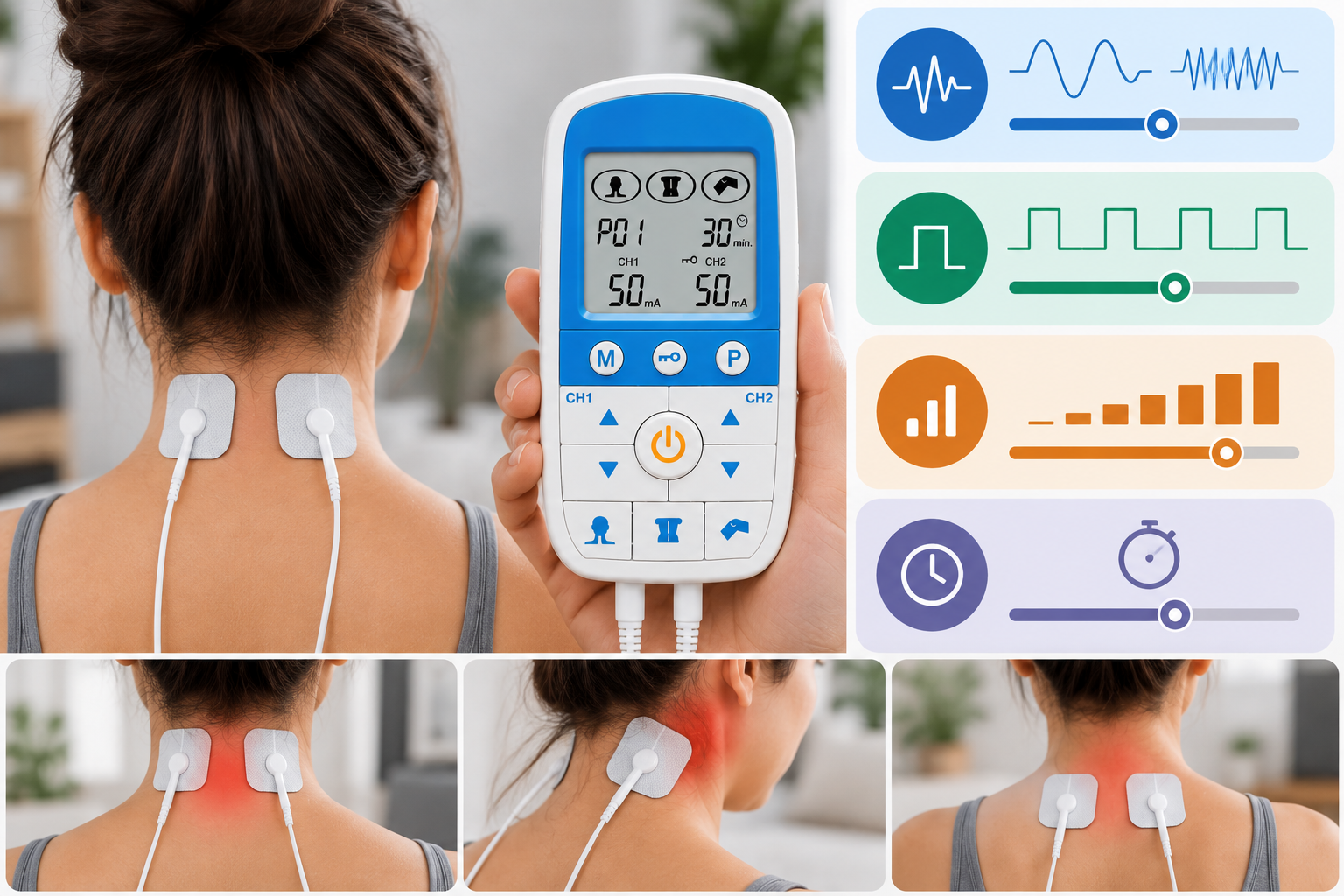
Best TENS Settings for Neck Pain: Frequency, Pulse Width, Intensity and Safe Adjustment
If you are searching for the best TENS settings for neck pain, there is no single combination of frequency, pulse width and intensity that is guaranteed to work for everyone. TENS settings are highly individual, and the most appropriate combination depends on the machine, electrode position, sensation and the person using it.
There is an important safety point before discussing settings: standard TENS should not be applied directly to the neck. NHS guidance advises against using TENS on the neck, while Cambridge University Hospitals specifically advises that electrodes should not be placed on the front of the neck.
Therefore, this guide is about understanding tens settings for neck pain and adjusting a TENS machine safely when TENS has been recommended for your symptoms. It is not a prescription for placing electrodes on the cervical area.
Quick Answer: What Are the Best TENS Settings for Neck Pain?
There is no universally correct TENS setting for neck pain.
For general TENS use, frequency controls how often electrical pulses are delivered, pulse width controls the duration of each pulse, and intensity controls how strong the stimulation feels. NHS patient guidance explains that changing frequency and pulse width changes the sensation, while intensity determines how strong the stimulation feels.
A sensible approach is to:
- Start with the settings recommended by your healthcare professional or the machine manufacturer.
- Begin intensity at a low level.
- Increase intensity gradually.
- Aim for a noticeable, strong but comfortable tingling rather than pain.
- Experiment with frequency or pulse width only within the range supported by your machine.
- Stop if stimulation becomes painful, causes an unpleasant reaction or irritates the skin.
- Never use standard TENS electrodes directly on the front or sides of the neck.
Some NHS TENS services give example starting ranges, but these vary considerably. For example, Great Ormond Street Hospital describes a first-use range of 70–120 Hz and 70–120 microseconds for its patient population, while Leeds Teaching Hospitals gives an example of 70 Hz and 150 μs. These examples demonstrate why a setting should not automatically be treated as a universal prescription.
What Do the Different TENS Settings Mean?
Understanding the controls makes it much easier to adjust a tens machine for neck pain responsibly.
Frequency
Frequency, sometimes called pulse rate, is the number of electrical pulses delivered each second. It is measured in Hertz (Hz).
A lower frequency can produce a slower, more noticeable pulsing or beating sensation, while a higher frequency can feel more like a faster or smoother tingling. An NHS patient guide describes adjustable pulse rates from 2–150 Hz and explains that lower rates can feel more like a beating sensation, whereas higher rates can feel smoother and more continuous.
There is no evidence-based reason to assume that the highest frequency is automatically the most effective for neck-related pain.
Pulse Width
Pulse width refers to how long each electrical pulse lasts. It is usually measured in microseconds (μs).
Changing pulse width changes how the stimulation feels. An NHS TENS guide explains that wider pulse widths can produce a sensation of deeper stimulation.
Again, more is not necessarily better. The goal is to find a setting that produces a useful and comfortable sensation.
Intensity
Intensity is the strength of the electrical stimulation.
Unlike frequency and pulse width, intensity is usually the setting you adjust most directly according to how the stimulation feels. NHS guidance recommends slowly increasing the intensity until you feel tingling, while Cambridge University Hospitals advises that the sensation should be strong but comfortable.
The intensity should not be turned up simply to make the treatment feel stronger. Painful stimulation is not the goal.
Mode
Some TENS machines provide continuous, burst or modulation modes. These alter the pattern in which stimulation is delivered.
Different people may prefer different modes. Great Ormond Street Hospital notes that pulse width, rate and mode may be changed when a person becomes accustomed to the initial settings or prefers another sensation.
If your machine has several modes, start with the manufacturer’s recommended programme rather than assuming one mode is best for neck pain.
Why There Is No Single “Best” TENS Setting
You may see articles recommending a specific combination such as 80 Hz and 200 μs or 70 Hz and 150 μs. These figures can be useful examples, but they should not be interpreted as a universal treatment protocol.
NHS clinical resources demonstrate considerable variation in suggested settings. One NHS source describes conventional TENS settings around 80–90 Hz with a 200 μs pulse width, another gives 70 Hz and 150 μs, and Cambridge University Hospitals emphasises finding the most comfortable and relaxing dial settings for the individual.
That variation is important.
The “best” setting is the one that is appropriate for your device and circumstances and produces a comfortable sensation without unsafe electrode placement.
Your response can also change depending on electrode position, skin condition, pad quality and how accustomed you become to the stimulation.
A Practical Way to Adjust TENS Settings
If you have been advised that TENS is appropriate for you, use a gradual approach.
Start with the machine switched off
NHS guidance recommends switching the TENS machine off before applying or removing electrode pads.
Use the recommended programme
If your physiotherapist or healthcare professional has given you specific frequency, pulse width or mode settings, start there.
If you have not been given individual settings, follow the manufacturer’s instructions rather than copying a setting from another machine.
Start intensity low
Once the pads are correctly positioned in an approved location, turn the machine on and gradually increase the intensity.
Look for a strong but comfortable sensation
The intended sensation is generally a tingling or buzzing feeling. Cambridge University Hospitals advises using the most comfortable and relaxing settings, while other NHS guidance describes increasing intensity until stimulation is strong but comfortable.
Adjust one setting at a time
If your machine allows frequency and pulse-width adjustments, changing one control at a time makes it easier to understand how the sensation changes.
Do not chase pain relief by continuously increasing intensity
If the sensation becomes painful, reduce the intensity. If the machine causes an unpleasant sensation or skin reaction, stop using it and reassess whether TENS is appropriate.
TENS Settings for Neck Pain: Quick Comparison
| Setting | What it controls | What changing it can do | General approach |
| Frequency (Hz) | Number of pulses per second | Changes the speed/pattern of sensation | Adjust within the machine’s available range |
| Pulse width (μs) | Duration of each pulse | Changes the character and perceived depth of stimulation | Use a comfortable setting |
| Intensity | Strength of stimulation | Makes tingling weaker or stronger | Increase gradually; keep comfortable |
| Mode | Pattern of stimulation | Changes how pulses are delivered | Follow device/clinician guidance |
| Timer | Treatment duration | Controls how long stimulation runs | Follow instructions rather than assuming a universal duration |
What Frequency Should I Use for Neck Pain?
There is no single frequency that can be recommended as the best choice for every person with neck pain.
Some clinical TENS resources use frequencies in the conventional TENS range, but the examples differ between services. One NHS guide provides 70–120 Hz as a first-use range for its patients, while another NHS guide provides 70 Hz as an example starting point.
An NHS TENS service also explains that people can experiment with different pulse rates because the most comfortable setting varies, giving an example range of approximately 20–130 Hz.
This is why copying a particular frequency from an online article is less useful than understanding what the control does.
If your machine has a preset TENS programme, using the manufacturer’s recommended programme can be a reasonable starting point. If you have been given a personalised setting by a physiotherapist or pain specialist, use that instead.
What Pulse Width Should I Use?
Pulse width is measured in microseconds and determines the duration of each individual electrical pulse.
There is similarly no universal pulse width for neck pain. NHS resources provide different examples depending on the device and clinical context. For example, one NHS guide describes 70–120 μs for initial use, while another gives 150 μs as an example.
The important point is that pulse width and frequency interact with the overall sensation.
If changing the pulse width makes the stimulation uncomfortable, reduce it or return to the previous setting. Do not assume that a larger number will produce better pain relief.
How Strong Should TENS Feel?
Intensity is one area where the guidance is relatively consistent.
TENS should normally feel strong but comfortable, rather than painful.
NHS guidance recommends gradually increasing the intensity until you feel a tingling sensation. Cambridge University Hospitals similarly advises that the stimulation should be comfortable, while an NHS pain service recommends increasing the intensity gradually until it becomes strong but not uncomfortable.
If you find yourself bracing your muscles, experiencing pain or wanting to immediately remove the pads because the stimulation is too strong, reduce the intensity.
Why TENS Settings Can Feel Different from One Day to Another
It is normal for the same setting to feel different under different circumstances.
Possible factors include:
- Electrode position
- Distance between electrodes
- Skin condition
- How well the pads are sticking
- Condition of reusable electrode pads
- Individual sensitivity
- How accustomed you have become to the sensation
- The selected frequency and pulse width
An NHS TENS resource notes that settings can vary depending on where pads are positioned, while Cambridge University Hospitals explains that the sensation changes when frequency and pulse width are altered.
This is one reason a particular numerical setting should not be treated as a guarantee of pain relief.
TENS Pad Placement Matters More Than Finding a “Perfect” Setting
A technically appropriate setting cannot make an unsafe electrode position safe.
For neck-related symptoms, this is especially important.
NHS guidance says not to use TENS on the neck. Cambridge University Hospitals states that electrodes should not be placed on the front of the neck, and another NHS TENS resource warns against placing pads over the front of the neck.
If you have been advised to use TENS for symptoms associated with your neck, ask a qualified healthcare professional to show you an appropriate alternative electrode position.
For a more detailed discussion of positioning, see our guide to Best TENS Pad Placement for Neck Pain.
Where Should TENS Pads Go for Neck Pain?
Standard TENS pads should not be placed directly on the front or sides of the neck.
Some clinical TENS guidance allows pads to be positioned around a painful area or along relevant nerve pathways, but this does not override the specific safety warning concerning the neck. Cambridge University Hospitals recommends that a physiotherapist show the patient where electrodes can be positioned.
Depending on the individual situation, a healthcare professional may recommend an alternative location around the shoulder or upper back. That placement should be demonstrated rather than assumed.
Do not use a random online diagram as a substitute for personalised instructions.
How Long Can TENS Be Used for Neck Pain?
There is no universal treatment duration specifically for neck pain.
Cambridge University Hospitals advises starting with 30–60 minute periods and increasing as needed if the treatment is helpful. Its patient information also states that some people may use TENS for much of the day.
Other NHS guidance differs. RNOH’s TENS patient guide gives a maximum of 60 minutes at a time and usually up to three times per day. This difference demonstrates why treatment duration should be based on the specific device and clinical advice rather than one universal rule.
Regardless of duration, NHS guidance says not to use TENS while sleeping, bathing or showering, driving or operating machinery.
Common TENS Setting Mistakes
Turning the intensity up too high
More intense does not automatically mean more effective. Aim for a strong but comfortable sensation.
Copying someone else’s settings
A setting that feels comfortable for one person may feel very different for another.
Changing every control at once
If you change frequency, pulse width and intensity simultaneously, it becomes difficult to identify which adjustment affected the sensation.
Assuming a preset is medically prescribed
A preset programme is a starting option built into the machine. It is not necessarily a treatment prescription for your particular type of neck pain.
Using TENS directly on the neck
This is the most important mistake to avoid. Standard TENS should not be placed directly on the neck.
Continuing despite skin irritation
Stop if the skin becomes itchy, irritated or red. NHS guidance recommends removing the pads if irritation occurs.
Using poor-quality or worn electrodes
Old or poorly adhering pads can affect contact with the skin and make stimulation inconsistent. Replacing worn electrode pads can help maintain reliable contact, provided the replacements are compatible with your machine.
How to Get More Consistent TENS Stimulation
If your tens machine neck pain routine feels inconsistent, check the basics before changing the numerical settings.
Check the electrode pads
Make sure they are clean, intact and still adhesive.
Check the connections
Ensure the leads are firmly connected to the pads and machine.
Check the skin
Skin should be clean and dry before application. Cambridge University Hospitals recommends clean, dry, unbroken skin for electrode placement.
Check electrode spacing
Pads should not touch each other. Clinical TENS guidance recommends leaving an appropriate gap between electrodes.
Then adjust the settings
If the setup is correct but the sensation remains unsuitable, adjust frequency or pulse width gradually within the machine’s permitted range.
For more troubleshooting advice, see Why Does a TENS Machine Feel Weak? Causes, Fixes and What to Check.
Choosing a TENS Machine for Adjustable Settings
If you are comparing TENS machines, look beyond the number of programmes.
Useful features can include:
- Adjustable intensity
- Adjustable frequency
- Adjustable pulse width
- Different stimulation modes
- A clear display
- Easy-to-use controls
- Automatic timer
- Compatible replacement electrodes
- Clear safety instructions
- Appropriate CE or UKCA marking
The NHS recommends checking for a CE or UKCA mark when buying a TENS machine.
A machine with numerous settings is not automatically better. What matters is whether you can understand and comfortably control those settings.
Our guide to Best TENS Machine Features: What to Look For Before You Buy can help when comparing devices.
Choosing Electrode Pads
The quality and condition of the electrodes can influence how consistently stimulation feels.
When buying electrode pads for neck pain, do not choose a product simply because it is advertised for the neck. Standard TENS pads should not be placed directly on the neck regardless of their shape or size.
Instead, check:
- Connector compatibility
- Pad dimensions
- Adhesive quality
- Reusability
- Skin compatibility
- Manufacturer instructions
TensLeads offers a range of replacement TENS electrodes in different sizes and connection formats, allowing users to select pads compatible with their equipment.
Can TENS Provide Neck Pain Pain Relief?
TENS can provide temporary pain relief for some types of pain, but the NHS states that it does not work for everyone.
It is therefore better to view TENS as a possible symptom-management option rather than a guaranteed solution.
If neck pain persists, repeatedly returns or is accompanied by other symptoms, appropriate medical assessment is more important than continually adjusting TENS settings.
NHS guidance recommends seeking medical advice if neck pain or stiffness does not go away.
TENS Settings Safety Checklist
Before using your machine, check:
- TENS has been deemed appropriate for me.
- I have read the instructions for my particular machine.
- I am not placing standard TENS pads directly on my neck.
- My electrode pads are compatible with my machine.
- My skin is clean, dry and intact.
- The pads are not touching each other.
- The machine is switched off while I attach or remove the pads.
- I am starting with a low intensity.
- The sensation is strong but comfortable.
- I am changing settings gradually rather than changing everything at once.
- I will stop if the stimulation becomes painful.
- I will stop if my skin becomes irritated.
- I will not use TENS while sleeping, bathing, showering, driving or operating machinery.
Frequently Asked Questions
Does TENS help neck pain?
TENS may provide temporary pain relief for some people, but it does not work for everyone and should not be regarded as a cure. The NHS describes TENS as a treatment that can provide temporary pain relief for certain types of pain.
For neck-related symptoms, safety is particularly important because standard TENS should not be applied directly to the neck.
Where should TENS pads go for neck pain?
Standard TENS pads should not be placed directly on the front or sides of the neck. NHS guidance advises against using TENS on the neck, while Cambridge University Hospitals recommends that a healthcare professional show patients where their electrodes can safely be positioned.
If TENS has been recommended for your symptoms, ask a qualified professional whether an alternative position around the shoulder or upper back is appropriate for you.
How long can TENS be used for neck pain?
There is no single duration that applies to everyone. Cambridge University Hospitals recommends beginning with 30–60 minute periods and increasing as needed if helpful, whereas other NHS guidance recommends shorter defined sessions.
Follow your machine’s instructions and any individual advice from your healthcare professional. Do not sleep with TENS switched on.
What frequency should I use for neck pain?
There is no universally correct frequency. NHS resources provide different examples, including 70 Hz and ranges such as 70–120 Hz, depending on the clinical context and device.
Use the setting recommended for your machine or by your healthcare professional and adjust only within the available range.
What should TENS feel like?
TENS normally produces a tingling, buzzing or pulsing sensation. The intensity should be strong enough to feel clearly but should remain comfortable rather than painful.
Can I increase the intensity if TENS stops feeling strong?
You may need to adjust intensity gradually as you become accustomed to the sensation, but do not keep increasing it into painful territory. NHS guidance recommends a strong but comfortable sensation.
Can I put TENS pads on the back of my neck?
Do not assume that the back of the neck is safe simply because some online diagrams show electrodes there. NHS guidance says not to use TENS on the neck.
If you have been specifically advised to use TENS for symptoms associated with your neck, ask a healthcare professional to demonstrate the appropriate electrode position.
Key Takeaways
The best tens settings for neck pain are not a single set of numbers.
Frequency controls the number of pulses per second, pulse width controls the duration of each pulse, and intensity controls how strong the stimulation feels. Different NHS clinical resources use different example settings, reinforcing that there is no universal combination that should be prescribed to everyone.
For safe use:
Start low and increase intensity gradually.
Aim for strong but comfortable tingling, not painful stimulation.
Change frequency and pulse width gradually and within your machine’s recommended range.
Do not copy another person’s settings as though they are a prescription.
Most importantly, do not place standard TENS electrodes directly on the neck.
If TENS has been recommended as part of your approach to neck-related pain, appropriate electrode positioning and professional guidance should come before fine-tuning the numerical settings.
Products
TENS Machines
Choose a TENS machine with clear controls, adjustable intensity and settings that match your intended use. Check compatibility, instructions and appropriate CE or UKCA marking before purchasing.
Replacement Electrode Pads
Replacement electrodes can be useful when existing pads become worn or lose their adhesive properties. Always select pads with the correct connector and dimensions for your TENS machine.
Explore TENS Machines; Replacement Electrode Pads
Browse the TensLeads TENS Machines and Replacement Electrode Pads to compare available devices, electrodes and accessories.
Medical Disclaimer
This article provides general educational information and is not a substitute for medical diagnosis, treatment or personalised advice. TENS is not suitable for everyone. Standard TENS electrodes should not be placed directly on the neck. If you are unsure whether TENS is appropriate for you, where electrodes should be positioned or which settings to use, speak with a GP, physiotherapist, pain specialist or other qualified healthcare professional. Always follow the instructions supplied with your specific TENS machine.
:::