
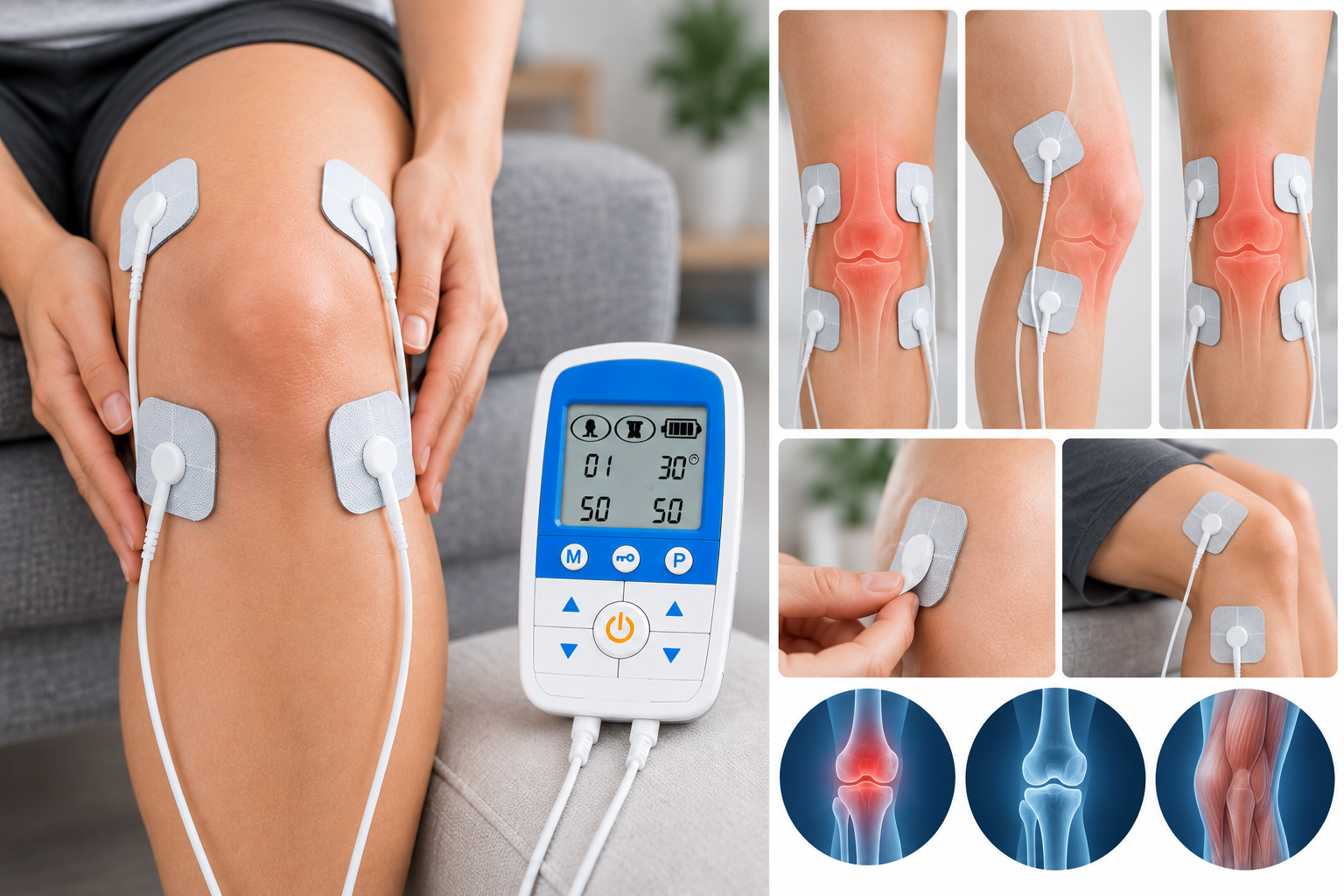
Best TENS Pad Placement for Knee Pain: Where to Put Electrodes and How to Use Them Safely
Finding the right TENS pad placement for knee pain is an important part of using a TENS machine safely and comfortably. Unlike some body areas where electrode placement requires particular caution, the knee can be treated with electrodes positioned around the painful area when TENS is appropriate for the individual.
The NHS provides an example of TENS electrodes positioned above and below the knee. General NHS hospital guidance also recommends placing electrodes around or either side of the painful area while keeping the pads separated.
However, there is no single pad arrangement that is suitable for every type of knee pain. Your symptoms, the location of discomfort, the condition of your skin and the instructions for your particular TENS machine all matter.
TENS may provide temporary knee pain pain relief for some people, but it does not work for everyone and should not be considered a cure.
Quick Answer: Where Should TENS Pads Go for Knee Pain?
For appropriate TENS use around the knee, electrodes are generally positioned around the painful area rather than directly on one specific “pain point”.
The NHS TENS guide illustrates a simple arrangement with electrodes positioned above and below the knee.
A practical approach is:
- Place electrodes on clean, dry, intact skin.
- Position them around the painful area according to your machine’s instructions.
- Keep electrodes separated rather than allowing them to touch.
- Do not place electrodes over broken, infected, irritated or numb skin.
- Attach pads while the machine is switched off.
- Start the intensity low.
- Increase the intensity gradually until the stimulation feels strong but comfortable.
- Stop if the stimulation becomes painful or your skin becomes irritated.
If you have been given personalised instructions by a physiotherapist, GP or other healthcare professional, those instructions should take priority over a generic online diagram.
Why Does TENS Pad Placement Matter?
TENS, or transcutaneous electrical nerve stimulation, delivers a small electrical current through electrodes attached to the skin.
The position of the electrodes affects where the stimulation is delivered and how the sensation feels. NHS guidance recommends putting the pads on or near the painful area and leaving a gap between them.
Clinical TENS guidance can also use electrode positions on either side of a painful area. Dorset County Hospital, for example, advises placing electrodes either side of the painful area with at least 2.5 cm between them.
This means that placement is not simply about putting the pads directly over the point that hurts most.
For knee pain, the goal is generally to position the electrodes in a way that provides a comfortable stimulation pattern around the area while following the instructions for the specific device.
Does the Exact Knee Placement Matter?
Yes, but there is not necessarily one perfect position.
The knee is a relatively compact area, and pain can be felt at the front, side, back or around the joint. Different electrode positions can therefore produce different sensations.
A placement that feels comfortable for one person may feel less useful or less comfortable for another.
This is why NHS TENS guidance recommends that a physiotherapist or healthcare professional can show patients where to place electrodes when appropriate.
If you have not been shown how to position your pads, follow the instructions supplied with your machine and avoid experimenting on areas that your device specifically prohibits.
TENS Pad Placement Above and Below the Knee
One of the simplest approaches shown in NHS guidance is positioning electrodes above and below the knee.
This arrangement places the electrodes around the area rather than directly on the centre of the kneecap.
When using any placement:
Leave enough space between the pads.
The electrodes should not touch one another. Dorset County Hospital recommends keeping pads at least 2.5 cm apart.
Use intact skin.
Do not place electrodes over broken, infected or irritated skin. NHS guidance also advises against using TENS on areas with reduced or absent sensation.
Follow your machine’s instructions.
The recommended electrode size, connector and positioning instructions can vary between TENS systems.
Suggested Diagram: TENS Pad Placement Around the Knee
A useful diagram for this article could show a front view of a human leg and knee, with two electrode pads positioned above and below the knee.
The visual should include:
Recommended general positioning: electrodes around the knee with a clear gap between them.
Safety zone: clean, dry, intact skin.
Avoid: broken or infected skin, numb areas and any location prohibited by the machine instructions.
The diagram should be labelled as a general educational example, rather than a personalised medical prescription.
Alternative Placement Around the Knee
Another general principle used in TENS guidance is to position electrodes either side of the painful area.
This can mean placing the pads so that the painful region sits between them, rather than placing both electrodes directly on top of the same spot.
However, the exact position should take into account where your symptoms are located and the instructions for your TENS device.
If your pain is concentrated in one particular area of the knee, avoid assuming that placing an electrode directly over that spot will necessarily provide better pain relief.
Front of the Knee
Pain at the front of the knee can occur for several different reasons, and the appropriate electrode arrangement depends on the individual.
For general TENS use, the NHS provides an illustration using electrodes positioned above and below the knee.
If you have been advised to use this arrangement, ensure the pads are placed on intact skin and that they do not overlap or touch.
Side of the Knee
If discomfort is predominantly felt around one side of the knee, the electrode arrangement may need to be adjusted to surround the painful region.
Do not position a pad directly over damaged skin or an area where you have reduced sensation.
If you are uncertain about the best position for your particular symptoms, a physiotherapist can demonstrate an appropriate arrangement.
Back of the Knee
Extra care is appropriate around the back of the knee because this area contains important anatomical structures.
Do not assume that because an electrode fits physically in an area it is automatically an appropriate place to use it.
If you want to use TENS around the back of the knee, follow the specific instructions for your device and obtain professional guidance if you are uncertain.
Do Not Place Pads on Every Painful Spot
It can be tempting to use several electrodes to cover every part of the knee that hurts.
More electrodes do not necessarily mean better results.
The number of electrodes you can use depends on the machine’s channels, electrode configuration and instructions.
If your machine has two channels, that does not mean you should simply add electrodes wherever you feel discomfort.
Use only the number and arrangement specified by your device or treatment plan.
How Far Apart Should TENS Pads Be?
The pads should not touch.
NHS hospital guidance commonly recommends leaving a gap of at least around 2–3 cm between electrodes. Dorset County Hospital specifically recommends at least 2.5 cm.
Spacing matters because the electrodes need to maintain separate contact with the skin.
A simple rule is:
Do not overlap. Do not allow the electrode pads to touch.
If you are unsure about the correct spacing for a particular pad size, check the machine’s instructions.
How to Prepare Your Skin Before Applying TENS Pads
Good electrode contact begins before the machine is switched on.
Clean the skin
The area should be clean and dry.
Avoid creams immediately before use
Oils, creams and other products can affect adhesion.
Check for skin problems
Do not place electrodes on broken, infected or irritated skin.
Check sensation
NHS guidance advises against using TENS on areas where you cannot feel normally.
Check the pads
Reusable electrodes should still have good adhesive contact. If they are excessively worn or no longer stick securely, replace them.
How to Apply TENS Pads Safely
Once you know the appropriate placement, the setup is straightforward.
Step 1: Switch the machine off
Always attach the pads while the TENS machine is switched off.
Step 2: Connect the electrodes
Attach the pads to the leads or wireless unit according to the manufacturer’s instructions.
Step 3: Position the pads
Place them in the recommended positions around the knee.
Step 4: Turn the machine on
Begin at a low intensity.
Step 5: Increase gradually
Slowly increase the intensity until you feel a noticeable, strong but comfortable tingling sensation. NHS guidance recommends increasing the intensity gradually and says stimulation should not be painful.
Step 6: Monitor the skin
If your skin becomes itchy, irritated or red, switch off the machine and remove the electrodes.
Step 7: Switch off before removing
Turn the machine off before removing the pads.
What Should TENS Feel Like on the Knee?
TENS normally feels like tingling, buzzing or pulsing.
The sensation should be strong enough to notice but comfortable enough to tolerate.
Cambridge University Hospitals describes the desired stimulation as strong but comfortable, while NHS guidance recommends gradually increasing the intensity until tingling is felt.
You should not need to endure painful electrical stimulation to use TENS effectively.
If it hurts:
Reduce the intensity.
If it remains uncomfortable:
Stop the session and reassess the electrode position and equipment.
If discomfort continues:
Seek professional advice.
What If One Side Feels Stronger Than the Other?
It is possible for stimulation to feel different from one electrode position to another.
Before assuming the machine is faulty, check:
- Whether both pads are adhering properly
- Whether the skin is clean and dry
- Whether the leads are properly connected
- Whether the electrodes are worn
- Whether the pads are positioned as instructed
If one electrode has poor contact with the skin, the stimulation can feel different.
If your TENS machine consistently feels weak or uneven, our guide Why Does a TENS Machine Feel Weak? Causes, Fixes and What to Check covers common equipment and electrode issues.
When Should You Move the Pads?
Do not continuously move the electrodes during a session simply because you cannot immediately feel the effect you expected.
If the position has been recommended by a healthcare professional, follow that placement.
If you are using general machine instructions and the stimulation feels uncomfortable, switch the device off before repositioning the electrodes.
Never move a pad while the machine is actively delivering stimulation.
Common TENS Pad Placement Mistakes for Knee Pain
Placing pads too close together
Electrodes should remain separated.
Putting electrodes on broken skin
Do not use TENS on broken, infected or irritated skin.
Using numb areas
Reduced sensation can make it harder to recognise uncomfortable stimulation. NHS guidance advises against using TENS on areas where you cannot feel normally.
Placing pads wherever the pain is strongest
The most painful spot is not automatically the best electrode location.
Using worn-out pads
Poor adhesion can affect contact and make stimulation inconsistent.
Using the wrong pad connector
Always check compatibility before buying replacement electrodes.
Increasing intensity instead of checking the pads
A weak sensation may be caused by poor electrode contact rather than insufficient intensity.
Copying a random internet diagram
Different diagrams may have been created for different machines, treatment approaches or clinical circumstances.
Using TENS while sleeping
The NHS advises against using TENS while sleeping.
Using TENS while driving
TENS should not be used while driving or operating machinery.
TENS Pad Placement: Quick Comparison
| Approach | General principle | Important consideration |
| Above and below knee | Electrodes positioned around the knee | Shown as an example in NHS guidance |
| Either side of painful area | Painful region sits between electrodes | Keep pads appropriately separated |
| Directly on damaged skin | Avoid | Broken/infected/irritated skin is unsuitable |
| On numb skin | Avoid | Reduced sensation increases safety concerns |
| Pads touching | Avoid | Leave an appropriate gap |
| Multiple pads | Depends on machine | Follow channel and device instructions |
| Random online placement | Not recommended | Diagrams may not apply to your circumstances |
How Long Can TENS Be Used for Knee Pain?
There is no universal treatment duration for everyone.
Different NHS services provide different guidance. RNOH’s general TENS guide describes using TENS for up to 60 minutes at a time and usually up to three times a day, while Cambridge University Hospitals describes starting with 30–60-minute periods and increasing use if it is helpful.
These are general examples, not a prescription for every person.
Follow the instructions supplied with your particular TENS machine and any guidance from your healthcare professional.
Do not use TENS while sleeping, and do not use it in the bath or shower.
Does TENS Help Knee Pain?
TENS may provide temporary pain relief for some people.
The NHS says TENS can help with certain types of pain, including arthritis pain and pain associated with sports injuries, but also makes clear that it does not work for everyone.
The purpose of knee pain tens therapy should therefore be viewed realistically.
TENS may help manage discomfort temporarily, but it does not necessarily treat the underlying reason for the knee pain.
If your knee pain is persistent, severe or affecting your ability to walk or carry out normal activities, appropriate medical assessment is more important than simply increasing TENS use.
Can TENS Be Used for Knee Arthritis?
The NHS lists arthritis pain among the types of pain for which TENS may help.
However, evidence for electrotherapy varies between conditions and individuals, and TENS should not be presented as a treatment that reverses arthritis.
If you have ongoing knee symptoms, discuss appropriate management with a healthcare professional.
What About Knee Pain After Exercise or Sport?
TENS may be used for some types of sports-injury pain, according to NHS guidance.
However, TENS does not tell you whether an injury is minor or serious.
If the knee becomes severely painful, badly swollen, changes shape, locks, or you cannot move it or put weight on it, seek appropriate medical advice rather than relying on TENS.
Choosing Electrode Pads for Knee Pain
The right electrode pads for knee pain should be compatible with your machine and appropriate for the placement recommended for you.
Consider:
- Pad size
- Connector type
- Adhesive quality
- Reusability
- Number of pads supplied
- Cost of replacement pads
- Compatibility with your TENS machine
TensLeads offers reusable electrodes in different sizes and connection formats, including multi-size packs.
A pad that looks similar to your existing electrode may not necessarily use the same connector, so check compatibility before ordering.
Why Pad Condition Matters
A TENS machine can be functioning normally while worn electrodes cause problems.
As reusable pads age, they may:
- Become less adhesive
- Lift from the skin
- Feel less consistent
- Become visibly worn
- Require more frequent replacement
Replacing worn electrodes can help maintain reliable skin contact.
If your electrodes are no longer sticking properly, consider replacing them rather than repeatedly increasing the machine’s intensity.
Choosing a TENS Machine for Knee Pain
If you are buying a tens machine for knee pain, look for practical features rather than simply the largest number of programmes.
Useful features include:
- Adjustable intensity
- Clear controls
- Multiple TENS programmes
- Adjustable frequency
- Adjustable pulse width
- Automatic timer
- Portable design
- Compatible replacement electrodes
- Clear safety instructions
The NHS recommends checking for CE or UKCA marking when buying a TENS machine.
A simple, easy-to-use machine with affordable compatible electrodes may be more useful for regular use than a complicated machine with features you do not need.
For more information, see Best TENS Machine for Knee Pain: UK Buying Guide.
TENS Pad Placement Safety Checklist
Before every session, check:
- I have checked that TENS is appropriate for me.
- I have read the instructions for my machine.
- My skin is clean and dry.
- The skin is intact and has normal sensation.
- My electrode pads are in good condition.
- My electrodes are compatible with my machine.
- The pads are not touching.
- The machine is switched off while I attach the pads.
- I am starting at a low intensity.
- The stimulation feels strong but comfortable.
- I will stop if stimulation becomes painful.
- I will remove the pads if my skin becomes irritated.
- I will not use TENS while sleeping.
- I will not use TENS in the bath or shower.
- I will not use TENS while driving or operating machinery.
When Should You Speak to a Healthcare Professional?
TENS is not a substitute for investigating persistent or concerning knee pain.
The NHS recommends seeing a GP if knee pain does not improve within a few weeks.
You should seek more urgent medical advice if the knee is very painful, you cannot move it or put weight on it, or it is badly swollen or has changed shape.
You should also speak with a healthcare professional before using TENS if you are unsure what is causing your pain or whether TENS is suitable for you.
Frequently Asked Questions
Does TENS help knee pain?
TENS may provide temporary pain relief for some people. The NHS states that TENS can help certain types of pain, including arthritis and sports-injury pain, but it does not work for everyone.
It should therefore be considered a possible symptom-management option rather than a guaranteed treatment or cure.
Where should TENS pads go for knee pain?
The NHS illustrates TENS electrodes positioned above and below the knee. General NHS guidance also recommends positioning pads around or either side of the painful area while keeping them separated.
Follow your machine’s instructions or any placement demonstrated by a healthcare professional.
How long can TENS be used for knee pain?
There is no single duration that applies to everyone. RNOH gives general guidance of up to 60 minutes at a time and usually up to three times a day, while Cambridge University Hospitals describes starting with 30–60-minute periods.
Follow the instructions for your machine and any professional advice you have received.
Can I put TENS pads directly over my kneecap?
Electrode placement varies according to the machine and treatment plan. NHS guidance provides an example with electrodes positioned above and below the knee rather than establishing one universal requirement to place pads directly over the kneecap.
Follow your device instructions or ask a healthcare professional to demonstrate appropriate placement.
How far apart should TENS pads be on the knee?
Do not allow the electrodes to touch. Dorset County Hospital recommends keeping TENS pads at least 2.5 cm apart.
If your machine provides different spacing instructions, follow the manufacturer’s guidance.
Can I use TENS on the back of my knee?
Do not assume that every part of the knee is suitable for electrode placement. The back of the knee contains important structures, so follow your device instructions and seek professional guidance if you are unsure about using TENS there.
What should TENS feel like?
TENS should generally produce a tingling, buzzing or pulsing sensation. The intensity should be strong enough to notice but comfortable rather than painful.
Can I use TENS if my knee is swollen?
Swelling can have many possible causes, so TENS should not be used as a way of determining what is wrong with the knee. If swelling is significant, persistent or accompanied by severe pain or difficulty bearing weight, seek medical advice.
Can I use TENS after a knee injury?
TENS may help with some sports-injury pain, according to the NHS, but it does not determine how serious an injury is.
Seek medical advice for severe pain, major swelling, deformity, inability to move the knee or inability to put weight on it.
Key Takeaways
Getting TENS pad placement for knee pain right is mainly about positioning the electrodes around the painful area, maintaining good skin contact and following the instructions for your particular device.
The NHS illustrates electrodes positioned above and below the knee.
Keep electrode pads separated. NHS hospital guidance recommends leaving an appropriate gap, with Dorset County Hospital advising at least 2.5 cm.
Use clean, dry, intact skin. Avoid broken, infected, irritated or numb areas.
Start intensity low and increase gradually. Aim for a strong but comfortable tingling sensation rather than painful stimulation.
Do not assume one placement works for everyone. If you are unsure, ask a healthcare professional to demonstrate an appropriate position.
Check your equipment. Worn pads, damaged leads and incompatible replacement electrodes can affect the reliability of your TENS setup.
Keep expectations realistic. TENS may provide temporary relief for some people, but it does not work for everyone and does not necessarily address the underlying cause of knee pain.
Products
TENS Machines
TensLeads offers a range of TENS machines, including portable digital TENS/EMS, dual-channel and wireless options. When comparing machines, consider adjustable intensity, programme selection, ease of use, portability, timer functions and electrode compatibility.
Replacement Electrode Pads
TensLeads offers replacement electrodes in different sizes and connection formats, including reusable pads and multi-size packs. Choose replacement electrodes according to your machine’s connector and compatibility requirements.
Explore TENS Machines; Replacement Electrode Pads
Explore the TensLeads TENS Machines and Replacement Electrode Pads to compare available machines, electrode pads and accessories.
Medical Disclaimer
This article is for general educational purposes only and is not a substitute for medical advice, diagnosis or treatment. TENS is not suitable for everyone and individual responses vary. If you are unsure whether TENS is appropriate for your knee pain, where electrodes should be positioned or how long you should use the machine, speak with a GP, physiotherapist, pain specialist or another qualified healthcare professional. Always follow the instructions supplied with your specific TENS machine.
:::