
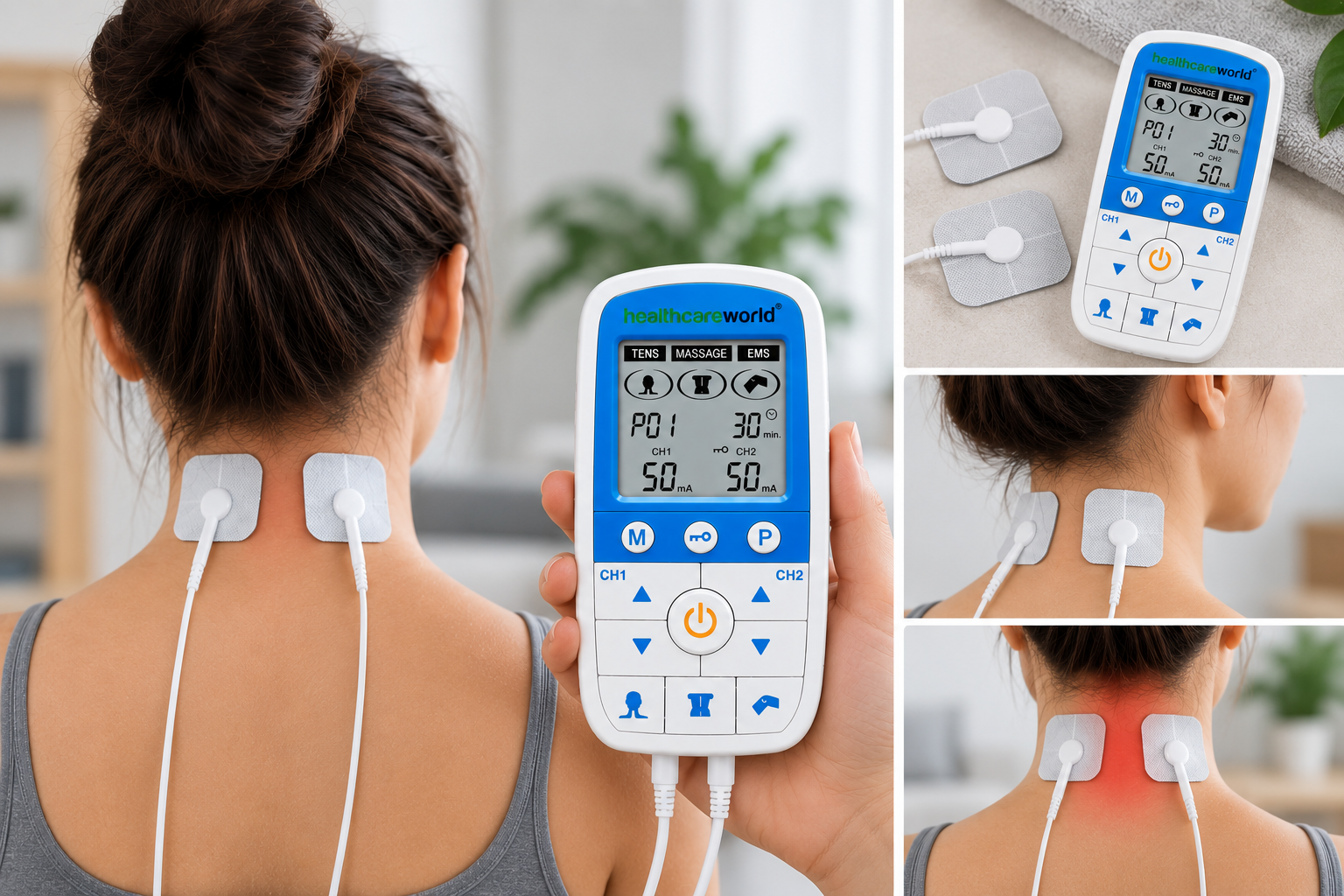
Best TENS Machine for Neck Pain: UK Buying Guide
Choosing the best TENS machine for neck pain is not simply about finding the device with the most programmes or the highest number of intensity levels. If you are considering TENS for neck-related discomfort, the first priority is understanding whether and how it can be used safely.
There is one particularly important point for anyone shopping for a TENS machine for neck pain: standard TENS electrodes should not be placed directly on the neck. NHS guidance says not to use TENS on the neck, while NHS hospital guidance specifically warns against placing pads on the front or sides of the neck. (NHS) (Leeds Teaching Hospitals NHS Trust)
That means a good buying decision should focus on adjustable controls, ease of use, electrode compatibility, portability, programme choice and replacement-pad availability, rather than looking for a machine marketed as a direct treatment for the neck.
TENS can provide temporary pain relief for some people, but it does not work for everyone and should not be viewed as a cure. (NHS)
Quick Answer: What Is the Best TENS Machine for Neck Pain?
The best TENS machine for someone experiencing neck-related pain is generally one that is easy to operate, has adjustable intensity, provides appropriate programme options, uses readily available replacement electrodes and has clear safety instructions.
However, there is no single TENS machine that is medically proven to be the best for all neck pain. More programmes or higher intensity do not automatically mean better pain relief.
When comparing machines, prioritise:
- Adjustable intensity
- Straightforward controls
- Suitable TENS programmes
- Clear display
- Reliable electrode connections
- Easily available replacement pads
- Reasonable ongoing pad costs
- Portable design if you intend to use TENS away from home
- Appropriate CE or UKCA marking
- Clear instructions and safety information
Most importantly, do not choose a machine on the assumption that its pads can safely be placed directly on your neck. Standard TENS should not be used on the neck. (NHS)
What Should You Look for in a TENS Machine for Neck Pain?
When people search for tens machine neck pain, they often focus on technical specifications first. Those specifications are useful, but they need to be considered in the right order.
A practical buying decision should begin with safety and usability, followed by controls, electrode compatibility and running costs.
1. Adjustable Intensity
Intensity controls how strong the electrical stimulation feels.
A useful TENS machine should allow you to start at a low intensity and increase it gradually. NHS guidance says TENS should produce a tingling sensation and should not be painful. Cambridge University Hospitals similarly describes the desired sensation as strong but comfortable. (NHS) (Cambridge University Hospitals)
This makes adjustable intensity much more useful than simply having a high maximum output.
2. Adjustable Frequency
Frequency, measured in Hertz (Hz), determines how many pulses are delivered each second.
Different frequencies produce different sensations, and there is no universally correct frequency for neck-related pain. NHS TENS guidance uses different example settings depending on the clinical context, which reinforces why a particular number should not be treated as a universal prescription.
If you want more flexibility, choose a machine that allows frequency adjustment or provides several clearly explained programmes.
For a more detailed explanation, see our guide to Best TENS Settings for Neck Pain.
3. Adjustable Pulse Width
Pulse width describes the duration of each electrical pulse, usually measured in microseconds.
Changing pulse width changes the character of the stimulation. Like frequency, it is not a case of simply choosing the highest number.
A machine with adjustable pulse width can be useful for users who have been advised to experiment with settings or who have received specific guidance from a healthcare professional.
4. Multiple TENS Programmes
Some machines provide several TENS programmes, while others offer a basic continuous mode.
Multiple programmes can make a machine more versatile, but more programmes do not necessarily mean better pain relief.
For a first-time user, a simple machine with understandable controls may be more useful than a complicated device containing settings that are rarely used.
Look for clear descriptions of what each programme does rather than choosing solely according to programme count.
5. Easy-to-Use Controls
A TENS machine may have excellent technical specifications but still be frustrating if its buttons and display are difficult to understand.
Useful features include:
- Clearly labelled controls
- Easy-to-read display
- Simple intensity adjustment
- Straightforward programme selection
- Clearly visible battery information
- Automatic timer
- Easy-to-connect electrode leads
This matters particularly if you intend to use the machine regularly.
6. Electrode Compatibility
One of the most overlooked buying considerations is the connection between the machine and the electrode pads.
TENS pads can use different connection systems, including stud/snap-style connections and pin-style connections. Some machines also use proprietary or wireless electrodes.
Before buying, check:
- The pad connector type
- The lead connector type
- Compatible pad sizes
- Whether replacement pads are readily available
- The price of replacement pads
A machine is less convenient to own if replacement electrodes are difficult to find or disproportionately expensive.
7. Replacement-Pad Availability
Electrode pads are consumable accessories. Even reusable pads eventually lose adhesion or become less effective at maintaining good skin contact.
This makes replacement-pad availability an important part of the total ownership cost.
For example, TensLeads currently offers reusable electrodes in several sizes and connection formats, including a 12-pad variety pack with two sizes and a standard 3.5 mm stud connection. (TensLeads products)
Choosing a machine with widely available compatible electrodes can therefore be more economical over time than choosing a device based solely on its initial purchase price.
TENS Machine Features: What Matters Most?
| Feature | Why it matters | Priority |
| Adjustable intensity | Allows gradual adjustment to a comfortable sensation | High |
| Frequency adjustment | Gives greater control over stimulation | Useful |
| Pulse-width adjustment | Provides additional control over sensation | Useful |
| Multiple programmes | Adds flexibility | Useful |
| Simple controls | Makes regular use easier | High |
| Clear display | Helps with programme and intensity selection | High |
| Compatible replacement pads | Prevents problems when electrodes wear out | High |
| Affordable replacement pads | Reduces long-term ownership cost | High |
| Portable design | Useful for travelling or use away from home | Depends on lifestyle |
| Automatic timer | Helps control treatment sessions | Useful |
| Clear safety information | Supports safer use | Essential |
| CE/UKCA marking | Important when selecting a UK device | Essential |
How Many Channels Do You Need?
Another common question when comparing TENS machines is whether to choose a single-channel or dual-channel model.
A channel refers to an independently controlled stimulation output.
A single-channel device may be perfectly adequate when you only need to operate one pair of electrodes at a time.
A dual-channel machine provides greater flexibility because two electrode circuits can be controlled independently. This can be useful when a person has been advised to stimulate two appropriate areas during the same session.
However, having two channels does not mean you should place electrodes on both the neck and another part of the body. Electrode placement must still follow safety guidance.
NHS guidance specifically warns against using TENS on the neck and against using TENS on the chest and back at the same time. (NHS)
Therefore, choose dual-channel functionality for flexibility, not because you need to stimulate the neck directly.
Wired vs Wireless TENS Machines
Both wired and wireless TENS machines can be convenient, but they suit different preferences.
Wired TENS Machines
Traditional wired systems connect the control unit to the electrode pads using leads.
Advantages include:
- Familiar setup
- Broad pad compatibility
- Replacement leads are often available
- Generally straightforward to understand
- Often good value
The main disadvantage is that the wires can become inconvenient during movement.
Wireless TENS Machines
Wireless systems reduce or eliminate long leads between the controller and electrodes.
Advantages can include:
- Less cable clutter
- Greater freedom of movement
- Convenient portable use
- A cleaner setup
However, wireless systems can have more specific electrode or replacement-part requirements. Before purchasing, check the cost and availability of compatible replacement electrodes.
Which Is Better?
There is no universal winner.
If affordability and replacement-part flexibility are your priorities, a conventional wired system may make more sense.
If portability and freedom from cables matter more, a wireless model may be preferable.
The important point is to compare the whole system, not just the machine itself.
TENS Machine Price vs Total Cost of Ownership
The cheapest TENS machine is not necessarily the cheapest option to own.
Consider the total cost:
Initial machine price + replacement pads + replacement leads + accessories = ongoing ownership cost
For example, a machine that costs slightly more initially but uses inexpensive, widely available replacement electrodes may provide better value over several years than a cheaper device with expensive proprietary pads.
TensLeads currently lists several reusable electrode options, including 4 × 4 cm replacement pads, a mixed-size 12-pad pack, 5 × 9 cm pads and other connection-specific electrodes. (TensLeads products)
Prices can change, so check the current product listing before making a purchasing decision.
How Much Do Replacement TENS Pads Cost?
Replacement-pad prices vary according to size, connection type, shape and quantity.
At the time of writing, examples in the TensLeads range include:
- 4 × 4 cm reusable TENS pads: £4.10
- Mini Stud TENS Electrode Pads, 4 pieces: £6.99
- TENS Electrode Pads, 5 × 9 cm, 4 pieces: £5.49
- Mixed-size TENS electrode pad pack, 12 pads: £13.99
- Butterfly-shaped TENS electrodes: £7.99
These are examples rather than recommendations, and prices may change. More importantly, compatibility should come before price.
A cheaper pad is not good value if it cannot connect to your machine.
Why Electrode Pad Compatibility Matters
There is no single universal TENS electrode connection.
For example, TensLeads stocks 3.5 mm stud electrodes, 2 mm pin-style electrodes and other formats. Its 2.5 mm-to-2 mm replacement lead is specifically designed for compatible machines and 2 mm pin-type pads, and is not suitable for stud pads or wireless machines. (TensLeads replacement lead)
Before ordering replacement electrodes, compare the connector on your machine with the connector specified on the pad listing.
If you are unsure, check your original machine documentation or contact the supplier rather than guessing.
Does a Larger TENS Pad Mean Better Pain Relief?
Not necessarily.
Larger pads can cover a wider area, while smaller pads can be useful where more targeted placement has been recommended.
However, pad size should be selected according to the intended treatment area, machine compatibility and professional guidance rather than assuming that bigger electrodes provide stronger or better pain relief.
For neck-related symptoms, this is particularly important because a larger pad is not a reason to place an electrode directly on the neck.
NHS guidance remains clear that standard TENS should not be used on the neck. (NHS)
What About Specially Shaped TENS Pads?
Specially shaped electrodes can make positioning easier for some areas of the body.
For example, TensLeads offers a butterfly-shaped electrode with a central gel-free gap and describes it for areas including the upper back, between the shoulder blades and neck-and-shoulder area. (TensLeads butterfly electrode)
However, product descriptions should not be interpreted as overriding clinical safety guidance.
The NHS advises not to use TENS on the neck. If you are considering a specially shaped pad for symptoms associated with the neck, follow the instructions for the specific device and obtain professional guidance about where it can safely be positioned.
Can You Use a TENS Machine for Neck Pain?
This requires a distinction between using TENS for symptoms associated with neck pain and placing TENS electrodes on the neck.
The NHS says TENS should not be used on the neck. Leeds Teaching Hospitals NHS Trust also specifically advises not to place pads on the front or sides of the neck. (NHS) (Leeds Teaching Hospitals NHS Trust)
Therefore, buying a TENS machine does not mean you should use it by placing electrodes over the painful part of your neck.
If a GP, physiotherapist or pain specialist has recommended TENS as part of your symptom-management plan, ask them to demonstrate the appropriate electrode position.
Cambridge University Hospitals similarly advises that a physiotherapist can show patients where electrodes can be positioned. (Cambridge University Hospitals)
Does TENS Help Neck Pain?
TENS can provide temporary pain relief for some types of pain, but the NHS states that it does not work for everyone. (NHS)
That means a TENS machine should be considered a potential pain-management tool rather than a treatment that fixes the underlying cause.
This is especially important when shopping for a machine. Marketing language such as “powerful”, “professional” or “maximum pain relief” should not be interpreted as evidence that one device will treat neck pain better than another.
For general neck pain, NHS advice also includes staying active, trying appropriate flexibility exercises and using heat or cold packs. It recommends seeing a GP if neck pain or stiffness does not go away. (NHS neck pain guidance)
How to Choose a TENS Machine If You Are New to TENS
If this is your first TENS machine, simplicity is often more useful than an overwhelming number of controls.
Look for:
Easy intensity adjustment
You should be able to increase and decrease stimulation without struggling to find the correct button.
Clear programme selection
If the machine offers several programmes, the controls should make it easy to understand which mode you have selected.
Straightforward electrode connections
You should be able to attach and remove the leads without forcing the connectors.
Good instructions
The user manual should clearly explain electrode use, contraindications, settings and cleaning/storage.
Accessible replacement pads
Check that compatible replacement electrodes are sold separately.
Portable design
A compact machine may be useful if you want to take it to work or when travelling.
Reliable timer
An automatic timer can prevent the machine from continuing indefinitely.
Appropriate certification
For UK consumers, check that the product has the appropriate CE or UKCA marking. NHS guidance specifically recommends checking for CE or UKCA marking when buying a TENS machine. (NHS)
A TENS Machine Buying Checklist
Before purchasing, ask:
- Is the intensity adjustable?
- Can I understand the controls easily?
- Does it provide the TENS programmes I actually need?
- Is the display easy to read?
- Does it have an automatic timer?
- Is it wired or wireless, and which do I prefer?
- Are replacement pads readily available?
- Are the replacement pads reasonably priced?
- Are the electrodes compatible with the machine?
- Are replacement leads available if required?
- Does the product have appropriate CE or UKCA marking?
- Does the manual clearly explain safety precautions?
- Have I checked whether TENS is appropriate for me?
- Do I understand that standard TENS pads should not be placed directly on my neck?
What You Should Not Choose a TENS Machine For
Some features sound impressive but are not necessarily meaningful indicators of suitability.
Do not choose solely because it has the highest intensity
Stronger stimulation is not automatically better. TENS should feel strong but comfortable, not painful. (NHS)
Do not choose solely because it has the most programmes
A machine with 20 programmes is not automatically superior to one with five useful programmes.
Do not choose based solely on pad shape
An electrode shaped for a particular body area does not override safety restrictions.
Do not assume “wireless” means better
Wireless is primarily a convenience feature.
Do not ignore replacement costs
A low-cost machine can become expensive if its compatible electrodes are difficult to obtain or frequently need replacing.
Do not rely on marketing claims as medical evidence
Claims about pain relief should be considered alongside independent clinical guidance and the manufacturer’s actual instructions.
TensLeads TENS Machines: What Features Can Be Useful?
The TensLeads range includes several TENS machine formats, including portable digital, dual-channel, digital TENS/EMS and wireless models. (TensLeads)
The Portable Digital TENS & EMS Machine, for example, lists five TENS and five EMS programmes, 16 adjustable intensity levels, a 30-minute automatic timer and wireless functionality. (TensLeads Portable Digital TENS & EMS Machine)
Those features can be useful when comparing machines, but they should not be interpreted as proof that the machine is more effective for neck pain than another device.
The right choice depends on which controls you will actually use, how portable you want the device to be and how easily you can obtain compatible electrodes.
TENS Machines vs TENS Electrode Pads: Think of Them as One System
When shopping for neck pain tens therapy, it can be tempting to focus entirely on the machine.
A better approach is to consider the machine and electrodes together.
Your setup consists of:
TENS machine → leads/connectors → electrode pads → skin
If one part is incompatible or poorly maintained, the overall experience can suffer.
For example, worn electrodes may not adhere properly. Damaged leads can affect connection. An incompatible pad may not attach to the machine at all.
This is why replacement-pad availability should be considered before buying rather than after your original electrodes need replacing.
How Long Can a TENS Machine Be Used for Neck Pain?
There is no universal treatment duration specifically for neck pain.
Different NHS TENS services give different guidance depending on the treatment context. RNOH, for example, provides general guidance of up to 60 minutes at a time and usually up to three times per day, while Cambridge University Hospitals describes starting with 30–60 minute periods and adjusting according to individual response. (RNOH) (Cambridge University Hospitals)
These examples should not be treated as a prescription for every person.
Follow your machine’s instructions and any advice given by your healthcare professional.
NHS guidance also says not to use TENS while sleeping, in the bath or shower, or while driving or operating machinery. (NHS)
Frequently Asked Questions
Does TENS help neck pain?
TENS can provide temporary pain relief for some people, but it does not work for everyone and is not a cure. The NHS describes TENS as a treatment that can provide temporary pain relief for certain types of pain. (NHS)
For neck-related symptoms, safety is particularly important because standard TENS should not be used directly on the neck.
Where should TENS pads go for neck pain?
Standard TENS pads should not be placed directly on the front or sides of the neck. NHS guidance advises against using TENS on the neck, and Leeds Teaching Hospitals NHS Trust specifically warns against placing pads on the front or sides of the neck. (NHS) (Leeds Teaching Hospitals NHS Trust)
If TENS has been recommended for your symptoms, ask a qualified healthcare professional to demonstrate an appropriate alternative electrode position.
How long can TENS be used for neck pain?
There is no single duration suitable for everyone. Different NHS services provide different guidance, so follow your specific machine instructions and any advice from your healthcare professional. RNOH gives general guidance of up to 60 minutes at a time, while Cambridge University Hospitals describes starting with 30–60 minute periods. (RNOH) (Cambridge University Hospitals)
Do not sleep with a TENS machine switched on.
Is a wireless TENS machine better for neck pain?
Not necessarily. Wireless TENS machines can be more convenient because they reduce cable clutter, but wireless functionality does not mean the device is medically more effective for neck pain.
Compare portability, controls, electrode compatibility and replacement costs rather than choosing solely because a machine is wireless.
How many TENS channels do I need?
A single-channel machine can be sufficient for basic use, while a dual-channel machine offers greater flexibility for situations where two appropriate electrode circuits are recommended.
Having two channels does not make it safe to place one set of electrodes on the neck. Standard TENS should not be used on the neck. (NHS)
How often do TENS electrode pads need replacing?
There is no fixed replacement schedule for every reusable pad. Lifespan depends on the electrode type, frequency of use, skin preparation and how the pads are stored.
Replace pads when they no longer adhere properly, become damaged or can no longer provide reliable skin contact. Follow the manufacturer’s instructions for care and replacement.
Are expensive TENS machines better?
Not necessarily. A more expensive machine may offer additional programmes, channels, wireless functionality or more sophisticated controls, but those features do not automatically mean better pain relief.
Choose based on the features you actually need, ease of use, safety information, compatibility and long-term running costs.
Can I use any replacement TENS pads with my machine?
No. TENS pads have different connector types and sizes. Check your machine and lead specifications before purchasing replacements.
For example, TensLeads stocks both stud and pin-connected electrodes, while its 2.5 mm-to-2 mm replacement leads are specifically designed for compatible pin-type pads and are not suitable for stud pads or wireless machines. (TensLeads products) (TensLeads replacement lead)
Can I use a TENS machine if I have persistent neck pain?
Persistent neck pain should not simply be managed by repeatedly changing TENS settings.
The NHS advises seeing a GP if neck pain or stiffness does not go away after a few weeks, particularly if you are worried about it or have symptoms such as pins and needles or a cold arm. (NHS neck pain guidance)
If you are unsure whether TENS is appropriate, seek advice from a GP, physiotherapist or other qualified healthcare professional.
Key Takeaways
The best TENS machine for neck pain is not necessarily the most powerful or most expensive model.
For most buyers, the most useful features to compare are:
Adjustable intensity — so stimulation can be increased gradually to a strong but comfortable level.
Useful programmes — enough flexibility without unnecessary complexity.
Clear controls — particularly important if you are new to TENS.
Good electrode compatibility — check connector type before purchasing.
Affordable replacement pads — consider the long-term cost, not just the machine’s purchase price.
Portability — wireless or compact designs may be useful if you intend to use the machine away from home.
Clear safety information — an essential consideration for any electrotherapy device.
And for anyone considering TENS for neck-related symptoms, remember the most important point: standard TENS electrodes should not be placed directly on the neck. NHS guidance specifically advises against using TENS on the neck. (NHS)
If you are comparing machines, focus on the overall system: device controls, electrode compatibility, replacement-pad availability and ease of use.
For more information about positioning, see Best TENS Pad Placement for Neck Pain. For settings and adjustment, see Best TENS Settings for Neck Pain.
Products
TENS Machines
TensLeads offers a range of TENS machines, including portable digital, dual-channel, TENS/EMS and wireless options. (TensLeads TENS Machines)
When comparing models, consider intensity adjustment, programmes, portability, controls, timer functions and compatibility with replacement electrodes.
Replacement Electrode Pads
TensLeads stocks replacement TENS electrodes in a range of sizes and connection types, including standard stud electrodes, pin-connected pads, compact pads and larger options. (TensLeads Replacement Electrode Pads)
Always check the connector and machine compatibility before ordering.
Explore TENS Machines; Replacement Electrode Pads
Browse the TensLeads TENS Machines and Replacement Electrode Pads to compare machines, electrode sizes, connection types and replacement options.
Medical Disclaimer
This article is for general educational purposes and is not a substitute for medical advice, diagnosis or treatment. TENS is not suitable for everyone. Standard TENS electrodes should not be placed directly on the neck. If you are unsure whether TENS is appropriate for you, where electrodes should be positioned or which device is suitable, speak with a GP, physiotherapist, pain specialist or another qualified healthcare professional. Always follow the instructions supplied with your specific TENS machine.