
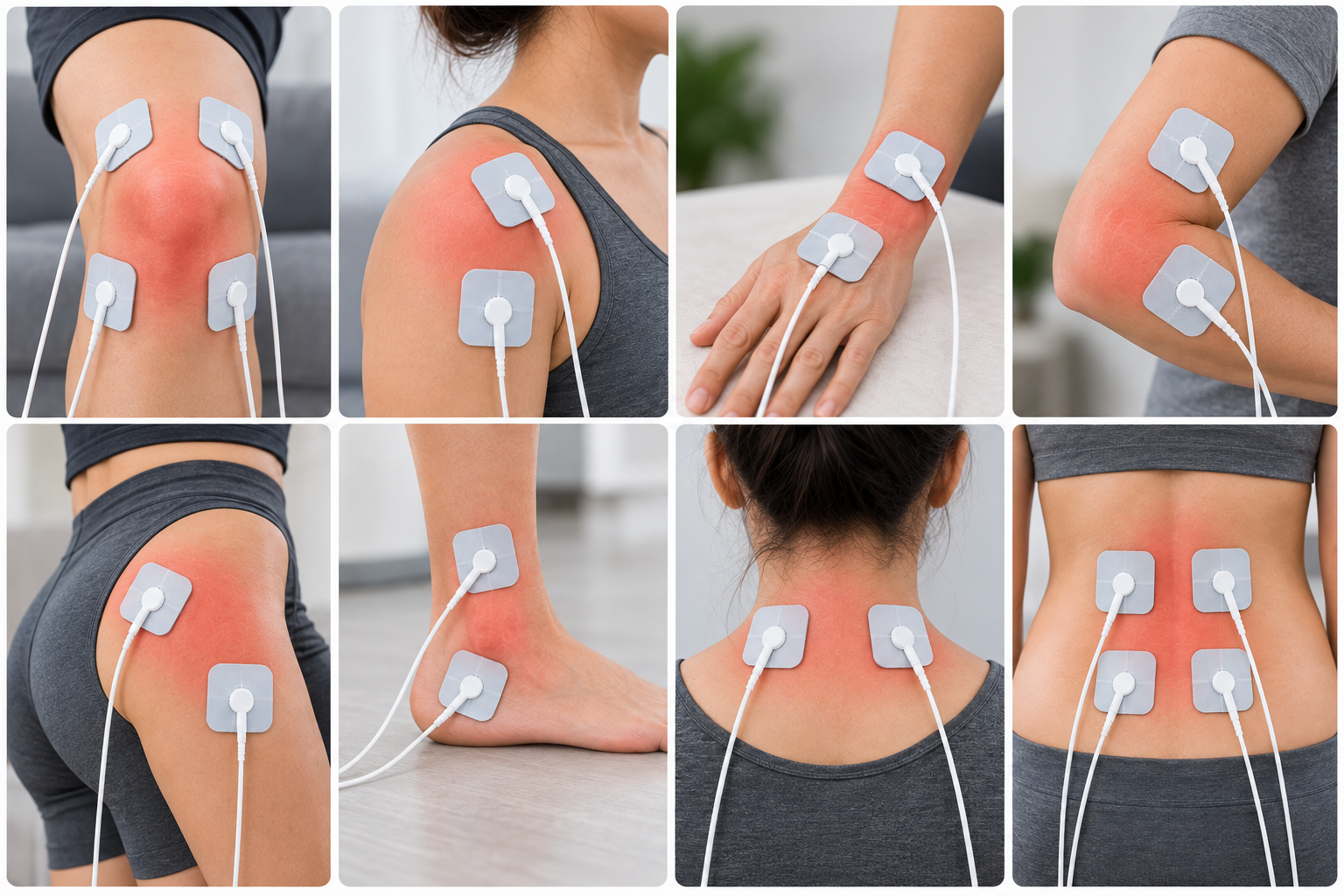
Best TENS Pad Placement for Arthritis: Where to Put Electrodes Safely
If you are looking for the best TENS pad placement for arthritis pain, the most important principle is simple: place the electrodes on or around the painful area, while keeping them separated and away from areas where TENS should not be used. The exact position depends on which joint is affected, where the pain is felt and the instructions for your particular TENS machine.
TENS may provide temporary pain relief for some people, including people with arthritis, but it does not work for everyone and does not treat the underlying cause of arthritis. The NHS describes TENS as a possible option for certain types of pain, while NICE currently recommends not offering TENS for osteoarthritis because there is insufficient evidence of benefit. (nhs.uk)
For safe use, think about placement, spacing, skin condition and intensity together. Correctly positioned pads with a comfortable level of stimulation are more important than finding a single “perfect” electrode pattern.
Quick answer: Where should TENS pads go for arthritis pain?
Generally, TENS pads are positioned on or around the painful joint or surrounding area, following the instructions supplied with your machine. Great Ormond Street Hospital explains that electrodes are generally positioned at the site of pain, although alternative positioning along a nerve pathway may sometimes be recommended by a healthcare professional. (GOSH Hospital site)
For example, if you are using TENS for knee discomfort, pads may be positioned around the painful area rather than directly on top of one particularly tender point. For hand, wrist, elbow, ankle or foot pain, the same general principle can apply: place the electrodes around the area according to the device instructions and appropriate professional guidance.
Always:
- Leave a gap between electrodes.
- Use clean, dry, intact skin.
- Avoid broken, infected, irritated or numb skin.
- Keep pads away from the neck, mouth and eyes.
- Do not place pads directly over the heart.
- Switch the machine off before attaching or removing electrodes.
- Stop if the skin becomes irritated or the stimulation becomes painful.
The NHS and NHS hospital guidance provide these precautions for TENS use. (nhs.uk)
Why TENS pad placement matters for arthritis
A TENS machine delivers electrical pulses through adhesive electrodes placed on the skin. Where those electrodes sit affects the sensation you experience and whether the stimulation is directed towards the area you are trying to manage.
The NHS recommends placing the pads on clean skin near the painful parts of the body and leaving a gap between them. (nhs.uk)
Poor placement can cause several problems. Pads positioned too close together may make the stimulation uncomfortable. Pads placed over unsuitable skin may worsen irritation. Incorrect positioning can also make it difficult to achieve a useful, comfortable sensation.
This is why electrode pads for arthritis pain should be treated as part of the overall TENS setup, rather than simply accessories that can be positioned anywhere.
A useful general rule: surround rather than squeeze
When appropriate for the affected joint, electrodes can often be positioned either side of or around the painful area, rather than placing them directly on top of one another or concentrating them in one tiny location.
The Royal National Orthopaedic Hospital advises positioning pads either side of the painful area and keeping them at least 2.5 cm (1 inch) apart. (Royal National Orthopaedic Hospital)
However, there is no universal electrode diagram that applies to every person with arthritis.
The affected joint, pain distribution, skin condition and device instructions all matter. If you have been shown a particular placement by a physiotherapist or pain specialist, use that arrangement rather than replacing it with a generic internet diagram.
TENS pad placement for knee arthritis
The knee is one of the most common joints affected by osteoarthritis. NHS guidance explains that osteoarthritis frequently affects weight-bearing joints such as the knees and hips. (nhs.uk)
If TENS has been recommended or is otherwise appropriate for you, a common general approach is to position electrodes around the painful area, rather than directly over the kneecap without guidance.
One example from an NHS evidence review describes a study in which electrodes were positioned above and below the knees and around the painful areas. However, that was a specific research protocol and should not be treated as a universal home-use prescription. (NICE)
For an at-home setup:
- Clean and dry the skin first.
- Switch the machine off before attaching the electrodes.
- Position the pads around the painful region according to your machine’s instructions.
- Keep the electrodes separated.
- Start with low intensity.
- Increase gradually until the sensation is strong but comfortable.
If your knee is suddenly very swollen, hot, red or severely painful, do not simply cover the symptoms with TENS. Seek appropriate medical advice. The NHS advises urgent assessment for sudden severe pain and swelling in one joint, particularly when the joint is hot or you feel unwell. (nhs.uk)
TENS pad placement for hip arthritis
Hip pain can be more difficult to target with surface electrodes because the hip joint is deeper beneath the body’s tissues than some other commonly treated areas.
This is one situation where you should avoid assuming that putting pads directly over the most painful point will necessarily be the best approach.
If a healthcare professional has recommended TENS, ask them to demonstrate appropriate electrode placement for your symptoms and device.
Do not place electrodes over areas that your machine instructions identify as unsuitable, and do not position them over broken, infected, irritated or numb skin.
TENS pad placement for hand and wrist arthritis
Hands and wrists can be affected by several forms of arthritis. The NHS notes that osteoarthritis can affect the small joints of the hands, while rheumatoid arthritis commonly begins in the small joints of the hands and feet. (nhs.uk)
Because these areas are relatively small, pad size becomes particularly important.
Large electrodes can be awkward to position around a small joint. Smaller compatible pads may make positioning easier, provided they are appropriate for your particular machine.
Avoid placing electrodes over damaged skin, and do not position pads where they interfere with rings, dressings or other equipment.
If you have reduced sensation in your hands or fingers, take particular care. NHS hospital guidance advises against using TENS over areas of reduced sensation. (Cambridge University Hospitals)
TENS pad placement for elbow arthritis
For elbow discomfort, electrodes may be positioned around the painful area rather than directly over the joint, depending on the recommended arrangement.
The important considerations remain the same:
- Use intact skin.
- Keep electrodes separated.
- Avoid placing pads on the front or side of the neck if treating pain that extends upwards.
- Begin with low intensity.
- Stop if stimulation becomes painful or the skin becomes irritated.
If the elbow is significantly swollen, hot or unusually painful, seek medical advice rather than assuming it is simply an arthritis flare.
TENS pad placement for ankle and foot arthritis
For ankle or foot discomfort, the same general principle applies: electrodes should be positioned around the painful area according to the device instructions or professional advice.
Foot and ankle placement can be affected by swelling, footwear, dressings and skin condition.
Do not apply electrodes to broken or irritated areas. If swelling has developed suddenly or is accompanied by severe pain, redness, heat or feeling unwell, seek medical advice. The NHS recommends urgent assessment for certain combinations of severe joint pain, swelling, heat and systemic symptoms. (nhs.uk)
Where should TENS pads NOT be placed?
Knowing where not to put TENS pads is just as important as knowing where to place them.
According to NHS guidance, do not use TENS:
- On the neck.
- On the mouth.
- Near the eyes.
- On irritated, broken or infected skin.
- On numb areas.
- On the chest and back at the same time.
- While sleeping.
- In the bath or shower.
- While driving.
- While using tools or machinery. (nhs.uk)
Cambridge University Hospitals additionally advises avoiding placement near or over the heart and over open wounds. (Cambridge University Hospitals)
The Royal National Orthopaedic Hospital specifically warns against the front and sides of the neck, as well as numb, broken, infected or inflamed skin. (Royal National Orthopaedic Hospital)
These restrictions are particularly relevant if you have arthritis affecting the shoulder, upper chest or upper back. Do not move electrodes into the neck simply because the painful area is close to it.
What about swollen or inflamed joints?
Arthritis can cause pain, stiffness and swelling, and symptoms may sometimes suddenly become worse during a flare-up. (nhs.uk)
However, not every painful or swollen joint should automatically be assumed to be an arthritis flare.
The NHS advises urgent medical assessment when severe pain and swelling develop suddenly in one joint, when the skin around the joint is hot or red, or when joint symptoms occur alongside a high temperature or feeling hot, cold or shivery. (nhs.uk)
This is important because TENS can alter the sensation of pain. Temporary symptom relief should not prevent you from recognising symptoms that need assessment.
If a joint looks significantly different from normal or the symptoms are unusual for you, speak to a healthcare professional before using TENS over the area.
How far apart should TENS pads be?
Do not allow electrode pads to touch.
Cambridge University Hospitals recommends keeping electrodes at least 1 inch (2 cm) apart, while the Royal National Orthopaedic Hospital recommends at least 2.5 cm (1 inch). (Cambridge University Hospitals)
The exact spacing may depend on the pad size and the area being treated.
For a small joint such as a finger or wrist, this can make electrode selection especially important. Do not force two large pads into a tiny area simply because you want both electrodes positioned directly over the joint.
If you cannot position the electrodes safely with sufficient separation, ask a healthcare professional for guidance.
Should TENS pads go directly over the arthritic joint?
Not necessarily.
Great Ormond Street Hospital describes placing electrodes at the site of pain as the most common approach, but also notes that healthcare professionals may sometimes recommend placement over the nerve pathway supplying the painful area. (GOSH Hospital site)
This means “directly over the joint” should not be treated as a universal rule.
For some areas, positioning around the painful region may be more practical. For others, a healthcare professional may recommend an alternative arrangement.
Follow the instructions for your specific machine and any professional guidance you have received.
How to prepare your skin before applying electrode pads
Good skin preparation can improve both comfort and electrode adhesion.
Before applying electrode pads for arthritis pain:
Clean the skin
Make sure the area is clean and free from excessive oils, creams or other products.
Dry the skin thoroughly
Moisture can affect adhesion.
Inspect the area
Do not place electrodes over broken, infected, irritated or numb skin. The NHS specifically advises against these areas. (nhs.uk)
Check the electrode pads
If the adhesive is no longer working properly, replace the pads rather than repeatedly pressing them down or increasing the intensity.
Switch the machine off
Always switch the TENS machine off before attaching the electrodes. (nhs.uk)
What should TENS feel like?
The NHS recommends gradually increasing the current until you feel a tingling sensation that should not be painful. (nhs.uk)
NHS hospital guidance describes the desired sensation as strong but comfortable. (Royal National Orthopaedic Hospital)
Do not assume that the strongest possible setting will provide the greatest benefit.
If stimulation feels painful:
- Reduce the intensity.
- Check electrode placement.
- Check that the pads are not touching.
- Check the condition of the pads.
- Stop using TENS if the discomfort continues.
If your machine feels unusually weak, check the pads, leads, connections and battery before simply turning the intensity higher. Our guide on why a TENS machine can feel weak and what to check covers common equipment-related causes.
How long can TENS be used for arthritis pain?
There is no single duration that applies to every person or TENS machine.
The Royal National Orthopaedic Hospital recommends a maximum of 60 minutes at a time, usually up to three times a day, and says that users should not fall asleep with the machine switched on. (Royal National Orthopaedic Hospital)
Other NHS services provide different guidance, so the instructions supplied with your particular device should be followed.
If TENS is useful to you, there is no need to assume that longer sessions are automatically better.
For more information, see our related guide to TENS settings for arthritis pain, including intensity and other adjustable controls.
How to position TENS pads safely: a simple process
A consistent setup can help prevent common placement mistakes.
Step 1: Identify the painful area
Work out where the pain is actually located rather than automatically choosing the joint itself.
Step 2: Check the skin
The skin should be clean, dry and intact.
Step 3: Check the pads
Make sure the adhesive is still in good condition.
Step 4: Switch the machine off
Do this before attaching the electrodes.
Step 5: Position the electrodes
Place them on or around the painful area according to your machine instructions or professional advice.
Step 6: Check the spacing
Make sure the electrodes do not touch and have an appropriate gap.
Step 7: Start at a low intensity
Turn the machine on and increase gradually.
Step 8: Find a comfortable sensation
Aim for noticeable tingling rather than painful stimulation.
Step 9: Monitor your skin
Stop if significant irritation develops.
Step 10: Turn the machine off before removing the pads
This reduces the risk of an unpleasant sudden sensation. The NHS specifically recommends switching off before applying or removing electrodes. (nhs.uk)
Suggested diagrams for an arthritis TENS placement guide
If you are creating visual content to accompany this article, diagrams can make safe placement much easier to understand.
Useful illustrations could include:
Diagram 1: General joint placement
Show a simplified knee, wrist and ankle with electrodes positioned around the painful areas. Include a clear gap between each pair.
Diagram 2: Correct vs incorrect spacing
Show two electrodes separated appropriately in one panel and touching or almost touching in the incorrect example.
Diagram 3: Safe areas vs prohibited areas
Use a body outline showing appropriate general electrode regions while clearly marking the neck, eyes and mouth as areas where standard TENS pads should not be placed.
Diagram 4: Knee example
Show electrodes positioned around the painful knee area rather than directly touching the kneecap or each other.
Diagram 5: Skin preparation
Show clean, dry, intact skin compared with broken or irritated skin where electrodes should not be applied.
The diagrams should be presented as general educational illustrations, not as personalised treatment instructions. Exact electrode placement should be demonstrated by a healthcare professional when appropriate.
Common TENS pad placement mistakes
Even when someone understands the basic principle, a few mistakes are particularly common.
Putting pads directly on the most painful point
Pain location does not automatically determine the correct electrode position.
Putting pads too close together
Small joints can make this tempting, but electrodes should remain separated.
Using damaged skin
Never place electrodes over broken, infected or irritated skin. (nhs.uk)
Using old pads
Worn adhesive can reduce reliable skin contact.
Moving pads towards the neck
This is particularly important when treating upper-body arthritis. Standard TENS should not be placed on the neck. (nhs.uk)
Ignoring reduced sensation
NHS hospital guidance advises against placing electrodes over areas of reduced sensation. (Cambridge University Hospitals)
Assuming placement can compensate for every problem
If TENS does not provide useful relief, repeatedly moving the electrodes is not necessarily the answer. TENS does not work for everyone. (nhs.uk)
TENS pad placement checklist
Before starting a session, ask:
- Is the painful area clearly identified?
- Is my skin clean, dry and intact?
- Are my electrode pads still in good condition?
- Are the electrodes separated?
- Am I avoiding the neck, mouth and eyes?
- Am I avoiding broken, infected, irritated or numb skin?
- Are the electrodes away from the heart?
- Have I switched the machine off before applying them?
- Have I started the intensity low?
- Does the stimulation feel strong but comfortable?
- Am I following my device’s instructions?
- Have I sought medical advice if the joint symptoms are unusual or severe?
If you can answer yes to these questions, you have addressed many of the most important placement and safety considerations.
TENS Machines; Replacement Electrode Pads
Correct placement is easier when you have electrode pads in a size and shape that suits the area being treated.
TensLeads offers TENS Machines; Replacement Electrode Pads, including reusable pads in different sizes and configurations. Having compatible replacement electrodes available is useful because reusable pads gradually lose adhesion with repeated use.
The TensLeads range includes options such as standard reusable pads, different-size electrode packs and pads designed for particular body areas. Always check your machine’s connector type before purchasing replacement pads.
If your electrodes no longer stick properly, replacing them may also help if stimulation has started to feel inconsistent.
Explore TENS Machines; Replacement Electrode Pads
Explore TENS Machines; Replacement Electrode Pads
Frequently Asked Questions
Does TENS help arthritis pain?
TENS may provide temporary pain relief for some people, and the NHS lists arthritis among conditions for which TENS may help. However, it does not work for everyone. For osteoarthritis specifically, NICE currently recommends not offering TENS because there is insufficient evidence of benefit. (nhs.uk)
Where should TENS pads go for arthritis pain?
Generally, pads are placed on or around the painful area, with a suitable gap between electrodes. The exact arrangement depends on the affected joint, your TENS machine and any professional advice you have received. Do not place standard TENS pads on the neck, mouth or eyes, or on broken, infected, irritated or numb skin. (nhs.uk)
How long can TENS be used for arthritis pain?
The appropriate duration varies. The Royal National Orthopaedic Hospital recommends up to 60 minutes at a time, usually up to three times a day, while other NHS guidance may differ. Follow your machine’s instructions and any advice from your healthcare professional. Do not sleep with the machine switched on. (Royal National Orthopaedic Hospital)
Should TENS pads go directly over the arthritic joint?
Not necessarily. Pads can often be positioned on or around the painful area, and a healthcare professional may sometimes recommend another arrangement. Do not assume that placing electrodes directly over the most painful part is always the correct approach. (GOSH Hospital site)
Can I use TENS on a swollen arthritic joint?
Do not automatically assume that swelling is simply an arthritis flare. Sudden severe pain and swelling, a hot or red joint, or joint symptoms accompanied by feeling unwell require appropriate medical assessment. (nhs.uk)
Can I use TENS every day for arthritis?
Some people may use TENS regularly, but the appropriate frequency and duration depend on the device and individual circumstances. Follow the manufacturer’s instructions and professional advice rather than assuming that daily or prolonged use is automatically suitable.
Why do my TENS pads keep losing contact?
The pads may be worn, dirty, dry or no longer sufficiently adhesive. Skin preparation can also affect contact. If reusable pads have lost their stickiness, replacement electrodes may be needed.
Key Takeaways
- The basic principle of TENS pad placement for arthritis pain is to position electrodes on or around the painful area while following your device instructions.
- There is no single electrode pattern that is correct for every arthritic joint.
- Keep electrodes separated; NHS hospital guidance commonly recommends around 2–2.5 cm or more between pads. (Royal National Orthopaedic Hospital)
- Use clean, dry and intact skin.
- Never place standard TENS pads on the neck, mouth or eyes.
- Avoid broken, infected, irritated or numb skin.
- Do not place electrodes near or over the heart.
- Start at low intensity and gradually increase to a noticeable but comfortable tingling sensation.
- Replace electrode pads when they lose their adhesive properties.
- Do not assume that TENS treats the underlying arthritis.
- The NHS says TENS may help certain types of pain, including arthritis pain, but it does not work for everyone. (nhs.uk)
- NICE currently recommends not offering TENS for osteoarthritis because evidence of benefit is insufficient. (NICE)
- Sudden severe joint pain, swelling, heat or redness, particularly with feeling unwell, should be medically assessed rather than simply treated with TENS. (nhs.uk)
Safety Disclaimer
This article is for general information only and is not a substitute for medical diagnosis or individual treatment advice. TENS does not work for everyone and should not be used as a cure for arthritis. Do not use TENS if you have a pacemaker or epilepsy, and during pregnancy unless advised by a doctor or midwife. Do not use it on the neck, mouth or eyes, or over broken, infected, irritated or numb skin. Do not use TENS while sleeping, bathing, driving or operating machinery. If you have sudden severe joint pain or swelling, a hot or red joint, or feel unwell, seek appropriate medical advice. Always follow the instructions supplied with your TENS machine and speak to a healthcare professional if you are unsure whether TENS or a particular electrode placement is suitable for you. (nhs.uk)