
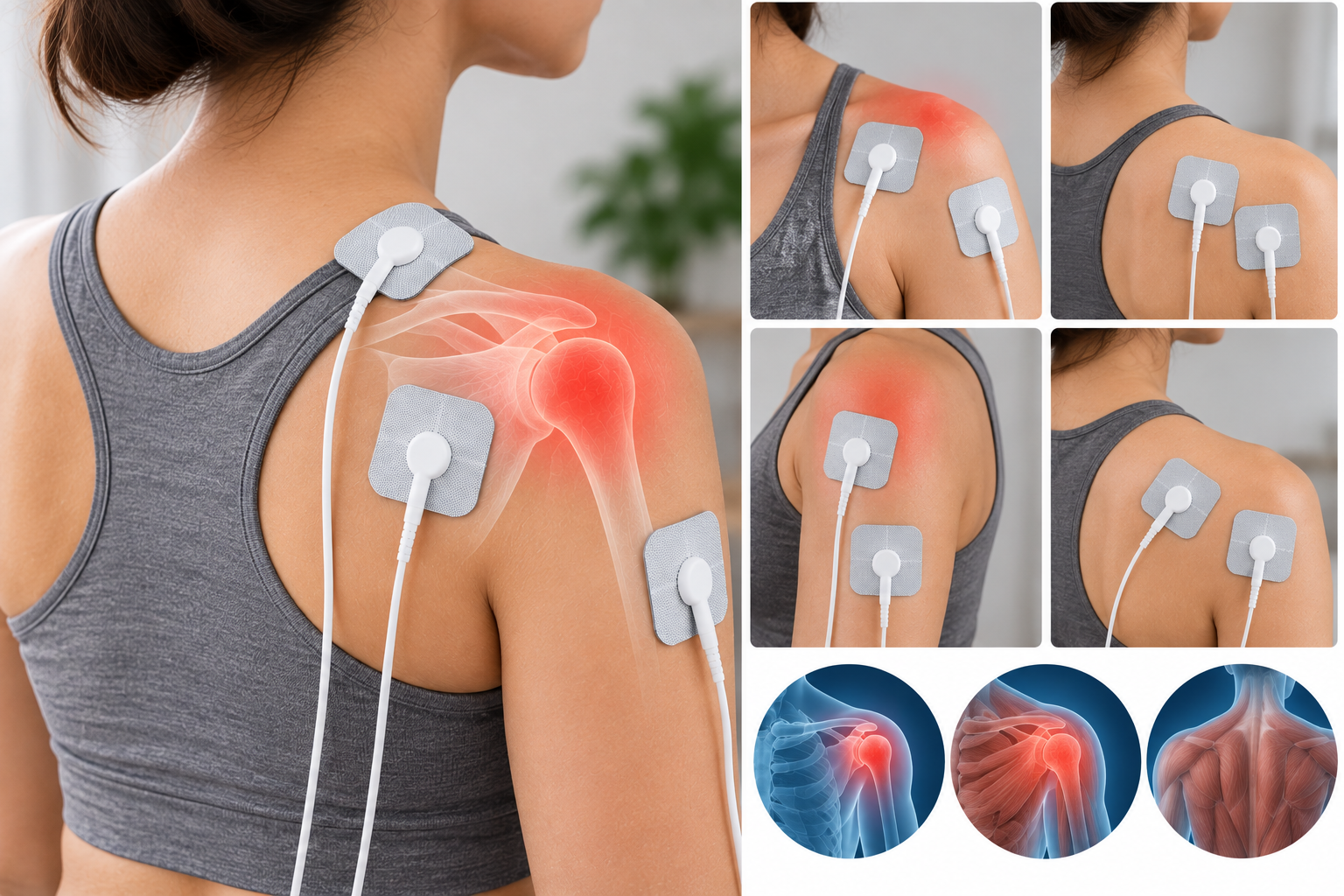
Best TENS Pad Placement for Shoulder Pain: Where to Put Electrodes Safely
Getting the TENS pad placement for shoulder pain right is important for comfortable and appropriate use of a TENS machine. However, shoulder placement requires particular care because the shoulder sits close to the neck and upper chest, areas where standard TENS electrodes should not be placed.
As a general principle, TENS electrodes are positioned on or around the painful area, following the instructions supplied with your particular machine or guidance from a healthcare professional. Cambridge University Hospitals advises that a physiotherapist can demonstrate where electrodes can be placed on or around the pain and can suggest alternative positioning when necessary.
For shoulder pain, however, do not place standard TENS pads on the neck, mouth or eyes. The NHS specifically lists the neck as an area where TENS should not be used.
The aim is not to place the electrodes directly on the most painful spot at all costs. Instead, you want a safe, comfortable arrangement that follows your device instructions and keeps the electrodes away from areas where TENS should not be applied.
Quick Answer: Where Should TENS Pads Go for Shoulder Pain?
For shoulder pain, TENS pads are generally positioned on or around the painful shoulder area, with the exact arrangement depending on where the pain is located, the size and shape of the electrodes and the instructions for your TENS machine.
A healthcare professional can demonstrate suitable positioning if you are unsure. Cambridge University Hospitals specifically recommends professional guidance for electrode placement and explains that electrodes may be positioned on or around the painful area.
There are several important safety rules:
- Do not place standard TENS pads directly on the neck.
- Do not place electrodes over the mouth or eyes.
- Do not place electrodes on broken, infected, irritated or numb skin.
- Keep the electrodes separated rather than allowing them to touch.
- Switch the machine off before applying or removing the pads.
- Start the stimulation at a low intensity and increase it gradually.
- Stop if the stimulation becomes painful or the skin becomes irritated.
The NHS states that TENS should produce a tingling sensation rather than pain and recommends removing the pads and switching off the machine if the skin becomes itchy, irritated or red.
Why TENS Pad Placement Matters for Shoulder Pain
TENS works by delivering a weak electrical current through electrodes placed on the skin. Where those electrodes are positioned affects where you feel the stimulation.
If the pads are too far away from the area you want to target, you may feel little stimulation where you expect it. If they are too close together, incorrectly positioned or placed on an unsuitable area, the experience may be uncomfortable or unsafe.
Correct placement can also make it easier to use a sensible intensity. You should not have to compensate for poor electrode contact or positioning by continually turning the machine up.
Cambridge University Hospitals advises that TENS electrodes should be positioned on or around the painful area and that the user should discuss placement with a healthcare professional when needed.
This is especially relevant to shoulder pain because the shoulder is close to the neck, chest and upper back.
Important Shoulder Safety Rule: Do Not Put TENS Pads on the Neck
This is the most important placement warning in this article.
The NHS says do not use TENS on your neck, mouth or eyes.
RNOH also specifically advises against placing TENS on the front or side of the neck.
Therefore, an article about TENS pad placement for shoulder pain should not instruct readers to place standard TENS electrodes directly across the neck simply because their pain extends towards that area.
If your shoulder pain spreads towards the neck, do not move the electrodes onto the neck to follow the pain.
Instead, speak to a healthcare professional about whether TENS is appropriate and, if so, where the electrodes can safely be positioned.
Suggested Diagram for This Section
Diagram idea: Front and back upper-body illustration showing the shoulder region as the potential placement area, with the front and side of the neck clearly marked “DO NOT PLACE TENS PADS HERE”. Keep the diagram educational rather than showing electrodes actually positioned on the neck.
General Principles for TENS Pad Placement Around the Shoulder
Before considering individual placement patterns, it helps to understand the basic principles.
Place electrodes around the painful area
TENS electrodes are generally placed on or around the area of pain. Your healthcare professional or device instructions should determine the specific arrangement.
Keep the pads apart
Electrodes should not touch each other. Cambridge University Hospitals advises keeping electrodes at least approximately 2 cm apart.
Use clean, dry skin
Clean and dry the skin before applying the electrodes. Do not place them over creams, lotions or other substances that could interfere with contact.
Avoid damaged skin
The NHS says not to use TENS on irritated, broken, infected or numb skin.
Avoid the neck
Even if pain extends towards the neck, do not place standard TENS electrodes there.
Make sure the pads are firmly attached
Poor contact can make stimulation feel weak or inconsistent.
Follow your machine’s instructions
Different TENS machines can use different electrode types, connection systems and recommended configurations.
Possible Placement Pattern: Around the Shoulder
When a healthcare professional has confirmed that TENS is appropriate, electrodes may be positioned around the painful shoulder area rather than directly over an unsafe region.
For example, depending on the individual situation and professional advice, electrodes may be positioned around the shoulder region so that the painful area sits between or near the electrode arrangement.
The exact location should not be treated as a universal prescription.
Shoulder pain can involve different areas, including the front, side or back of the shoulder. A placement that is appropriate for one person may not be appropriate for another.
Suggested Diagram
Diagram idea: A back/side view of the upper body with two electrodes shown around the shoulder region, clearly away from the neck. Add a caption such as “Example positioning only — follow your machine instructions or professional advice.”
This type of diagram is preferable to presenting one exact placement as “the correct” position for everyone.
Possible Placement Pattern: Above and Below the Painful Area
Another general principle used with TENS is to position electrodes so that the painful area is between them or close to the electrode arrangement.
For some shoulder pain patterns, a healthcare professional may demonstrate a suitable arrangement around the affected area.
The important distinction is that “above and below the painful area” does not mean placing a pad on the neck or directly over another unsafe area.
If the painful area extends towards the neck, ask a physiotherapist or other qualified healthcare professional to show you an appropriate alternative.
Possible Placement Pattern: Either Side of the Painful Area
Electrodes may also be positioned on either side of a painful area when appropriate.
This can be useful when the painful region is broad enough to accommodate two electrodes safely.
Again, the pads should remain separated and should be placed on suitable skin.
Your particular electrode size matters too. A large pad may require a different arrangement from two smaller pads.
Where Should TENS Pads Go for Shoulder Pain?
The safest answer is:
On or around the painful shoulder area, according to your machine’s instructions or guidance from a healthcare professional — but not on the neck, mouth or eyes.
There is no single electrode arrangement that can be recommended for every person with shoulder pain.
If your pain is mainly around the side or back of the shoulder, your physiotherapist may be able to demonstrate a suitable arrangement that stays within the safe placement area.
If the pain is close to the neck, do not simply put the electrode on the neck to get closer to the painful spot.
How to Prepare Your Skin Before Applying TENS Pads
Good skin preparation helps electrodes make consistent contact.
Clean the skin
Wash the area where the electrodes will be applied.
Dry the skin
Make sure it is completely dry before attaching the pads.
Avoid creams and lotions
Oily products can affect electrode adhesion.
Inspect the skin
Do not place electrodes over broken, infected, irritated or numb areas.
Check the electrode
Make sure the pad is clean, intact and still capable of adhering properly.
Cambridge University Hospitals recommends checking the skin underneath electrodes and moving the electrodes slightly if redness develops.
How to Apply TENS Pads for Shoulder Pain
Once you know that TENS is appropriate and have identified a suitable placement:
1. Switch the machine off
Always apply or remove electrodes with the machine switched off.
2. Prepare the skin
Make sure the skin is clean and dry.
3. Position the electrodes
Place the pads around the painful shoulder area according to your device instructions or professional guidance.
4. Check the spacing
Make sure the pads are not touching. Cambridge University Hospitals recommends approximately 2 cm or more between electrodes.
5. Check the safety zones
Make sure the electrodes are not on the neck, mouth, eyes or unsuitable skin.
6. Switch the machine on
Only turn the machine on after the electrodes are correctly positioned.
7. Start at low intensity
Gradually increase the stimulation.
8. Find a comfortable sensation
The NHS advises increasing the intensity until tingling is felt, but it should not be painful.
How Strong Should TENS Feel on the Shoulder?
TENS should normally feel like tingling, buzzing or pulsing.
The ideal intensity is not determined by a particular number because people have different sensitivities and machines have different output ranges.
Instead:
Start low → increase gradually → stop when the stimulation is strong but comfortable.
You should not deliberately increase the intensity until it becomes painful.
If the stimulation suddenly becomes sharp, painful or unpleasant, reduce the intensity.
RNOH advises increasing the intensity until the stimulation is strong but comfortable and reducing it if it becomes painful or uncomfortable.
What If the TENS Feels Weak?
Weak stimulation does not necessarily mean that you need to turn the machine up.
First check the basics.
Check the pads
Old or worn electrode pads may not stick properly.
Check the skin
Make sure the skin is clean and dry.
Check the leads
For a wired machine, make sure the connections are secure and the leads are undamaged.
Check the placement
Small changes in position can affect how the stimulation feels.
Check the programme
Changing frequency, pulse width or mode can alter the sensation.
If the pads are worn, replacing them may improve contact.
You can also read our guide on Why Does a TENS Machine Feel Weak? Causes, Fixes and What to Check for additional troubleshooting guidance.
How Often Should You Move TENS Pads?
If you use TENS regularly, pay attention to your skin.
Cambridge University Hospitals recommends checking the skin under the electrodes and moving them slightly if redness develops.
RNOH also advises avoiding applying electrodes to exactly the same spot every day.
Do not move the electrodes simply for the sake of moving them, however. The new position still needs to be appropriate for your shoulder and your machine.
If repeated use causes skin irritation, stop and seek advice if the problem does not settle.
Can You Put TENS Pads Directly Over the Shoulder Joint?
There is no universal requirement that TENS electrodes must be placed directly over the shoulder joint.
Placement should depend on the painful area, electrode size, machine instructions and professional guidance.
The safer approach is to position electrodes appropriately around the painful region while avoiding prohibited or unsuitable areas.
If you are unsure whether a particular spot over the shoulder is suitable, ask a physiotherapist or other healthcare professional to demonstrate the placement.
Should You Put One TENS Pad on the Shoulder and One on the Neck?
No.
Standard TENS should not be used on the neck. The NHS specifically states that TENS should not be used on the neck, mouth or eyes.
If you need an electrode arrangement that would require placing a pad on the neck, do not improvise.
Ask a healthcare professional about an alternative arrangement.
Suggested Diagram
Diagram idea: Show an incorrect example with one electrode on the shoulder and another on the side/front of the neck, crossed out with “DO NOT USE THIS PLACEMENT”. Beside it, show a safe conceptual shoulder-region arrangement with the neck left completely clear.
This type of diagram can prevent readers from interpreting shoulder-placement advice too broadly.
TENS Pad Placement and Electrode Size
The size of your electrodes can affect how easily they fit around the shoulder.
Small electrodes may be easier to position in a confined area, while larger electrodes cover more skin.
However, bigger does not automatically mean better.
When choosing electrode pads for shoulder pain, consider:
- Pad size
- Pad shape
- Connection type
- Adhesive quality
- Reusability
- Compatibility with your machine
TensLeads offers reusable electrodes in different sizes and connection types, allowing users to choose according to their particular TENS setup.
Always check the product specifications before ordering because not every electrode is compatible with every TENS machine.
Wired vs Wireless TENS for Shoulder Use
The design of the TENS machine can also affect how convenient electrode placement is.
Wired machines
Wired devices use leads between the control unit and electrodes.
They can provide a straightforward setup and may offer broad compatibility with replacement electrodes and leads, depending on the connector.
Wireless machines
Wireless systems reduce the number of external cables and may be more convenient for some users.
However, they may require specific compatible electrodes.
For shoulder use, consider which design makes it easiest for you to position the electrodes correctly without pulling on the pads or leads.
Does TENS Help Shoulder Pain?
TENS may provide temporary pain relief for some people, but it does not work for everyone.
The NHS describes TENS as a treatment that may help certain short- and long-term pain, but also states that it is not effective for everyone.
Shoulder-specific evidence is less certain. A Cochrane review of electrotherapy for rotator cuff disease found very low-certainty evidence and concluded that it was uncertain whether TENS improved pain and function compared with placebo.
Therefore, it is more accurate to describe shoulder pain TENS therapy as a potential temporary pain-management option rather than a proven treatment for every shoulder condition.
TENS should not be used as a reason to ignore persistent or unexplained shoulder pain.
How Long Can TENS Be Used for Shoulder Pain?
There is no single session duration that applies to everyone.
Cambridge University Hospitals advises beginning with around 30–60 minutes and increasing duration if helpful, while noting that some people may use TENS for considerably longer under appropriate guidance.
Other NHS guidance gives different recommendations, so the instructions supplied with your machine and any advice from your healthcare professional should take priority.
For someone new to TENS, a shorter session can be a practical way to assess:
- Whether the stimulation feels comfortable
- Whether the electrodes stay attached
- Whether the skin becomes irritated
- Whether you notice temporary pain relief
Do not use TENS while sleeping, bathing, showering, driving or operating machinery.
Common TENS Pad Placement Mistakes for Shoulder Pain
Putting a pad on the neck
This is one of the most important mistakes to avoid. Standard TENS should not be used on the neck.
Putting electrodes too close together
Leave adequate space between the pads.
Placing electrodes over broken skin
Avoid broken, irritated, infected or numb skin.
Applying pads over creams or lotions
These can interfere with adhesion and contact.
Putting electrodes wherever the pain travels
Pain can extend towards the neck or other areas, but that does not mean electrodes can safely be placed there.
Using worn electrodes
Old pads may provide inconsistent contact.
Increasing intensity to compensate for poor placement
Check the pads, leads and placement first.
Copying someone else’s placement exactly
The appropriate arrangement can depend on the individual, machine and electrode configuration.
Assuming TENS treats the underlying shoulder condition
TENS may provide temporary relief, but it does not diagnose or necessarily treat the cause of shoulder pain.
Ignoring worsening symptoms
Persistent or worsening shoulder pain may require assessment rather than continued self-management.
A Shoulder TENS Placement Checklist
Before starting your session, check:
| Check | What to look for |
| Skin | Clean, dry and intact |
| Pads | In good condition and sticking properly |
| Placement | On or around the painful shoulder area |
| Neck | Completely clear of standard TENS electrodes |
| Mouth/eyes | Electrodes kept away |
| Spacing | Pads not touching |
| Leads | Secure and undamaged |
| Machine | Switched off while applying pads |
| Intensity | Started low and increased gradually |
| Sensation | Strong but comfortable tingling |
| Skin after use | No persistent irritation or redness |
| Activity | Not driving, bathing, showering or sleeping |
When Should You Speak to a Healthcare Professional?
TENS should not replace an assessment when shoulder pain is persistent, severe or unexplained.
The NHS recommends seeing a GP if shoulder pain is getting worse, has not improved after two weeks or it is very difficult to move the arm or shoulder.
You should seek appropriate medical advice rather than relying on TENS if you have significant symptoms following an injury, major loss of movement, severe pain or other concerning symptoms.
For example, if you have injured your shoulder and cannot move your arm or your shoulder looks out of place or has changed shape, the NHS advises seeking urgent medical help because this can be associated with a dislocation.
Community NHS musculoskeletal services may also provide assessment and physiotherapy for shoulder pain in many areas.
Choosing TENS Equipment for Shoulder Pain
Once you understand safe electrode placement, choosing the right equipment becomes easier.
For a TENS machine shoulder pain setup, useful features may include:
Adjustable intensity: Allows gradual increases from a low starting level.
Multiple programmes: Provides different stimulation patterns to try.
Clear controls: Makes the machine easier to operate.
Portable design: Useful for convenient stationary use around the home.
Suitable channels: A dual-channel device may provide additional placement flexibility, depending on the machine.
Compatible electrodes: Replacement pads should be easy to source.
Reasonable running costs: Include replacement electrodes when considering the overall price.
If you are comparing machines, read our guide to Best TENS Machine Features: What to Look for Before You Buy.
TENS Machines
TensLeads offers a range of TENS Machines, including portable digital, dual-channel and wireless options.
When choosing a device for shoulder use, focus on the controls and electrode compatibility rather than simply selecting the machine with the largest number of programmes.
Replacement Electrode Pads
TensLeads also offers Replacement Electrode Pads in different sizes and connection types.
If your existing electrodes are becoming worn, losing adhesion or providing inconsistent contact, replacing the pads may be all you need rather than replacing the entire TENS machine.
Always check compatibility before ordering.
Explore TENS Machines; Replacement Electrode Pads
Ready to compare your options? Explore TENS Machines; Replacement Electrode Pads through the TensLeads product range.
Key Takeaways
The best TENS pad placement for shoulder pain is not one fixed position. Placement should be based on the painful area, your electrode configuration, machine instructions and, where needed, professional guidance.
Do not place standard TENS electrodes on the neck. The NHS specifically advises against using TENS on the neck, mouth or eyes.
Keep electrodes separated. Cambridge University Hospitals advises leaving approximately 2 cm or more between electrodes.
Use clean, dry, intact skin. Do not place electrodes over broken, infected, irritated or numb areas.
Start at a low intensity. Gradually increase stimulation until it feels noticeable and comfortable. TENS should not be painful.
Check your pads and leads. Worn electrodes or damaged leads can contribute to poor or inconsistent stimulation.
Do not use TENS while sleeping, bathing, showering, driving or operating machinery.
TENS may provide temporary shoulder pain relief for some people. However, shoulder-specific evidence remains uncertain, particularly for conditions such as rotator cuff disease.
TENS does not cure the underlying cause of shoulder pain. Persistent or unexplained symptoms should be appropriately assessed.
Safety Disclaimer
This article provides general information about TENS pad placement for shoulder pain and is not personalised medical advice or a diagnosis. TENS does not work for everyone and should not be used to delay assessment of persistent, worsening or unexplained shoulder pain. The NHS advises against using TENS on the neck, mouth or eyes and on broken, irritated, infected or numb skin. It also advises against using TENS while sleeping, bathing, showering, driving or operating machinery.
If you have a pacemaker or epilepsy, or are pregnant, check with an appropriate healthcare professional before using TENS. If you are unsure where to place the electrodes, ask a GP, physiotherapist or other qualified healthcare professional to demonstrate a suitable arrangement. Always follow the instructions supplied with your particular TENS machine.