
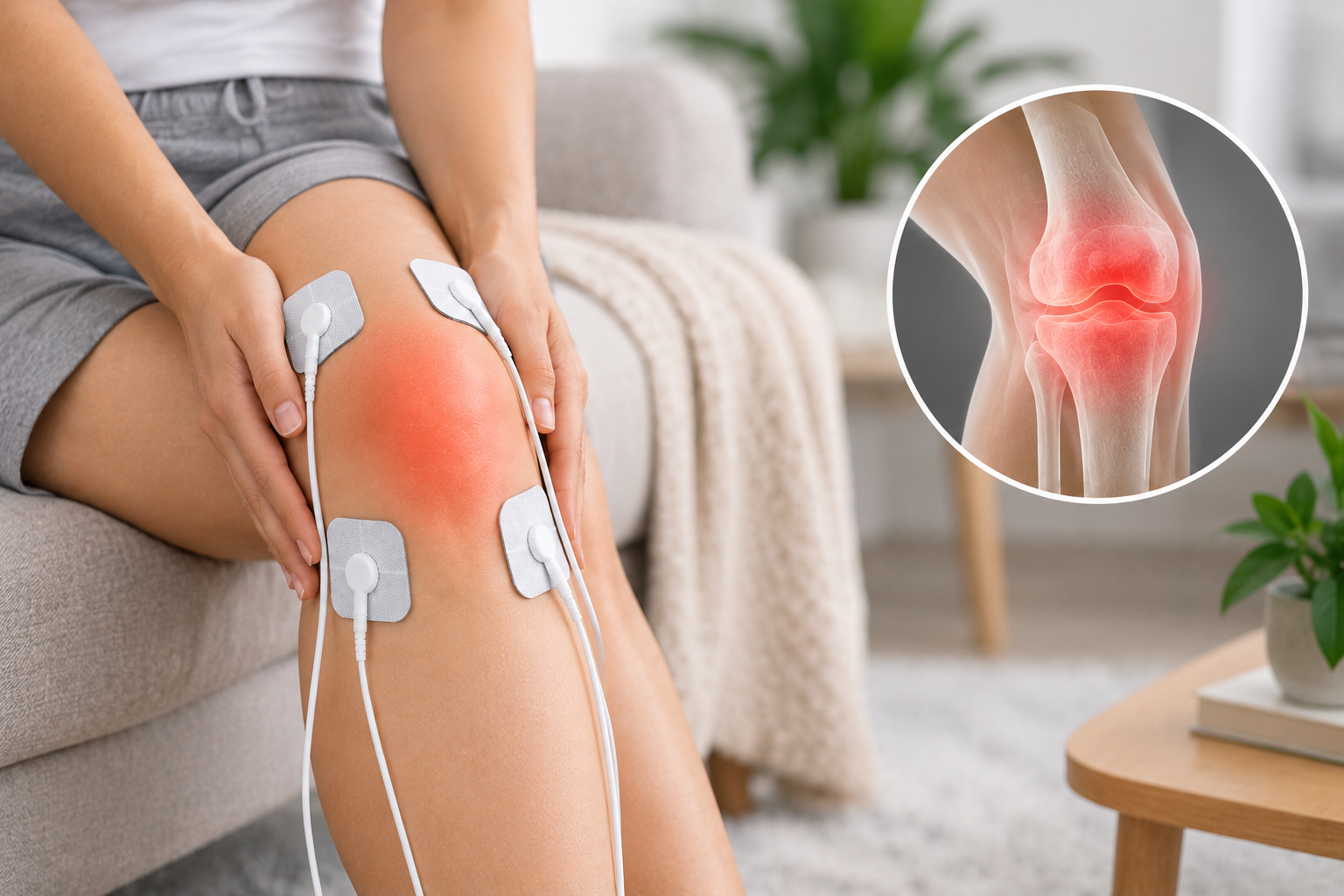
Best TENS Machine for Knee Pain: UK Buying Guide
Choosing the best TENS machine for knee pain is not simply about finding the device with the highest intensity or the greatest number of programmes. A good knee-pain TENS setup should be easy to use, allow gradual adjustment of stimulation, work with suitable electrode pads for knee pain, and offer enough flexibility to position the electrodes around the painful area comfortably.
For many people, portability also matters. Knee pain can interfere with walking, working, exercising and everyday activities, so a compact TENS machine that can be carried in a pocket or clipped to clothing may be more convenient than a larger unit.
There is also an important medical point to understand before buying. TENS can provide temporary pain relief for some people, but it does not work for everyone and does not treat the underlying cause of knee pain. The NHS advises that TENS may help certain short- and long-term pain, while NICE does not recommend TENS as a routine treatment for osteoarthritis because the evidence does not establish sufficient benefit.
Therefore, the best TENS machine for knee pain is the one that gives you appropriate control, compatible electrodes, practical portability and a comfortable user experience — rather than simply the machine with the most features.
Quick Answer: What Is the Best TENS Machine for Knee Pain?
The best TENS machine for knee pain should ideally have:
- Adjustable intensity so you can start low and gradually increase stimulation.
- Multiple TENS programmes so you are not restricted to one fixed stimulation pattern.
- Adjustable settings, where available, for greater control over frequency and pulse width.
- A suitable number of channels for the way you intend to position your electrodes.
- Portable, easy-to-use controls if you want to use TENS while moving around at home.
- Compatible replacement electrode pads that are easy to source.
- Clear instructions and appropriate safety information.
- A reasonable total ownership cost, including replacement pads and leads.
A device with these features gives you more flexibility when using knee pain TENS therapy, but having more controls does not automatically mean better pain relief.
The NHS recommends starting TENS at a low intensity and gradually increasing it until you feel tingling, without making the stimulation painful.
Why Choose a TENS Machine for Knee Pain?
TENS, or transcutaneous electrical nerve stimulation, uses a small electrical current delivered through electrodes placed on the skin. The NHS describes TENS as a treatment that can provide temporary pain relief and notes that it may help some types of short- and long-term pain, although it does not work for everyone.
A TENS machine can be attractive because it is:
Non-invasive: Electrodes sit on the skin rather than requiring an injection or surgical procedure.
Portable: Many modern units are small enough to carry around.
Adjustable: Depending on the model, you may be able to change intensity, frequency, pulse width or programme.
User-controlled: You can usually adjust the stimulation according to how it feels, provided you stay within the manufacturer’s instructions.
However, TENS should be viewed as a potential pain-management tool rather than a treatment that fixes the cause of knee pain.
If you have persistent, unexplained or worsening knee pain, it is important to seek appropriate medical advice rather than simply increasing TENS use.
What Should You Look for in the Best TENS Machine for Knee Pain?
Not every feature advertised on a TENS machine is equally important.
When shopping specifically for knee use, concentrate on the features that affect comfort, control, convenience and ongoing cost.
1. Adjustable Intensity
Adjustable intensity is one of the most useful features to look for.
When starting TENS, NHS guidance recommends beginning at a low level and gradually increasing the intensity until you feel a tingling sensation. It should not be painful.
A machine with multiple intensity levels makes this gradual adjustment easier.
For example, TensLeads’ Portable Digital TENS & EMS Machine offers 16 adjustable intensity levels. This provides a relatively straightforward way to increase stimulation progressively rather than jumping directly between a small number of fixed levels.
The important point is not the maximum intensity available. It is whether the machine gives you enough control to find a comfortable level.
2. Multiple TENS Programmes
Different programmes alter the pattern of electrical stimulation.
Depending on the machine, you may find options such as continuous, burst or modulation programmes, as well as preset programmes.
Having several programmes can be useful if you find that one pattern is more comfortable than another. However, more programmes do not necessarily mean better clinical results.
Clinical TENS guidance recommends using settings that are comfortable for the individual, and NHS guidance recognises that TENS does not work for everyone.
For a buyer, the practical advantage of multiple programmes is flexibility.
3. Adjustable Frequency and Pulse Width
Some TENS machines allow you to adjust frequency and pulse width manually.
Frequency determines how quickly the electrical pulses are delivered, while pulse width determines the duration of each pulse.
This can be useful if you want greater control over the sensation.
However, you do not necessarily need a machine with every possible adjustment. If you prefer simplicity, a device with well-designed preset programmes may be easier to use.
Our guide to Best TENS Settings for Knee Pain explains frequency, pulse width, intensity and gradual adjustment in more detail.
4. Number of Channels
Channel configuration is another useful consideration.
A single-channel machine generally allows one pair of electrodes to be connected at a time.
A dual-channel machine provides greater flexibility because it can allow two electrode circuits to be used simultaneously, depending on the design and instructions.
For knee pain, two-channel capability can be useful if you want to position electrodes around different parts of the knee or potentially address more than one area. However, more channels are not automatically necessary.
Think about how you actually expect to use the machine.
If you want simple, targeted use: A straightforward single-channel setup may be sufficient.
If you want greater placement flexibility: A dual-channel machine may be worth considering.
If you experience pain in more than one area: Additional channels may offer greater practical flexibility, subject to the device instructions.
5. Portability
Portability is particularly useful for people who do not want to remain in one place during a TENS session.
Cambridge University Hospitals notes that TENS units can be clipped to a waistband or placed in a pocket and should not interfere with normal movement. RNOH similarly describes TENS machines as small and lightweight.
When comparing machines, consider:
- Overall size
- Weight
- Battery requirements
- Control layout
- Lead length, if applicable
- Whether the unit has a belt clip
- Whether you can easily see and adjust the controls
A compact machine can be particularly convenient for home use.
Remember, however, that NHS guidance says you should not use TENS while driving or operating machinery.
6. Electrode Pad Compatibility
A TENS machine is only as useful as the electrode setup you can use with it.
Before buying, check the connection type carefully.
TensLeads supplies different electrode formats, including standard stud connections, pin-style electrodes and other specialised designs. Its product range includes 3.5mm stud pads, 2mm pin-compatible pads and pads designed for particular wireless machines.
Do not assume that every TENS pad fits every machine.
Check:
Connection type: Is the machine designed for stud/snap or pin electrodes?
Connector size: Different systems may use different connector dimensions.
Wired or wireless: Wireless systems can require specific replacement electrodes.
Pad size: Larger pads may cover a wider area, while smaller pads can provide more targeted placement.
Availability: Replacement pads should be easy to purchase when the originals become worn.
This is particularly important for a BOFU purchase because replacement electrodes form part of the machine’s long-term cost.
7. Replacement Pad Cost
The initial price of a TENS machine is only part of what you will spend.
Electrode pads are consumable accessories. Their adhesive and conductive properties can deteriorate with repeated use, so replacement pads eventually become necessary.
This makes total cost of ownership a useful way to compare machines.
For example, TensLeads currently lists:
- 4 × 4 cm reusable TENS pads at £4.10
- A 12-piece size variety pack at £13.99
- 5 × 9 cm reusable pads at £5.49
- TENS electrode pads for knee and shoulder use at £6.49
- Mini stud TENS pads at £6.99
Prices can change, so check the product page before purchasing.
A machine that looks inexpensive initially may become less economical if its replacement electrodes are difficult to source or unusually expensive.
8. Lead Compatibility and Replacement Leads
If you choose a wired TENS machine, also check whether replacement leads are readily available.
A damaged lead can make an otherwise functional TENS machine difficult or impossible to use.
TensLeads offers replacement leads with different connector configurations, including 2.5mm plug to 2.0mm pin connections. The company specifically advises checking your machine’s plug size and electrode connection type before purchasing.
This is another reason to check compatibility before buying rather than assuming that all TENS accessories are interchangeable.
Best TENS Machine Features for Knee Pain: At a Glance
| Feature | Why it matters for knee use | Priority |
| Adjustable intensity | Helps you increase stimulation gradually | High |
| Multiple TENS programmes | Provides flexibility in stimulation patterns | High |
| Adjustable frequency | Allows more control over pulse rate | Useful |
| Adjustable pulse width | Allows additional control over sensation | Useful |
| Dual channels | Can provide greater electrode-placement flexibility | Useful |
| Compact design | Easier to carry and store | High |
| Clear controls | Makes adjustments easier | High |
| Compatible replacement pads | Important for long-term use | High |
| Replacement leads available | Useful for wired systems | Useful |
| Auto timer | Convenient for controlled sessions | Useful |
| TENS + EMS | Adds another stimulation function, but is not essential for TENS pain relief | Optional |
Do You Need TENS + EMS for Knee Pain?
You may come across machines marketed as both TENS and EMS devices.
TENS and EMS are not the same thing.
TENS is generally used for electrical nerve stimulation and pain management, while EMS is designed for muscle stimulation. Having both functions can be useful if you have a reason to use EMS, but you do not need EMS simply to use TENS for knee pain.
If your main objective is TENS-based pain management, prioritise good TENS controls, appropriate electrode compatibility and ease of use rather than choosing a machine solely because it includes EMS.
If you are considering a TENS/EMS combination machine, read the instructions carefully and make sure you understand which programme you are selecting.
Wired vs Wireless TENS Machines for Knee Pain
Both wired and wireless designs can be practical, but they offer different advantages.
Wired TENS Machines
A conventional wired machine connects to electrode pads using lead wires.
Advantages can include:
- Familiar design
- Broad electrode compatibility depending on connector type
- Easy replacement of leads
- Potentially greater choice of electrode sizes and shapes
The main drawback is that the leads can be more noticeable when moving around.
Wireless TENS Machines
Wireless systems can reduce or eliminate external lead wires between the control unit and electrodes.
Advantages may include:
- Less cable management
- Greater freedom of movement
- Compact design
- Convenient everyday use
However, wireless machines may require specific compatible replacement electrodes.
Before buying a wireless TENS machine, check the cost and availability of its replacement pads.
Which Is Better for Knee Pain?
Neither design is automatically better.
If you prioritise maximum accessory flexibility, a wired system may suit you.
If you prioritise convenience and freedom from cables, a wireless model may be more attractive.
The right choice depends on how you expect to use the machine.
How Many Channels Do You Need?
A common question when comparing TENS machines is whether one or two channels are better.
For straightforward knee use, one channel may be enough.
A dual-channel machine can provide more flexibility for electrode positioning, but that does not mean you need to stimulate two separate areas simultaneously.
Think about your intended setup rather than buying based solely on the channel count.
For simple knee pain use: One channel may be sufficient.
For greater flexibility: Two channels may be useful.
For multiple treatment areas: Additional channels may provide more options, depending on the manufacturer’s instructions.
If you are buying your first TENS machine, ease of use may be more important than having the maximum number of channels.
What Type of Electrode Pads Are Best for Knee Pain?
There is no single electrode shape that is medically “best” for every knee.
The most important considerations are appropriate placement, good skin contact, compatibility and comfort.
TensLeads offers several reusable electrode options, including standard square pads, round pads and a dedicated TENS Electrode Pads for Knee & Shoulder product.
When choosing electrode pads for knee pain, consider:
Size: Larger pads may provide wider coverage, while smaller pads can be easier to position around a smaller area.
Shape: The shape should suit the area where the electrodes will be positioned.
Connection: The pad must match your machine or lead connection.
Adhesion: Pads should attach securely to clean, dry skin.
Reusability: Reusable electrodes can reduce the cost of repeated sessions.
The NHS recommends placing pads on clean skin near the painful area and leaving a gap between them. It also advises against using TENS on irritated, broken, infected or numb areas of skin.
Where Should TENS Pads Go for Knee Pain?
TENS pads are generally positioned on or around the painful area, according to the instructions supplied with your machine or guidance from a healthcare professional.
NHS guidance gives an example of electrodes positioned above and below the knee. Other NHS guidance recommends placing electrodes around the painful area and ensuring they do not touch each other.
The exact position should depend on where you experience pain and the specific electrode configuration.
If you are unsure, a GP, physiotherapist or other healthcare professional can advise you on suitable placement.
For a more detailed explanation, see Best TENS Pad Placement for Knee Pain.
What TENS Settings Should You Look for in a Knee Machine?
If you are buying a TENS machine specifically because you want control over knee pain TENS therapy, look for a device that allows gradual adjustment.
Useful controls may include:
Intensity: Allows you to control the strength of the sensation.
Frequency: Changes how quickly the electrical pulses are delivered.
Pulse width: Changes the duration of individual pulses.
Programme: Changes the pattern of stimulation.
The exact settings available vary considerably between machines.
Our guide to Best TENS Settings for Knee Pain explains these controls in detail and discusses why there is no single universally correct frequency or pulse width.
The key point is that more adjustable controls provide flexibility, but they do not guarantee better pain relief.
How Important Is Portability for Knee Pain?
Portability can make a major difference to whether you actually use a TENS machine regularly.
A machine that is uncomfortable to carry or complicated to operate may end up sitting in a drawer.
A compact unit can be easier to use while sitting at home, reading, watching television or performing other suitable stationary activities.
Cambridge University Hospitals notes that a TENS unit can be clipped to clothing or placed in a pocket.
However, portable does not mean suitable for every activity. The NHS specifically advises against using TENS while driving or operating tools and machinery.
How Much Should You Spend on a TENS Machine for Knee Pain?
Price alone should not determine your decision.
Instead, consider three costs:
Initial machine price
How much you pay for the TENS unit itself.
Replacement electrode cost
How much replacement pads cost and how readily they are available.
Replacement accessories
Whether you may eventually need replacement leads, chargers, batteries or other accessories.
A machine that costs slightly more initially may provide better value if it has useful adjustable controls and affordable, readily available replacement electrodes.
Conversely, an inexpensive machine may not represent good value if compatible replacement pads are difficult to find.
This is why checking the complete accessory ecosystem before purchasing can be more useful than comparing machine prices alone.
A Practical Buying Checklist
Before purchasing the best TENS machine for knee pain for your needs, check:
- Intensity: Does it offer enough adjustment levels for gradual increases?
- Programmes: Are there multiple TENS modes?
- Frequency: Can it be adjusted if you want more control?
- Pulse width: Is this adjustable if that feature matters to you?
- Channels: Is one or two channels more appropriate for your intended use?
- Portability: Is it small and light enough for your routine?
- Controls: Can you understand the display and buttons easily?
- Pads: Are compatible electrode pads readily available?
- Connection: Do you know whether the machine uses pin, stud or another connection?
- Replacement pads: What will they cost over time?
- Leads: If wired, can replacement leads be purchased?
- Instructions: Are clear operating and safety instructions provided?
- Timer: Does the machine have an automatic timer if you find that useful?
- Certification: If purchasing in the UK, check the product’s regulatory and safety information and look for appropriate marking as advised by current UK requirements.
TENS Machines for Knee Pain: What Features Actually Matter?
It is easy to be distracted by long lists of specifications.
For most buyers, the most useful features can be grouped into four areas.
Control: Adjustable intensity and useful programme options.
Comfort: Reliable electrode contact and the ability to find a comfortable stimulation level.
Convenience: Portability, clear controls and an appropriate timer.
Long-term value: Affordable, compatible replacement electrodes and accessories.
If a machine performs well in these four areas, it may be a more practical choice than a device that simply has a longer specification list.
TENS Machines
TensLeads currently offers a range of TENS machines, including portable digital TENS/EMS, dual-channel and wireless options. The range is designed around different preferences for controls, portability and stimulation programmes.
When comparing a TensLeads machine with another device, look beyond the headline price and compare the features that matter to your intended use: intensity adjustment, programmes, channel configuration, electrode compatibility and replacement-pad availability.
You can view the current range of TENS Machines on the TensLeads products page.
Replacement Electrode Pads
Replacement electrodes should be part of your buying decision from the beginning.
TensLeads currently stocks a range of reusable electrode pads, including different sizes, shapes and connection types. Its variety pack contains 12 reusable pads in two sizes and uses a standard 3.5mm stud connection, with compatibility listed for Beurer, Sanitas and many other TENS machines.
Always check the connection type and machine compatibility before ordering.
If you already have a TENS machine but need new electrodes, replacing worn pads can be a more economical option than replacing the entire device.
TENS and Knee Pain: What the Evidence Says
It is important not to confuse a product buying guide with a medical recommendation.
The NHS says TENS can provide temporary pain relief and may help certain types of short- and long-term pain, but it also states that TENS does not work for everyone.
For osteoarthritis specifically, the evidence is more cautious. NICE’s evidence review considered electrotherapy interventions including TENS and found uncertainty around their effectiveness. NICE’s current osteoarthritis recommendations therefore do not recommend electrotherapy such as TENS as a routine treatment.
This does not mean that a person can never experience temporary relief from TENS. It means that you should not purchase a TENS machine on the assumption that it will treat or reverse osteoarthritis.
For persistent knee pain, appropriate management may involve assessment, exercise and other treatments depending on the underlying condition.
Does TENS Help Knee Pain?
TENS may provide temporary pain relief for some people, but it does not work for everyone. The NHS describes TENS as a treatment that may help certain types of short- and long-term pain.
However, if your knee pain is caused by osteoarthritis, NICE does not recommend TENS as a routine treatment because the evidence for electrotherapy is not strong enough to support routine use.
If you have unexplained or persistent knee pain, speak with an appropriate healthcare professional rather than relying solely on a TENS machine.
Where Should TENS Pads Go for Knee Pain?
Pads are generally positioned on or around the painful knee area, with sufficient space between electrodes. NHS guidance provides an example of pads above and below the knee.
Placement can affect the sensation, so follow your machine’s instructions or ask a healthcare professional to demonstrate appropriate positioning if you are unsure.
Never place TENS electrodes on broken, irritated, infected or numb skin.
For a step-by-step guide, read Best TENS Pad Placement for Knee Pain.
How Long Can TENS Be Used for Knee Pain?
The appropriate duration depends on the machine, the individual and the guidance provided.
Cambridge University Hospitals advises starting with 30–60 minutes and increasing the duration if TENS is helpful, while RNOH provides a different general recommendation of up to 60 minutes at a time, usually up to three times per day. This difference demonstrates why your own device instructions and clinical advice should take priority over a generic timetable.
Do not sleep while using TENS. Do not use it in the bath or shower, and do not use it while driving or operating machinery.
When Should You Not Buy or Use a TENS Machine Without Medical Advice?
TENS is not suitable for everyone.
The NHS advises against using TENS if you have epilepsy or a pacemaker and says that people who are pregnant should only use it if their doctor or midwife advises them to.
You should also avoid using TENS over irritated, broken, infected or numb skin.
If you are unsure whether TENS is suitable for you, check with a GP, physiotherapist or another qualified healthcare professional before using it.
You should not use a TENS machine simply to delay assessment of new or unexplained knee pain.
When Should Knee Pain Be Assessed?
A TENS machine is not a substitute for medical assessment.
Seek appropriate medical advice if knee pain persists, becomes significantly worse or interferes with normal activities.
More urgent assessment may be needed if the knee is very painful, cannot be moved or cannot bear weight, is badly swollen or has changed shape.
The NHS provides further guidance on when knee pain needs medical assessment and what symptoms should prompt urgent help.
How to Choose: A Simple Decision Guide
If you are still deciding between TENS machines, ask yourself these questions.
Do you want maximum simplicity?
Choose a straightforward machine with clear controls and useful preset programmes.
Do you want greater control?
Look for adjustable intensity, frequency and pulse width.
Do you want to move around more easily?
Consider a compact or wireless design.
Do you want to treat more than one electrode arrangement?
A dual-channel machine may provide additional flexibility.
Do you want to keep long-term costs low?
Check replacement electrode prices and compatibility before purchasing.
Do you already own a TENS machine?
You may only need compatible replacement electrode pads or leads rather than a new device.
Key Takeaways
The best TENS machine for knee pain is not necessarily the most powerful machine. Focus on adjustability, comfort, compatibility and ease of use.
Adjustable intensity is one of the most important features. The NHS recommends gradually increasing stimulation until you feel tingling without pain.
Multiple programmes can provide flexibility. However, more programmes do not automatically mean better pain relief.
Frequency and pulse width controls are useful but not essential for everyone. Choose based on how much control you want over the stimulation.
Dual channels can provide additional flexibility. But a single-channel machine may be perfectly adequate for straightforward knee use.
Portability can make regular use easier. Compact machines can be carried in a pocket or clipped to clothing, although TENS should never be used while driving or operating machinery.
Electrode compatibility matters. Always check the connection type before buying replacement pads.
Replacement-pad cost should be included in your buying decision. The machine is only part of the long-term cost.
TENS can provide temporary pain relief for some people. It does not work for everyone and should not be presented as a cure.
For osteoarthritis, the evidence is limited. NICE does not recommend TENS as a routine electrotherapy treatment for osteoarthritis.
Products
TENS Machines
Compare TensLeads’ range of TENS Machines according to the features that matter to you, including portability, programmes, intensity adjustment and channel configuration.
Replacement Electrode Pads
Keep your TENS setup working effectively by replacing worn electrodes with compatible Replacement Electrode Pads. TensLeads offers different sizes, shapes and connection types to suit different machines.
Explore TENS Machines; Replacement Electrode Pads
Ready to compare your options? Explore TENS Machines; Replacement Electrode Pads through the TensLeads product range.
Safety Disclaimer
This article provides general information about choosing and using a TENS machine for knee pain and is not personalised medical advice or a diagnosis. TENS does not work for everyone and does not treat the underlying cause of knee pain. The NHS advises against TENS for people with epilepsy or a pacemaker and recommends that pregnant people use it only if advised by a doctor or midwife. Do not use TENS on irritated, broken, infected or numb skin, while sleeping, in the bath or shower, or while driving or operating machinery.
If you are unsure whether TENS is suitable for you, have persistent or unexplained knee pain, or have significant swelling, difficulty bearing weight or other concerning symptoms, seek advice from a GP, physiotherapist or other qualified healthcare professional. Always follow the instructions supplied with your particular TENS machine.