
TENS for Knee Pain: Does It Help and How to Use It Safely
If you are considering TENS for knee pain, it may be worth understanding what the treatment can realistically do before buying a machine or applying electrode pads. TENS uses a small electrical current delivered through adhesive electrodes to produce a tingling sensation and can provide temporary pain relief for some people. However, it does not work for everyone and it should not be viewed as a cure for the underlying cause of knee pain. (nhs.uk)
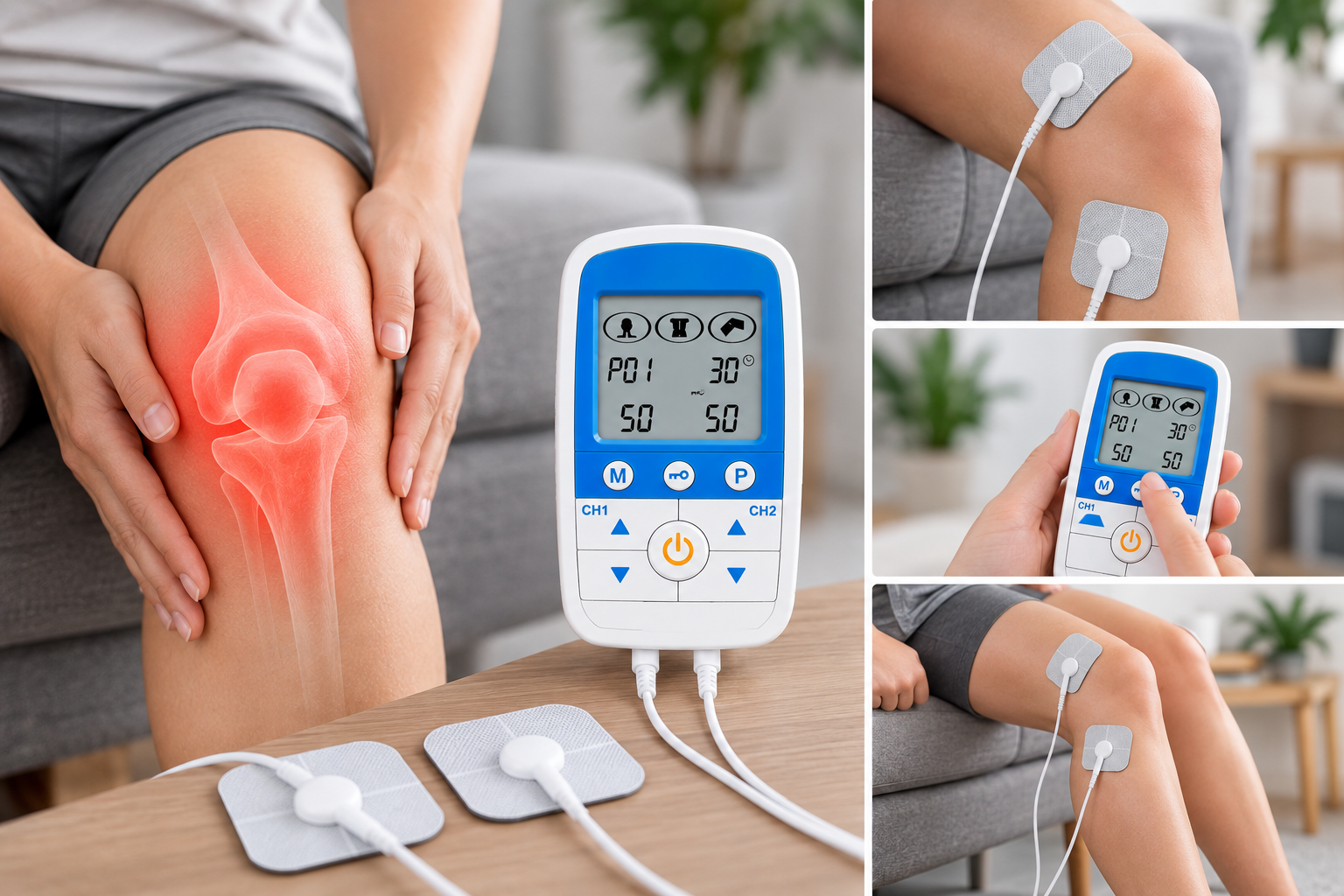
For knee pain, electrode placement is generally more straightforward than for areas such as the neck. NHS guidance illustrates TENS pads positioned above and below the knee, while hospital TENS guidance commonly recommends positioning electrodes either side of the painful area with an appropriate gap between them. (nhs.uk)
The most important things are to use clean, intact skin, keep the pads separated, start at a low intensity and increase gradually to a strong but comfortable sensation. You should also follow the instructions for your specific TENS machine knee pain setup and seek professional advice if you are unsure whether TENS is suitable for you.
Quick Answer: Does TENS Help Knee Pain?
TENS may provide temporary relief for some people with knee pain. The NHS lists arthritis pain and sports-injury pain among the types of pain for which TENS may help, while also making clear that TENS does not work for everyone. (nhs.uk)
For knee pain, the basic approach is:
- Place the electrode pads on clean, dry, intact skin around the painful area.
- Keep the pads separated rather than allowing them to touch.
- For suitable knee applications, pads may be positioned above and below the knee or around the painful area, following your device instructions or professional advice.
- Start with the machine switched off while attaching the electrodes.
- Begin with low intensity.
- Increase gradually until you feel a noticeable, strong but comfortable tingling.
- Stop or reduce the intensity if stimulation becomes painful or uncomfortable.
- Check your skin after use.
- Do not use TENS while driving, bathing, showering or sleeping.
TENS should be considered a possible tool for knee pain pain relief, rather than a treatment that repairs the knee or guarantees lasting relief.
What Is TENS and How Can It Be Used for Knee Pain?
TENS stands for transcutaneous electrical nerve stimulation. A small battery-powered machine sends electrical impulses through electrodes attached to the skin. The sensation is usually described as tingling, buzzing or pulsing.
The NHS explains that TENS provides temporary pain relief and is thought to work partly by affecting pain signalling and encouraging the body to release natural pain-relieving chemicals. (nhs.uk)
The important word is temporary.
TENS may make pain easier to manage while it is being used, but it does not necessarily address why your knee hurts. RNOH similarly describes TENS as a way of providing short-term relief while the machine is switched on rather than a cure. (Royal National Orthopaedic Hospital)
This distinction is particularly important because knee pain can have many possible causes. NHS guidance lists problems ranging from sprains and strains to tendon problems, osteoarthritis, bursitis and other conditions. (nhs.uk)
You should therefore avoid assuming that TENS is appropriate simply because your symptoms are located around the knee.
Why Might Someone Try TENS for Knee Pain?
People may consider knee pain TENS therapy because they want an additional way to manage discomfort while continuing normal activities.
TENS is:
- Non-invasive
- Portable
- Controlled by the user
- Available in a range of machine designs
- Adjustable on many devices
- Compatible with reusable electrode pads
The NHS notes that TENS can be used for certain short-term and long-term pain conditions, including pain associated with arthritis and sports injuries. (nhs.uk)
However, evidence varies between conditions and individuals. It is more accurate to say that TENS may help with symptoms than to promise that it will relieve knee pain for everyone.
TENS for Knee Pain: What Does the Evidence Mean?
Evidence around TENS is not as simple as finding one study and declaring a particular machine or setting the “best”.
For example, NICE’s evidence review of electrotherapy for osteoarthritis evaluated studies using TENS alongside other interventions. One study described electrodes positioned around the patella and used a continuous TENS programme, with participants adjusting the stimulation to a strong but manageable sensory level. (NICE)
This demonstrates that TENS has been investigated for knee osteoarthritis, but it does not establish one electrode arrangement or numerical setting as universally appropriate.
Likewise, NHS guidance states that TENS does not work for everyone. (nhs.uk)
The sensible conclusion is therefore:
TENS may be useful for temporary symptom relief for some people, but individual response varies and it should not replace appropriate assessment or other recommended management.
Where Should TENS Pads Go for Knee Pain?
Knee placement is generally based around the painful area rather than directly over one specific “magic point”.
The NHS TENS guide includes an illustration showing electrode pads positioned above and below the knee. (nhs.uk)
General NHS hospital guidance also recommends positioning pads either side of the painful area and keeping them at least around 2.5 cm apart. (Dorset County Hospital)
A practical principle is therefore to position the electrodes around the painful area, while following the instructions supplied with your particular machine.
Do not place pads over:
- Broken skin
- Infected skin
- Irritated or inflamed skin
- Numb areas
- Areas where placement is prohibited by your machine instructions
And remember that electrode positioning should not be used to self-treat unexplained or severe knee symptoms without appropriate assessment.
For a more detailed placement guide, see Best TENS Pad Placement for Knee Pain.
A Simple Knee TENS Placement Approach
If you have been advised that TENS is appropriate for you, the general setup can be approached methodically.
1. Identify the area of discomfort
Think about where you actually feel the pain rather than automatically placing pads in the same position every time.
2. Check the skin
The area should be clean, dry and intact. Cambridge University Hospitals advises against placing electrodes on broken skin and recommends checking the skin during use. (Cambridge University Hospitals)
3. Keep the pads apart
Electrodes should not touch. NHS hospital guidance commonly recommends leaving at least 2–3 cm between them. (Dorset County Hospital)
4. Attach the electrodes while the machine is switched off
This is an important basic safety step. (nhs.uk)
5. Turn the machine on and increase intensity gradually
The sensation should become noticeable but remain comfortable.
6. Monitor the skin
If redness, soreness or irritation develops, switch off the machine and remove the electrodes.
Suggested Diagram: TENS Pad Placement Around the Knee
A useful visual for this article would show a front and side view of a knee, with two electrodes positioned above and below the knee and a clear gap between them.
The diagram should also include a small safety panel showing:
DO: clean, dry skin; separated pads; low-to-gradual intensity.
DO NOT: place electrodes on broken, infected or numb skin; allow pads to touch; use TENS in water.
The illustration should be presented as a general educational example, not a personalised medical prescription.
How Should TENS Feel on the Knee?
TENS should generally feel like tingling, buzzing or pulsing.
It should not feel like sharp pain.
NHS guidance recommends turning the dial slowly until you feel a tingling sensation. (nhs.uk)
Dudley Group NHS Foundation Trust similarly advises starting at a low setting and gradually increasing the intensity until the sensation feels strong but comfortable. If it becomes painful or uncomfortable, the intensity should be reduced. (The Dudley Group NHS Foundation Trust)
This gives you a useful rule:
Strong enough to notice, comfortable enough to tolerate.
You do not need to chase the highest number on the machine.
What TENS Settings Should You Use for Knee Pain?
There is no single frequency, pulse width and intensity combination that can be recommended for everyone with knee pain.
TENS machines can offer different combinations of frequency, pulse width, intensity and programme modes. NHS patient information explains that changing pulse rate/frequency and pulse width alters the sensation, while the intensity determines how strong the stimulation feels. (Cambridge University Hospitals)
Some clinical studies use specific settings. For example, one NICE evidence-review study used continuous TENS at 150 Hz with a 150 μs phase duration and allowed participants to adjust amplitude to a strong, manageable sensory level. (NICE)
But this should not be interpreted as a universal prescription.
Your machine may use different controls, and the most comfortable setting can vary between individuals.
If you want to understand the controls in more detail, our guide to Best TENS Settings for Knee Pain can explain frequency, pulse width, intensity and programme selection.
Should You Use a Preset TENS Programme?
Many modern TENS machines offer preset programmes.
A preset can be a convenient starting point, particularly if you are new to TENS, but the programme name does not mean it has been medically prescribed for your particular knee problem.
A “knee” or “joint” programme, where available, should be understood as a machine setting rather than a diagnosis or guarantee of effectiveness.
If a healthcare professional has recommended particular settings, follow their instructions instead.
How Long Can TENS Be Used for Knee Pain?
There is no single treatment duration suitable for everyone.
Different NHS services provide different general recommendations. RNOH advises a maximum of 60 minutes at a time and usually up to three times a day, while Cambridge University Hospitals describes starting with 30–60 minutes and increasing the duration if helpful. (Royal National Orthopaedic Hospital)
Other NHS services give different instructions depending on the patient and treatment context.
This is why you should follow:
- Your healthcare professional’s advice, if you have been given it.
- Your TENS machine’s instructions.
- Any specific guidance supplied with your electrodes.
Do not assume that longer use automatically produces better results.
The NHS also advises against using TENS while sleeping, bathing, showering, driving or operating machinery. (nhs.uk)
How Often Can You Use TENS?
Frequency of use depends on the machine, individual circumstances and treatment advice.
Some NHS guidance permits repeated daytime use, while other services recommend defined sessions with breaks. For example, RNOH advises up to three sessions of up to 60 minutes, while Cambridge University Hospitals describes longer use for some people if it is helpful and tolerated. (Royal National Orthopaedic Hospital)
Because guidance differs, do not treat one schedule as a universal prescription.
If your skin becomes sore or irritated, give it time to recover and seek advice if the problem continues.
Common Mistakes When Using TENS for Knee Pain
Putting pads directly over damaged skin
Electrodes should not be applied to broken, infected, sore or otherwise unsuitable skin. (Cambridge University Hospitals)
Allowing the pads to touch
Electrodes should be separated rather than placed edge-to-edge. (Dorset County Hospital)
Turning the intensity up too quickly
Start low and increase gradually.
Assuming more intensity means more pain relief
The objective is a strong but comfortable sensation, not maximum intensity.
Using worn electrode pads
As reusable pads age, they can lose their adhesive properties and make consistent contact more difficult.
Ignoring damaged leads
Check leads and connectors regularly. Replace damaged components rather than continuing to use them.
Using TENS in water
TENS machines should not be used in the bath or shower. (Cambridge University Hospitals)
Using TENS while driving
Do not use the machine while driving or operating machinery. (Cambridge University Hospitals)
Falling asleep while wearing TENS
NHS hospital guidance advises against sleeping with the machine switched on. (Royal National Orthopaedic Hospital)
Expecting TENS to fix the knee
TENS may provide temporary symptom relief. It does not establish or treat every possible cause of knee pain.
Using TENS instead of seeking assessment
Persistent or severe knee pain may need professional assessment rather than increasingly frequent TENS sessions.
What If TENS Feels Too Weak?
If your tens machine knee pain setup suddenly feels weaker, do not immediately turn the intensity to maximum.
First check the equipment.
Check the electrode pads
Are they still adhesive? Are the pads visibly worn or dry?
Check the connections
Make sure the leads are properly connected to both the machine and electrodes.
Check the skin
Clean, dry skin helps provide appropriate electrode contact.
Check the pad position
Make sure the pads are positioned correctly and are not touching.
Then adjust the intensity gradually
If everything appears to be working normally, increase the intensity gradually until the sensation becomes strong but comfortable.
If you regularly experience weak stimulation, our guide Why Does a TENS Machine Feel Weak? Causes, Fixes and What to Check can help you work through possible causes.
Choosing a TENS Machine for Knee Pain
If you are considering buying a TENS machine, look beyond the number of programmes.
Useful features can include:
- Adjustable intensity
- Multiple TENS programmes
- Adjustable frequency
- Adjustable pulse width
- Clear display
- Simple controls
- Automatic timer
- Portable design
- Reliable electrode connections
- Easily available replacement pads
The NHS recommends checking for an appropriate CE or UKCA mark when buying a TENS machine. (nhs.uk)
A machine does not need to have dozens of settings to be useful. For many users, a straightforward interface and reliable electrode compatibility may be more important than a long list of programmes.
For a detailed buying guide, see Best TENS Machine for Knee Pain: UK Buying Guide.
Wired or Wireless: Which Is Better?
Both options can work well, depending on your preferences.
Wired TENS machines
These connect the control unit to the electrodes through leads.
Advantages can include:
- Familiar operation
- Straightforward electrode replacement
- Broad choice of compatible pads
- Often lower purchase cost
The downside is that wires can be inconvenient during movement.
Wireless TENS machines
Wireless systems can reduce cable clutter and may be convenient for people who want greater freedom of movement.
However, they may use more specialised electrodes or replacement components.
The best choice is therefore not necessarily the machine with the most advanced technology. Consider how you actually intend to use it.
Why Replacement Electrode Pads Matter
A TENS machine is only one part of the setup.
The electrode pads are responsible for transferring the electrical stimulation from the machine to your skin, so their condition and compatibility matter.
Reusable electrodes eventually wear out. You may notice that they:
- Stop sticking properly
- Lift around the edges
- Feel inconsistent
- Have a visibly worn surface
- Need replacing more frequently
TensLeads offers replacement TENS electrodes in different sizes and connection types, including reusable pads and multi-size packs. (nhs.uk)
When buying replacements, check the connector type and dimensions carefully.
Can Larger Electrode Pads Be Better for Knee Pain?
Not necessarily.
The appropriate electrode size depends on the machine, intended placement and the area being treated.
A larger electrode covers more surface area, while a smaller electrode may allow more targeted positioning.
There is no simple rule that larger pads provide better pain relief.
More important is appropriate positioning, good skin contact and compatibility with your machine.
When Should You Speak to a Healthcare Professional About Knee Pain?
TENS should not become a substitute for getting knee pain assessed when assessment is appropriate.
The NHS advises seeing a GP if knee pain does not improve within a few weeks. (nhs.uk)
You should seek more urgent advice if the knee is very painful, you cannot move it or put weight on it, or it is badly swollen or has changed shape. (nhs.uk)
A healthcare professional can also help determine whether TENS is appropriate and, where relevant, demonstrate electrode placement.
This is particularly important if you are unsure why the knee hurts.
When Should You Avoid TENS?
The NHS advises against TENS if you have epilepsy or a pacemaker, and says that pregnancy should be discussed with a doctor or midwife before using TENS. (nhs.uk)
Other NHS clinical guidance also advises against applying electrodes to broken skin, areas of reduced sensation and certain other body locations. (Cambridge University Hospitals)
Always check the contraindications and precautions for your particular machine.
TENS for Knee Pain: Safety Checklist
Before starting a session, check:
- I have checked that TENS is appropriate for me.
- I have read the instructions for my machine.
- My skin is clean and dry.
- The skin is intact and has normal sensation.
- My electrode pads are in good condition.
- The pads are compatible with my machine.
- The electrodes are separated and not touching.
- The machine is switched off while I attach the pads.
- I am starting at a low intensity.
- The stimulation feels strong but comfortable.
- I am monitoring my skin.
- I will stop if stimulation becomes painful.
- I will not use TENS while sleeping.
- I will not use TENS in the bath or shower.
- I will not use TENS while driving or operating machinery. (nhs.uk)
Frequently Asked Questions
Does TENS help knee pain?
TENS may provide temporary pain relief for some people. The NHS lists arthritis and sports-injury pain among conditions for which TENS may help, but also states that TENS does not work for everyone. (nhs.uk)
It should therefore be viewed as one possible symptom-management option rather than a guaranteed treatment.
Where should TENS pads go for knee pain?
For suitable knee applications, NHS guidance illustrates pads positioned above and below the knee. General NHS TENS guidance also describes placing electrodes either side of a painful area while keeping them separated. (nhs.uk)
Follow your machine’s instructions or the placement demonstrated by your healthcare professional.
How long can TENS be used for knee pain?
There is no universal session length. RNOH gives general guidance of up to 60 minutes at a time and usually up to three times a day, while Cambridge University Hospitals describes starting with 30–60 minutes and increasing use if helpful. (Royal National Orthopaedic Hospital)
Follow the instructions for your particular machine and any professional advice you have received.
Can I put TENS pads directly over my kneecap?
Electrode positioning varies according to the machine and treatment plan. NHS guidance illustrates electrodes above and below the knee rather than providing a universal instruction to place them directly over the kneecap. (nhs.uk)
If you have been advised to use TENS, follow the placement instructions supplied with your machine or demonstrated by your healthcare professional.
What should TENS feel like on the knee?
TENS should normally produce a tingling, buzzing or pulsing sensation. Start at a low intensity and gradually increase it until the stimulation is strong but comfortable. It should not be painful. (nhs.uk)
Can I use TENS for knee arthritis?
The NHS lists arthritis pain among the types of pain for which TENS may help. (nhs.uk)
However, individual responses vary. If you have persistent knee symptoms, speak with a healthcare professional about the most appropriate overall management approach.
Can I use TENS after a knee injury?
TENS may be used for some types of sports-injury pain, according to the NHS. (nhs.uk)
However, if the knee is severely painful, badly swollen, has changed shape, or you cannot move it or put weight on it, seek appropriate medical advice rather than relying on TENS. (nhs.uk)
Can I use TENS while walking?
Some NHS TENS guidance says users may continue normal daily activities while wearing the machine, but this depends on the particular setup and activity. (Cambridge University Hospitals)
Do not use TENS while driving or operating machinery, and follow your device’s instructions regarding physical activity.
Key Takeaways
TENS may provide temporary knee pain relief for some people, but it does not work for everyone and should not be presented as a cure. (nhs.uk)
Knee electrode placement is generally around the painful area. NHS guidance illustrates pads positioned above and below the knee, while general TENS guidance recommends keeping electrodes separated. (nhs.uk)
Start intensity low and increase gradually. The goal is a noticeable, strong but comfortable tingling sensation—not painful stimulation. (The Dudley Group NHS Foundation Trust)
Do not use worn or incompatible electrodes. Good contact and the correct connector are important for reliable use.
Do not use TENS on broken, infected, irritated or numb skin. (Cambridge University Hospitals)
Do not use TENS while sleeping, bathing, showering, driving or operating machinery. (nhs.uk)
Do not ignore persistent or severe knee pain. The NHS recommends medical advice when knee pain does not improve within a few weeks and more urgent advice for severe pain, inability to bear weight or major swelling/deformity. (nhs.uk)
When choosing a TENS system, consider the machine and electrodes together. Adjustable controls, simple operation, reliable connections and affordable replacement pads can make regular use much easier.
Products
TENS Machines
TensLeads offers a range of TENS machines, including portable digital TENS/EMS, dual-channel and wireless options. When comparing devices, consider adjustable intensity, programme choice, ease of use, portability, timer functions and electrode compatibility.
Replacement Electrode Pads
TensLeads offers reusable electrode pads in different sizes and connection formats, including multi-size options for users who need replacement electrodes. (nhs.uk)
Always check that replacement pads are compatible with your particular machine before purchasing.
Explore TENS Machines; Replacement Electrode Pads
Browse the TensLeads TENS Machines and Replacement Electrode Pads to compare machines, electrodes and accessories.
Medical Disclaimer
This article is for general educational purposes only and is not a substitute for medical advice, diagnosis or treatment. TENS is not suitable for everyone, and individual results vary. If you are unsure whether TENS is appropriate for your knee pain, where electrodes should be positioned or how long you should use the machine, speak with a GP, physiotherapist, pain specialist or another qualified healthcare professional. Always follow the instructions supplied with your specific TENS machine.
:::