
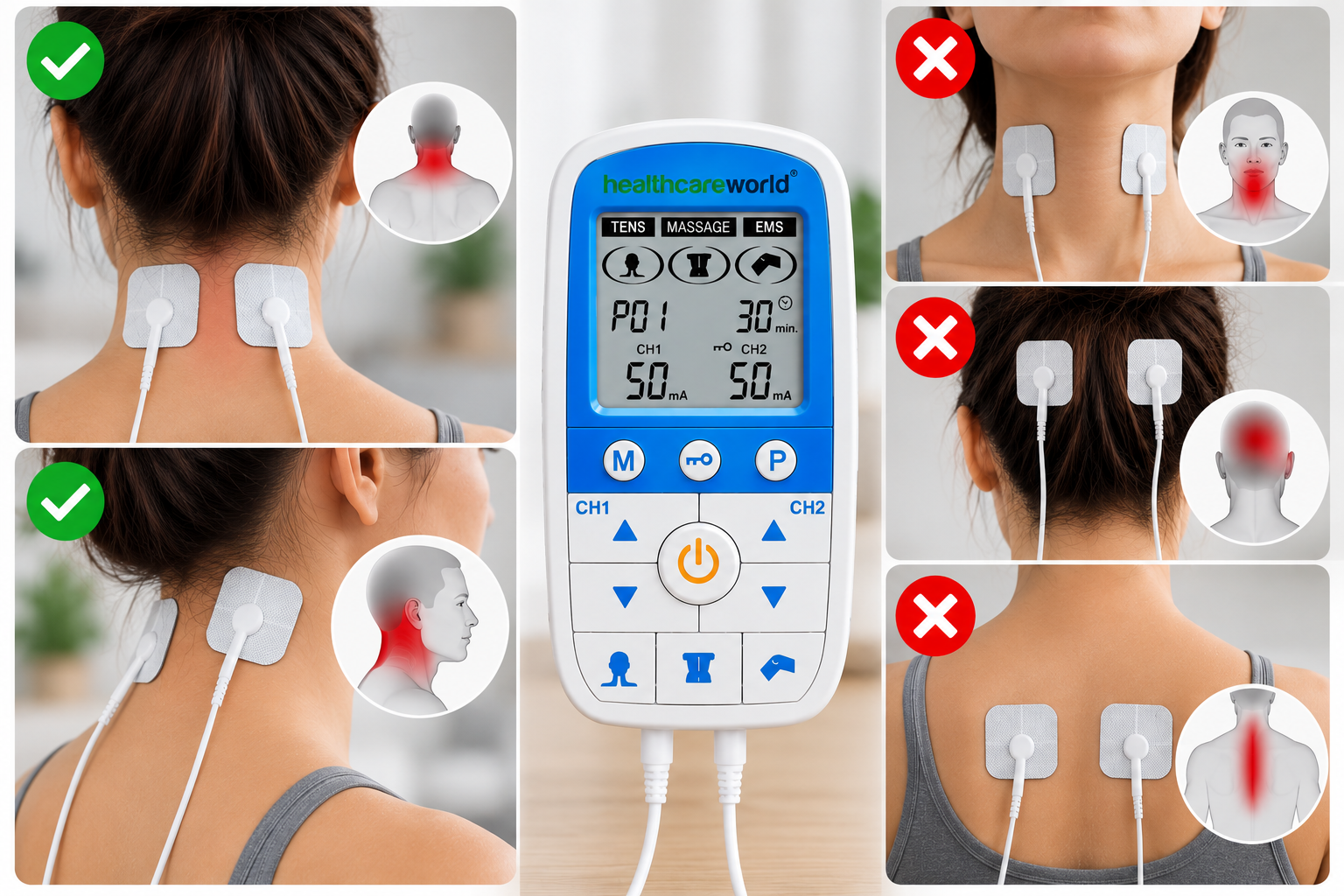
Common Mistakes When Using TENS for Neck Pain: What to Avoid for Safer Use
If you are using TENS as part of your approach to neck pain pain relief, getting the basics right matters. Poor electrode placement, excessive intensity, worn pads, damaged leads and unrealistic expectations can all make TENS less useful—or potentially make its use unsafe.
There is one neck-specific warning that deserves particular attention: standard TENS electrodes should not be placed directly on the neck. The NHS advises not to use TENS on the neck, while NHS hospital guidance specifically warns against placing electrodes on the front or sides of the neck.
TENS can provide temporary pain relief for some people, but it does not work for everyone and is not a cure. If you have unexplained or persistent neck pain, TENS should not replace appropriate medical assessment.
This guide covers the most common TENS mistakes for neck pain, how to recognise them, and what to do instead.
Quick Answer: What Are the Most Common TENS Mistakes for Neck Pain?
The biggest mistakes include:
- Placing standard TENS pads directly on the neck
- Copying electrode diagrams without checking whether they are appropriate
- Turning the intensity up too quickly or too high
- Using worn-out electrode pads
- Continuing to use damaged leads
- Applying electrodes to broken, irritated or numb skin
- Using TENS while sleeping, bathing or driving
- Assuming stronger stimulation means better pain relief
- Expecting TENS to cure the underlying cause of neck pain
- Continuing self-treatment without seeking advice when symptoms persist or change
The safest approach is to follow the instructions for your specific TENS machine neck pain setup and seek professional guidance if you are unsure where electrodes can safely be positioned.
Mistake 1: Placing TENS Pads Directly on the Neck
This is the most important mistake to avoid.
When people search for electrode pads for neck pain, they may find diagrams showing electrodes positioned around the cervical spine, across the back of the neck or on the sides of the neck. These images should not automatically be copied.
The NHS states that TENS should not be used on the neck.
NHS hospital guidance also advises against placing TENS electrodes over the front or sides of the neck. Cambridge University Hospitals specifically warns against positioning electrodes on the front of the neck.
Therefore, do not assume that moving a pad slightly away from the throat makes direct neck placement safe.
What to do instead: If a healthcare professional has recommended TENS for symptoms associated with neck pain, ask them to demonstrate an appropriate electrode position. Depending on the individual circumstances, they may recommend an alternative area such as an appropriate shoulder or upper-back region.
For more detailed guidance, see Best TENS Pad Placement for Neck Pain.
Mistake 2: Copying an Online Placement Diagram
A diagram can make TENS look very straightforward: identify the painful area, put a pair of pads around it and switch the machine on.
That approach is not appropriate for every body area.
TENS electrode placement can vary depending on the location of symptoms, the device, the electrode configuration and the treatment plan. Great Ormond Street Hospital explains that electrodes are generally positioned around the painful area, but can sometimes be positioned along a nerve pathway, with placement discussed with a clinician.
This is particularly relevant to neck pain because standard TENS should not be used directly on the neck.
What to do instead: Treat online diagrams as general educational material rather than personal treatment instructions. Follow your machine’s instructions and any electrode-placement advice given by your healthcare professional.
Mistake 3: Turning the Intensity Up Too Quickly
A common assumption is that stronger stimulation must produce better results.
It does not.
NHS guidance recommends gradually increasing the intensity until a tingling sensation is felt. The stimulation should not be painful.
Cambridge University Hospitals describes the desired TENS sensation as strong but comfortable.
If you turn the intensity up rapidly, the sensation may become uncomfortable before you have had a chance to establish a suitable level.
A better approach:
- Start at a low intensity.
- Increase gradually.
- Notice how the stimulation feels.
- Stop increasing once it is clearly noticeable and comfortable.
- Reduce the intensity if it becomes painful or unpleasant.
TENS should generally feel like tingling, buzzing or pulsing—not sharp, painful stimulation.
Mistake 4: Assuming the Highest Setting Is the Best Setting
Another common tens mistake for neck pain is treating the machine’s maximum intensity as the target.
The number displayed on the machine does not tell you what your body needs.
Two people using the same machine can tolerate very different intensities. Skin condition, electrode contact, electrode position and individual sensitivity can all affect the sensation.
There is therefore little value in saying that everyone should use level 10, level 15 or the maximum setting.
What to do instead: Use intensity as a comfort-based adjustment. The goal is a strong but comfortable sensation, not the highest possible number.
For more information about frequency, pulse width and intensity, read Best TENS Settings for Neck Pain.
Mistake 5: Using Worn-Out Electrode Pads
Electrode pads do not last indefinitely.
Reusable pads gradually lose their adhesive properties through repeated use. As they become worn, they may not sit securely against the skin.
Poor contact can make stimulation feel inconsistent or weaker.
You may find yourself increasing the machine’s intensity to compensate when the real problem is the electrode.
Signs that your pads may need replacing include:
- They no longer stick properly
- The edges repeatedly lift away
- The gel surface has become visibly worn
- Stimulation feels inconsistent
- The pads have become damaged
- They are difficult to position securely
Before changing the machine’s settings, check whether the electrode pads themselves are still in good condition.
TensLeads offers replacement TENS electrodes in different sizes and connection formats, including reusable options.
Mistake 6: Using the Wrong Replacement Pads
Finding replacement electrodes is not simply a matter of choosing a pad that looks similar.
TENS pads can use different connector systems and sizes.
For example, TensLeads stocks different electrode configurations, including stud-connected and pin-connected pads. Its replacement leads are also designed for specific connector combinations.
A pad that does not match your machine or lead may not connect correctly.
Before buying replacement electrodes, check:
- Connector type
- Pad dimensions
- Number of electrodes supplied
- Compatibility information
- Whether the pads are reusable
- Manufacturer recommendations
The cheapest replacement pad is not necessarily the best value if it is incompatible with your machine.
Mistake 7: Continuing to Use Damaged TENS Leads
The electrode pads are not the only consumable part of a TENS system.
Leads can also become worn through repeated bending, pulling or storage.
Inspect your leads periodically. If a cable is visibly damaged or the connection is unreliable, do not continue using it simply because the machine itself still works.
A reliable connection is important for consistent operation.
If you are replacing a lead, make sure its plug and electrode connection match your machine and pads.
Mistake 8: Applying Pads to Irritated or Numb Skin
Electrode placement should always take the condition of the skin into account.
NHS guidance says not to use TENS on irritated, broken, infected or numb areas.
That means you should not simply place a pad wherever the pain happens to be.
Before each session, check the skin where the electrodes will be applied.
Avoid areas that are:
- Broken
- Infected
- Irritated
- Inflamed
- Numb or lacking normal sensation
If the skin becomes itchy, irritated or red during TENS, switch the machine off and remove the pads.
Mistake 9: Using TENS While Sleeping
It can be tempting to leave a TENS machine running because the stimulation feels comfortable.
However, the NHS advises against using TENS while sleeping.
This is particularly important because you may not notice changes in sensation or skin irritation while asleep.
What to do instead: Use TENS only when you are awake and able to monitor how you feel and how your skin is responding.
Mistake 10: Using TENS in the Bath or Shower
TENS machines and water are not a safe combination.
The NHS advises not to use TENS in the bath or shower.
Do not try to make a machine waterproof by covering it or putting the controller somewhere outside the shower while continuing to use the electrodes.
Switch the device off and remove the electrodes before bathing or showering.
Mistake 11: Using TENS While Driving
Even if the stimulation feels comfortable, TENS should not be used while driving.
The NHS advises against using TENS while driving or operating machinery.
The distraction of the sensation, unexpected changes in stimulation or the need to adjust the controller can all interfere with safe operation.
If you need to drive, finish your TENS session first.
Mistake 12: Changing Every Setting at Once
Modern TENS machines may offer several controls, including frequency, pulse width, intensity and different programmes.
Changing all of them at the same time can make it difficult to work out what changed the sensation.
For example, if you increase intensity, change frequency and switch programmes simultaneously, you will not know which adjustment made the difference.
A more practical approach is to change one variable at a time.
Start with the manufacturer’s recommended programme. If your machine permits adjustment, make small changes and pay attention to how the stimulation feels.
For a more detailed explanation, see Best TENS Settings for Neck Pain.
Mistake 13: Assuming a Preset Programme Is a Medical Prescription
A TENS machine may contain programmes labelled for different types of pain or body areas.
That does not mean a preset programme has been individually prescribed for you.
Programme names are features of the device, not diagnoses.
A programme designed to provide a particular sensation does not establish that the programme is appropriate for your specific neck symptoms.
What to do instead: Use the machine according to its instructions. If you have received personalised settings from a healthcare professional, follow those instructions.
Mistake 14: Expecting TENS to Cure Neck Pain
TENS is a symptom-management tool, not a guaranteed cure.
The NHS says TENS may help some short-term or long-term pain, but it does not work for everyone.
That distinction matters when considering neck pain tens therapy.
If TENS makes you feel more comfortable temporarily, that can be useful. But temporary symptom relief does not necessarily mean that the underlying reason for your neck pain has been resolved.
NHS guidance for neck pain recommends self-care measures such as staying active, appropriate exercises and heat or cold packs, and advises seeking medical advice when neck pain does not go away.
Mistake 15: Continuing TENS Without Seeking Advice
TENS should not become a reason to ignore symptoms that need assessment.
The NHS recommends speaking to a healthcare professional if you are unsure what is causing your pain before using TENS.
For neck pain, seek appropriate medical advice if symptoms persist, worsen or are accompanied by symptoms that concern you.
NHS guidance recommends seeing a GP if neck pain or stiffness does not go away, particularly when symptoms are affecting daily life.
Do not simply respond to persistent symptoms by increasing the TENS intensity or using the machine more frequently.
Common TENS Mistakes: Quick Comparison
| Mistake | Why it can be a problem | Better approach |
| Pads directly on the neck | Standard TENS should not be used on the neck | Ask a professional about appropriate alternative placement |
| Copying online diagrams | Diagrams may not apply to your device or circumstances | Follow device/clinical guidance |
| Intensity too high | Can become painful or uncomfortable | Increase gradually |
| Worn electrode pads | Poor contact can affect stimulation | Replace worn pads |
| Wrong replacement pads | May not connect correctly | Check connector compatibility |
| Damaged leads | Can affect reliable operation | Replace damaged leads |
| Pads on irritated skin | May aggravate the skin | Use only on suitable intact skin |
| Using while asleep | You cannot monitor stimulation or skin | Use only while awake |
| Using in water | Unsafe use of electrical equipment | Remove before bathing/showering |
| Using while driving | Can distract from driving | Use only when stationary |
| Changing all settings at once | Makes adjustment difficult to evaluate | Change one setting at a time |
| Expecting a cure | TENS does not address every underlying cause | Treat it as possible temporary symptom relief |
| Ignoring persistent symptoms | May delay appropriate assessment | Seek professional advice |
How to Check Your TENS Setup Before Every Session
A short pre-use check can prevent many common problems.
Check the machine
Make sure the device is intact and functioning normally.
Check the leads
Look for visible damage, loose connections or unusual wear.
Check the electrodes
Make sure the pads are clean, intact and still adhesive.
Check your skin
Use electrodes only on clean, dry, intact skin with normal sensation.
Check the placement
For neck-related pain, confirm that you are not placing standard TENS electrodes directly on the neck.
Check the controls
Make sure the intensity is at a low level before starting.
Check your environment
Do not use TENS while driving, operating machinery, bathing or showering. Do not use it while asleep.
A Safer TENS Checklist for Neck-Related Pain
Before switching on your TENS machine neck pain setup, ask:
- Have I checked that TENS is appropriate for me?
- Have I read my machine’s instructions?
- Are my electrode pads compatible with my machine?
- Are the pads still in good condition?
- Are the leads undamaged?
- Is my skin clean, dry and intact?
- Am I avoiding the front and sides of my neck?
- Are the electrodes appropriately separated?
- Is the machine switched off while I attach the pads?
- Am I starting at a low intensity?
- Is the stimulation comfortable?
- Am I awake and able to monitor the session?
- Am I somewhere safe and stationary?
- Will I stop if my skin becomes irritated or the stimulation becomes painful?
What to Do If TENS Feels Too Weak
A weak sensation does not automatically mean that the machine is faulty.
First check the electrode pads and connections.
Check the pads
Old or poorly adhering electrodes may not make good contact.
Check the leads
Make sure both ends are properly connected.
Check the skin
Clean, dry skin generally provides better electrode contact.
Check the placement
Make sure the electrodes are positioned as instructed and are not touching.
Check the intensity
Increase it gradually rather than immediately moving to the maximum.
If the machine still seems unusually weak after these checks, there may be an equipment or connection problem.
Our guide Why Does a TENS Machine Feel Weak? Causes, Fixes and What to Check covers these issues in more detail.
Do Better TENS Machines Prevent These Mistakes?
A better-designed machine can make correct use easier, but no TENS machine can remove the need for safe electrode placement and appropriate use.
Useful features include:
- Clearly labelled controls
- Adjustable intensity
- Easy-to-read display
- Automatic timer
- Straightforward programme selection
- Secure electrode connections
- Clear instructions
- Readily available replacement pads
When buying a machine, the NHS recommends checking that it has the appropriate CE or UKCA marking.
Our guide to Best TENS Machine Features: What to Look For Before You Buy explains the features worth comparing before purchasing.
Choosing Replacement Electrode Pads
If your pads are worn, replacing them may be more useful than continually changing the machine’s settings.
TensLeads provides reusable electrode pads in different sizes and connection formats.
When selecting electrode pads for neck pain, however, remember that a pad marketed for a particular body area does not override safety guidance. Standard TENS electrodes should not be placed directly on the neck.
Choose replacements based on:
- Machine compatibility
- Connector type
- Size
- Adhesive quality
- Reusability
- Manufacturer instructions
Does TENS Help Neck Pain?
TENS can provide temporary pain relief for some people, but it does not work for everyone. The NHS describes TENS as a treatment that may help some types of short-term or long-term pain.
For neck pain specifically, the more important question is whether TENS is appropriate for your individual situation and, if so, where the electrodes can safely be placed.
Standard TENS should not be applied directly to the neck.
Where Should TENS Pads Go for Neck Pain?
Standard TENS pads should not be placed directly on the neck. NHS guidance advises against using TENS on the neck, and NHS hospital guidance specifically warns against the front and sides of the neck.
If a healthcare professional has recommended TENS for symptoms associated with neck pain, ask them to demonstrate the appropriate alternative placement rather than copying an online diagram.
How Long Can TENS Be Used for Neck Pain?
There is no universal session length specifically for neck pain.
Different NHS TENS services provide different general usage guidance. RNOH, for example, describes up to 60 minutes at a time and usually up to three times a day, while Cambridge University Hospitals describes starting with 30–60-minute periods and adjusting according to individual response.
Follow your machine’s instructions and any personalised guidance from your healthcare professional.
Do not sleep with the machine switched on.
Can I Put TENS Pads on the Back of My Neck?
Do not assume that the back of the neck is safe simply because some online diagrams show pads there. NHS guidance says not to use TENS on the neck.
If TENS has been recommended for your symptoms, ask a qualified healthcare professional to demonstrate an appropriate electrode position.
Can I Increase TENS Intensity If It Stops Feeling Strong?
You can adjust intensity gradually within the limits of your machine and treatment instructions, but do not increase it until the stimulation becomes painful.
TENS should generally produce a strong but comfortable sensation.
If the sensation has become noticeably weaker, check the electrode pads, leads, connections and skin contact before assuming that more intensity is needed.
When Should I Stop Using TENS?
Stop if the stimulation becomes painful or if your skin becomes itchy, irritated or red. NHS guidance recommends switching the machine off and removing the pads if irritation occurs.
You should also seek professional advice if your symptoms are persistent, worsening or unusual rather than simply increasing TENS use.
Key Takeaways
Avoiding common tens mistakes for neck pain is largely about getting the fundamentals right.
Do not place standard TENS electrodes directly on the neck. This is the most important neck-specific safety point in NHS guidance.
Start intensity low and increase gradually. The intended sensation should be noticeable and comfortable rather than painful.
Check your electrodes and leads. Worn pads and damaged connections can contribute to weak or inconsistent stimulation.
Do not use TENS on unsuitable skin. Avoid broken, infected, irritated or numb areas.
Do not use TENS while sleeping, bathing, showering or driving.
Do not expect TENS to cure neck pain. It may provide temporary relief for some people, but it does not work for everyone.
Do not ignore persistent symptoms. If neck pain does not improve or you develop symptoms that concern you, seek appropriate medical advice.
A well-maintained TENS machine with compatible electrodes can make use simpler, but safe treatment still depends on correct setup and sensible expectations.
Products
TENS Machines
TensLeads offers a selection of TENS machines, including portable digital, TENS/EMS, dual-channel and wireless options. When comparing models, consider adjustable intensity, controls, programmes, portability, timer functions and electrode compatibility rather than simply choosing the machine with the most features.
Replacement Electrode Pads
TensLeads offers replacement electrode pads in different sizes and connection formats. Replacing worn electrodes can help maintain reliable skin contact and consistent stimulation, provided the replacement pads are compatible with your machine.
Explore TENS Machines; Replacement Electrode Pads
Explore the TensLeads TENS Machines and Replacement Electrode Pads to compare devices, replacement electrodes and accessories.
Medical Disclaimer
This article is provided for general educational purposes only and is not a substitute for medical advice, diagnosis or treatment. TENS is not suitable for everyone. Standard TENS electrodes should not be placed directly on the neck. If you are unsure whether TENS is appropriate for you, where electrodes should be positioned or which settings to use, speak with a GP, physiotherapist, pain specialist or another qualified healthcare professional. Always follow the instructions supplied with your specific TENS machine.
:::