
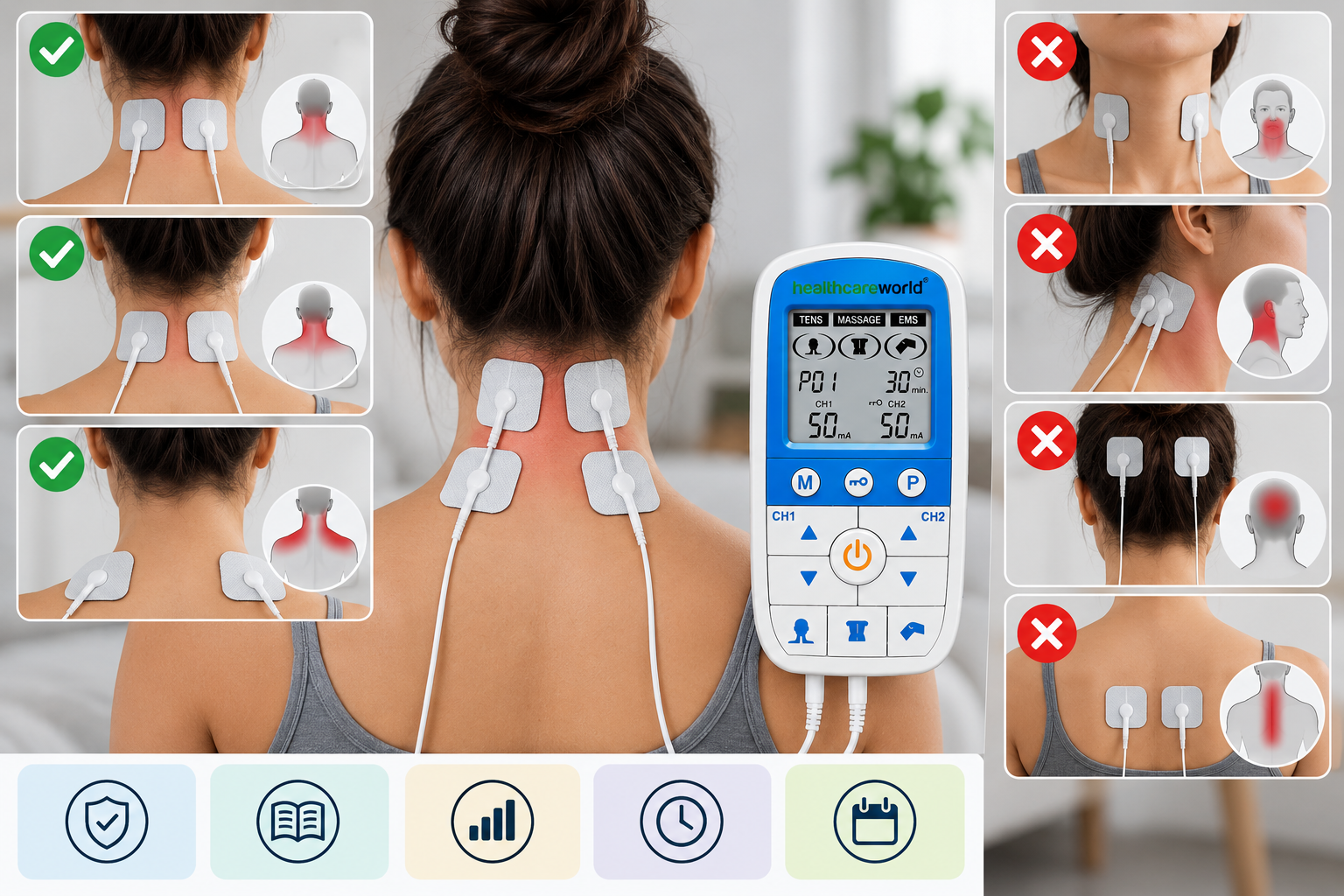
Best TENS Pad Placement for Neck Pain: Safe Positions, Mistakes to Avoid and How to Use TENS Correctly
If you are looking for the best TENS pad placement for neck pain, the most important point is also the one most often missed: standard TENS electrode pads should not be placed directly on the front or sides of the neck. NHS guidance specifically advises against using TENS on the neck, and several NHS pain-management guides reinforce this warning. (nhs.uk)
That does not necessarily mean a person with neck discomfort cannot discuss TENS with a healthcare professional. In some circumstances, a clinician may recommend an alternative electrode position away from the neck itself, depending on the individual and the type and location of their pain. However, there is no single “best” DIY pad pattern for neck pain that is appropriate for everyone.
This guide explains what to know about neck pain pain relief, how TENS pad positioning generally works, where pads should never be placed, how to avoid common mistakes, and when professional advice is more appropriate.
Quick Answer: Where Should TENS Pads Go for Neck Pain?
For standard home TENS use, do not place electrode pads directly on the front or sides of your neck. NHS guidance says not to use TENS on the neck, while NHS hospital guidance specifically warns against placing electrodes over the front or sides of the neck. (nhs.uk)
If a healthcare professional has recommended TENS for your particular symptoms, they may show you a suitable alternative placement, potentially using areas around the shoulder or upper back rather than the neck itself. The exact position should follow the instructions supplied with your machine and any advice given by your clinician.
This distinction is important because searching for tens machine neck pain can produce diagrams showing electrodes positioned directly over the cervical area. A diagram found online should not override the safety instructions for your device or current NHS guidance.
Why Does TENS Pad Placement Matter?
TENS, or transcutaneous electrical nerve stimulation, uses a small electrical current delivered through adhesive electrode pads placed on the skin. The aim is to produce a comfortable tingling sensation that may temporarily alter how pain is perceived.
Placement matters because the electrodes determine where the electrical stimulation is delivered. NHS guidance recommends placing pads on clean skin near the painful area, leaving a gap between them, and gradually increasing the intensity until a tingling sensation is felt without pain. (nhs.uk)
For many body areas, clinical TENS guides describe placing electrodes around or either side of the painful region. Great Ormond Street Hospital also explains that clinicians may sometimes position electrodes along a nerve pathway rather than directly at the painful site. (GOSH Hospital site)
However, neck pain requires additional caution. The front and sides of the neck contain important structures, which is why NHS and NHS hospital guidance specifically warns against placing TENS electrodes there. (Dorset County Hospital)
The Most Important Rule: Do Not Put TENS Pads Directly on the Neck
This is the central safety point for anyone researching electrode pads for neck pain.
NHS guidance states that TENS should not be used on the neck, mouth or eyes. (nhs.uk) Dorset County Hospital similarly advises that TENS pads should never be placed over the front or sides of the neck. (Dorset County Hospital)
Cambridge University Hospitals also specifically warns against placing TENS electrodes on the front of the neck, noting that this may cause a person to feel faint. (Cambridge University Hospitals)
Therefore, avoid placing pads:
- Directly on the front of the neck
- Directly on either side of the neck
- Over the throat
- Over the carotid area
- Close to the mouth or eyes
- On broken, irritated, infected or numb skin
- In any location prohibited by your machine’s instructions
Do not assume that moving a pad only a small distance higher or lower makes an otherwise unsafe position safe.
So Where Can TENS Be Used If Your Neck Hurts?
This is where online advice needs to be handled carefully.
There is no universally appropriate alternative placement that can be prescribed simply from the words “neck pain”. Depending on the cause, pain location and treatment plan, a healthcare professional may sometimes recommend electrode positions away from the neck, such as around an appropriate shoulder or upper-back area.
Some NHS TENS guidance describes general approaches such as placing pads around the painful area or on either side of the spine, but these are general TENS principles and should not be interpreted as permission to place electrodes on the cervical neck. (EKHUFT Leaflets)
For that reason, if you have specifically been advised to use neck pain TENS therapy, ask a GP, physiotherapist, pain specialist or another appropriately qualified healthcare professional to demonstrate the exact placement for you.
A Simple Rule for Safer Placement
Think of TENS pad positioning in this order:
1. Identify the painful area
Work out where you actually feel the discomfort rather than automatically placing pads over the neck.
2. Check the device instructions
Different machines can have different electrode requirements, connectors, programmes and precautions.
3. Exclude unsafe areas
For neck-related symptoms, the front and sides of the neck should be treated as a no-go area for standard TENS.
4. Use only clinician-approved alternative positions
If you have been shown a shoulder or upper-back placement, follow that specific positioning rather than copying a generic internet diagram.
5. Start with the machine switched off
NHS guidance advises switching the TENS machine off before attaching the pads. (nhs.uk)
6. Begin at a low intensity
Increase gradually until you feel a strong but comfortable tingling sensation. It should not be painful. (nhs.uk)
7. Stop if the skin reacts
If the skin becomes itchy, irritated or red, switch the machine off and remove the electrodes. (nhs.uk)
TENS Pad Placement for Neck Pain: Safe vs Unsafe
| Placement or situation | General guidance |
| Front of the neck | Do not use |
| Sides of the neck | Do not use |
| Throat/carotid area | Do not use |
| Near eyes or mouth | Do not use |
| Broken or infected skin | Do not use |
| Numb skin | Do not use |
| Clinician-approved shoulder area | May be appropriate when specifically advised |
| Clinician-approved upper-back area | May be appropriate when specifically advised |
| Placement shown by a qualified professional | Follow the specific instructions given |
The safest approach is therefore not to search for a universal neck-pain diagram and copy it. Instead, use a diagram as an educational reference and obtain personalised placement instructions where necessary.
Suggested Diagram: Safe TENS Placement for Neck-Related Pain
For a visual accompanying this article, the most useful diagram would show a front-and-back human upper-body illustration with the front and sides of the neck clearly marked as “DO NOT PLACE TENS PADS HERE”.
A second part of the diagram could show that alternative electrode positions around the shoulder or upper-back region should only be used when recommended for the individual’s symptoms. This would be safer and more clinically responsible than an illustration showing TENS pads directly on the neck.
Why Online TENS Neck Diagrams Can Be Misleading
A common problem with searching tens pad placement for neck pain is that different websites may show completely different electrode positions.
Some diagrams are designed for particular clinical circumstances, specific stimulation techniques or professional supervision. Others may simply be generic illustrations that do not reflect the safety instructions for every TENS device.
This is particularly important because NHS guidance is explicit that TENS should not be used on the neck. (nhs.uk)
Even NHS pain-management resources that describe flexible electrode placement emphasise avoiding the front or sides of the neck. (Dorset County Hospital)
So if you find an image that shows pads directly across the cervical region, do not assume that the image makes that placement safe.
How to Prepare Your Skin Before Applying TENS Pads
Correct placement is only one part of using electrodes safely.
Before attaching pads:
Clean and dry the skin
The area should be clean and dry. Avoid applying creams, oils or talc immediately before using adhesive electrodes because they can interfere with adhesion and conductivity.
Check the skin
Do not place electrodes over broken, infected, inflamed or irritated skin. NHS guidance also advises against using TENS on numb areas. (nhs.uk)
Check the pads
Electrode pads should be clean and in good condition. If a reusable pad has become excessively dry, damaged or difficult to keep attached, replacing it may provide a more reliable connection.
Leave space between electrodes
Clinical TENS guidance recommends leaving a gap between electrode pads rather than placing them directly against one another. RNOH and Dorset County Hospital both recommend at least 2.5 cm between pads. (Dorset County Hospital)
How to Use a TENS Machine After Placement
Once your clinician-approved electrode positions have been established, using the machine should be straightforward.
Step 1: Switch the machine off
Attach the electrode pads while the device is switched off. (nhs.uk)
Step 2: Attach the leads
Connect the electrode leads securely according to your machine’s instructions.
Step 3: Apply the pads
Place them only in the positions recommended for your treatment. Never improvise by moving them onto the front or sides of your neck.
Step 4: Turn the machine on
Start at a low intensity.
Step 5: Increase gradually
Increase the intensity until you experience a noticeable but comfortable tingling. TENS should not feel painful. (nhs.uk)
Step 6: Monitor your skin and comfort
Stop if the sensation becomes painful or your skin becomes irritated.
Step 7: Turn the machine off before removing the pads
Switch off the device before taking the electrodes off your skin.
If you’re experiencing problems with weak stimulation, electrode adhesion or inconsistent sensation, our guide to Why Does a TENS Machine Feel Weak? Causes, Fixes and What to Check covers some common things to check.
How Long Can TENS Be Used for Neck Pain?
There is no single duration that is appropriate for everyone with neck pain.
The correct treatment time depends on the machine, programme, individual circumstances and professional advice. NHS guidance does not give one universal session length for every TENS user. RNOH’s patient guide gives a general maximum of 60 minutes at a time and says TENS is usually used up to three times a day, while emphasising that the manufacturer’s instructions should be followed. (Royal National Orthopaedic Hospital)
Some specialist clinical guidance describes different usage patterns, which is another reason not to treat a single timing recommendation as a prescription.
The practical rule is simple: follow your device’s instructions and any treatment plan provided by your healthcare professional, and never sleep with a TENS machine switched on. NHS guidance specifically advises against using TENS while sleeping. (nhs.uk)
Common TENS Pad Placement Mistakes
Even when someone understands the basic idea of TENS, several mistakes can make treatment uncomfortable or potentially unsafe.
Putting pads directly on the neck
This is the biggest mistake to avoid. Do not place standard TENS electrodes on the front or sides of the neck. (nhs.uk)
Copying a random online diagram
An image may have been created for a particular clinical technique or condition. It should not replace professional advice.
Placing electrodes too close together
Pads should have a suitable gap between them. RNOH and Dorset County Hospital recommend at least 2.5 cm. (Dorset County Hospital)
Using damaged or irritated skin
Electrodes should not be applied to broken, infected, irritated or numb skin. (nhs.uk)
Turning the intensity up too quickly
The sensation should be strong but comfortable rather than painful. RNOH notes that excessive current, incorrect electrode placement or prolonged use without breaks can cause burns or skin damage. (Royal National Orthopaedic Hospital)
Using TENS while sleeping
Do not sleep with the machine switched on. (nhs.uk)
Ignoring the manufacturer’s instructions
Even if two machines appear similar, their controls, electrode connections and recommended use can differ.
Choosing the Right Electrode Pads for TENS
Good electrode pads should provide secure skin contact without causing unnecessary discomfort.
When choosing electrode pads for neck pain, however, the priority should not simply be finding the smallest pad or a pad marketed specifically for the neck. The more important question is whether the pad is compatible with your TENS machine and suitable for the treatment position you have been advised to use.
Look for:
- Correct connector type
- Appropriate pad size
- Good adhesive contact
- Reusable construction if required
- Clear usage instructions
- Compatibility with your particular TENS device
TensLeads offers different sizes and connection types, including reusable pads and replacement electrodes. (Tensleads)
For example, the TensLeads range includes a variety pack containing 12 reusable electrodes in two sizes, while other options are designed around particular connector systems. Always check compatibility before purchasing replacement pads. (Tensleads)
What About Butterfly-Shaped TENS Pads?
Larger or specially shaped electrodes can sometimes make placement more convenient for areas such as the back or shoulders. TensLeads, for example, offers a butterfly-shaped electrode with a central gap and describes it for areas including the upper back and between the shoulder blades. (Tensleads)
However, the existence of a particular pad shape does not mean that it is automatically suitable for placement on the neck.
For neck-related symptoms, follow the same safety principle: do not place standard TENS electrodes directly on the front or sides of the neck unless a qualified professional has specifically instructed you to use a different specialist technique.
Does TENS Actually Help Neck Pain?
TENS may provide temporary pain relief for some people and is used in pain-management settings, but it does not work for everyone and it should not be presented as a cure.
The NHS describes TENS as a treatment that may help with some short-term or long-term pain, while noting that it does not work for everyone. (nhs.uk)
Evidence also varies according to the condition being treated. NICE recommends against TENS for chronic primary pain because there is no evidence of benefit for that indication. (NICE)
For ordinary neck pain, therefore, it is better to think of TENS as a possible symptom-management tool rather than a treatment that addresses the underlying reason for the pain.
NHS guidance for neck pain also recommends measures such as staying active, appropriate neck exercises and heat or cold packs, and advises seeing a GP if the pain does not go away. (nhs.uk)
When Should You Speak to a Healthcare Professional?
Do not rely on TENS placement alone if your neck pain is unexplained, persistent or accompanied by other concerning symptoms.
Speak to a healthcare professional if your neck pain is not improving after a few weeks or is significantly affecting daily life. NHS guidance recommends seeking medical advice when neck pain or stiffness does not go away. (nhs.uk)
You should also seek appropriate medical assessment rather than simply attempting TENS if the pain follows a significant injury or if you develop neurological symptoms such as unusual weakness, numbness or other changes that concern you.
If you are unsure whether TENS is suitable for you, NHS guidance recommends speaking with a healthcare professional before using it. (nhs.uk)
TENS Safety Checklist for Neck-Related Pain
Before starting a session, run through this checklist:
- I have checked that TENS is appropriate for me.
- I have read the instructions supplied with my machine.
- I am not placing pads directly on the front or sides of my neck.
- The skin is clean and intact.
- The electrode pads are in good condition.
- The pads are separated appropriately.
- The machine is switched off while I attach the pads.
- I am starting with a low intensity.
- The sensation is comfortable rather than painful.
- I will not use the machine while sleeping.
- I will not use it in the bath or shower.
- I will not drive or operate machinery while using it. (nhs.uk)
Frequently Asked Questions
Does TENS help neck pain?
TENS may provide temporary pain relief for some people, but it does not work for everyone and should not be considered a cure. The NHS notes that TENS can help some types of pain, but also advises that people who are unsure of the cause of their pain should speak with a healthcare professional. (nhs.uk)
For neck pain specifically, the key issue is safe application: standard TENS pads should not be placed directly on the neck.
Where should TENS pads go for neck pain?
Standard TENS pads should not be placed on the front or sides of the neck. NHS guidance advises against using TENS on the neck, and NHS hospital guidance specifically warns against electrode placement over the front or sides of the neck. (nhs.uk)
If TENS has been recommended for your neck-related symptoms, ask a healthcare professional to show you whether an alternative position, such as an appropriate shoulder or upper-back area, is suitable for you.
How long can TENS be used for neck pain?
There is no universal session length for neck pain. Follow the instructions supplied with your TENS machine and any guidance provided by your healthcare professional. RNOH’s general TENS guide advises a maximum of 60 minutes at a time and usually up to three times daily, but other clinical guidance can vary. (Royal National Orthopaedic Hospital)
Do not sleep with a TENS machine switched on.
Can I put TENS pads on the back of my neck?
You should not assume that the back of the neck is automatically safe simply because NHS guidance specifically mentions the front and sides. The NHS states not to use TENS on the neck. (nhs.uk)
If a healthcare professional has specifically recommended TENS for your symptoms, ask them to demonstrate the appropriate electrode position rather than deciding on a cervical placement yourself.
Can I use TENS on my shoulders for neck pain?
A healthcare professional may sometimes recommend an alternative electrode position around the shoulder or upper-back region, depending on the individual’s symptoms and treatment plan. Do not use this as a generic instruction to treat every type of neck pain. Follow your clinician’s advice and your TENS machine’s instructions.
Can I use any TENS pads for neck pain?
Compatibility is important. TENS pads use different connection types and come in different sizes and shapes. Check the connector and machine compatibility before buying replacements. TensLeads provides several electrode options designed for different TENS systems. (Tensleads)
Key Takeaways
The biggest lesson about tens pad placement for neck pain is that safe positioning matters more than finding a particular diagram online.
Do not place standard TENS pads directly on the front or sides of the neck. NHS guidance advises against using TENS on the neck, and NHS hospital pain-management resources reinforce this precaution. (nhs.uk)
If TENS has been recommended as part of your approach to neck pain pain relief, ask a healthcare professional to demonstrate an appropriate alternative placement rather than experimenting directly on the neck.
Use clean, intact skin, keep electrodes appropriately separated, begin at a comfortable intensity and follow your machine’s instructions. TENS may provide temporary relief for some people, but it is not a cure and should not replace appropriate assessment of persistent or unexplained neck pain.
For further guidance on choosing a device, see our guide to Best TENS Machine Features: What to Look for Before You Buy.
Products
TENS Machines
A suitable TENS machine should offer straightforward controls, adjustable intensity and clear instructions. Look for a device carrying the appropriate UKCA or CE marking and make sure its electrode connection system is compatible with the pads you intend to use. NHS guidance recommends checking for CE or UKCA marking when buying a TENS machine. (nhs.uk)
Replacement Electrode Pads
Replacement pads are useful when existing electrodes lose adhesion or become worn. Choose the correct size and connector for your machine rather than selecting solely on appearance.
TensLeads provides a range of TENS machines and replacement electrodes in different sizes and connection formats. (Tensleads)
Explore TENS Machines; Replacement Electrode Pads
Browse the TensLeads TENS Machines and Electrode Pads range to compare compatible devices and replacement electrodes.
Medical Disclaimer
This article is for general educational purposes only and is not a substitute for medical advice, diagnosis or treatment. TENS is not suitable for everyone. Do not place standard TENS electrodes directly on the neck, particularly the front or sides. If you are unsure whether TENS is appropriate for your symptoms or where electrodes should be positioned, speak with a GP, physiotherapist or other qualified healthcare professional. Always follow the instructions supplied with your specific TENS machine.
I can also make the accompanying safe neck-pain TENS placement diagram in a way that clearly marks prohibited areas rather than showing unsafe pad placement.