
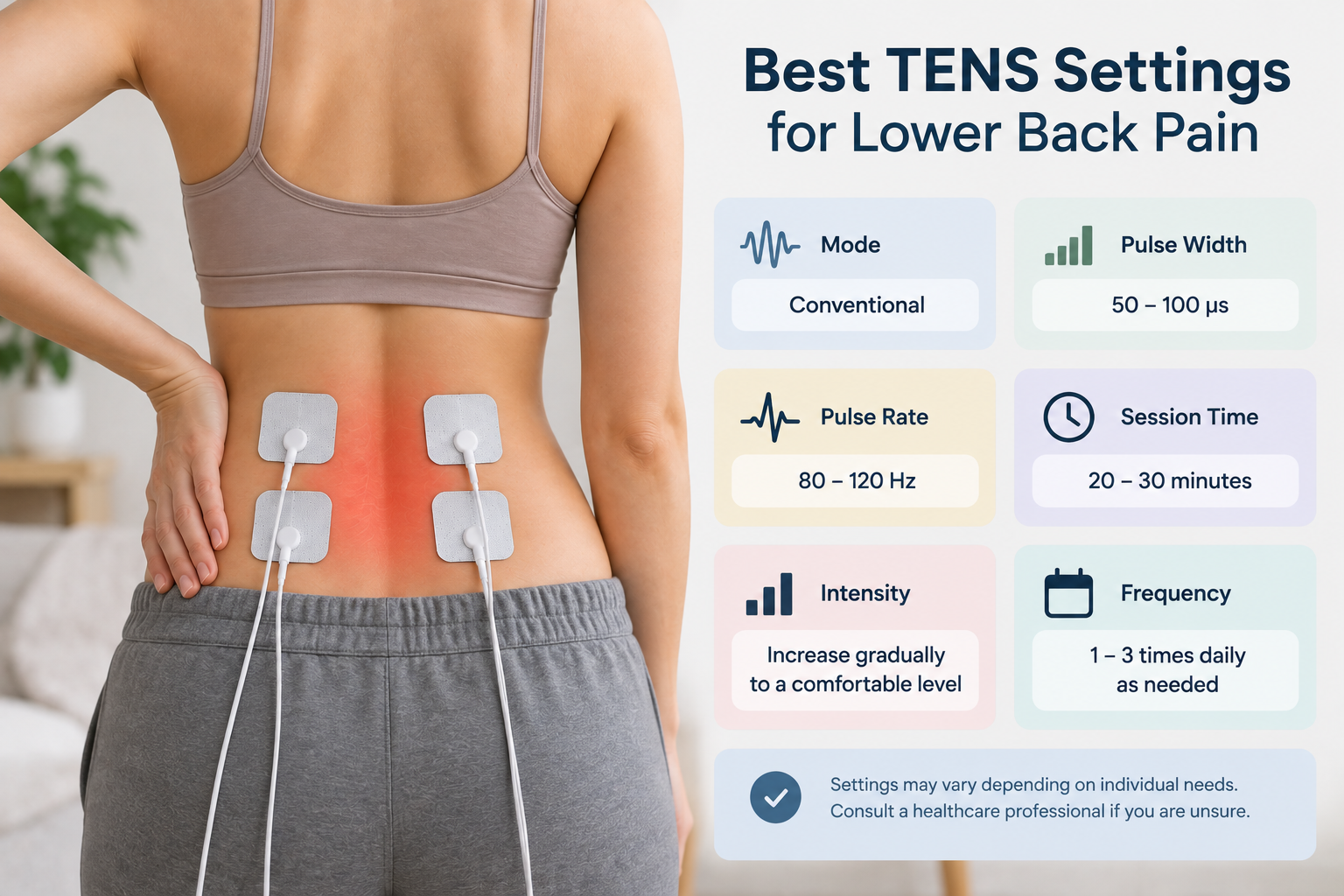
Best TENS Settings for Lower Back Pain
If you are considering TENS settings for lower back pain, there is no single frequency, pulse width or intensity that is guaranteed to work for everyone. TENS machines allow several controls to be adjusted, and the most appropriate combination depends on the device, electrode placement and how the stimulation feels to the individual.
A sensible general approach is to start with a comfortable programme and low intensity, then gradually increase the intensity until you feel a noticeable, strong but comfortable tingling. Frequency and pulse width can also be adjusted to change the character of the sensation, but these controls should not be treated as a prescription for treating a particular cause of back pain.
It is also important to put the evidence into context. NICE recommends that TENS should not be offered for managing low back pain, with or without sciatica, because the evidence is insufficient to support a clinical benefit. The NHS describes TENS as providing temporary pain relief and notes that it does not work for everyone. (NICE)
Therefore, if you choose to use a TENS machine for lower back pain, the goal should be safe, comfortable symptom management rather than trying to find a “perfect” setting or expecting TENS to fix the underlying problem.
What Do the Different TENS Settings Mean?
Before changing your settings, it helps to understand what each control actually does. Most adjustable TENS machines use some combination of mode, frequency, pulse width and intensity.
Frequency
Frequency, sometimes called pulse rate, describes how many electrical pulses are delivered each second. It is measured in Hertz (Hz).
A lower frequency can produce a slower, more noticeable pulsing or beating sensation, while a higher frequency can feel more like a continuous buzzing or tingling.
NHS TENS guidance explains that changing the frequency alters how the electrical stimulation feels. (Cambridge University Hospitals)
There is no reason to assume that the highest or lowest frequency is automatically best for lower back pain.
Pulse Width
Pulse width describes how long each individual electrical pulse lasts. It is usually measured in microseconds (µs).
Changing pulse width can alter the character and strength of the sensation. Cambridge University Hospitals notes that the sensation changes when pulse rate/frequency and pulse width controls are adjusted. (Cambridge University Hospitals)
Some NHS TENS guidance describes wider pulse widths as producing a stronger or deeper-feeling stimulation, although the experience varies with electrode placement and the individual. (EKHUFT Leaflets)
Intensity
Intensity controls how strong the stimulation feels.
This is different from frequency and pulse width. Increasing intensity does not necessarily mean you are using a more medically effective setting. Instead, the aim is generally to find a stimulation level that is noticeable and comfortable.
Cambridge University Hospitals recommends using comfortable and relaxing settings, while other NHS guidance describes increasing intensity gradually until the sensation is strong but not unpleasant. (Cambridge University Hospitals)
Mode
Depending on the machine, you may see modes such as continuous, burst or modulation.
These modes change the pattern in which stimulation is delivered. Some devices automatically vary aspects of the stimulation rather than requiring you to adjust every parameter manually.
If your machine includes preset programmes, follow the manufacturer’s instructions rather than assuming that a programme labelled “back pain” is medically superior to another setting.
Is There a Best TENS Setting for Lower Back Pain?
There is not one universally correct setting.
You may find websites recommending exact combinations such as a particular frequency, pulse width and intensity for lower back pain. However, it is misleading to present one combination as the scientifically established “best” setting for everyone.
Clinical TENS guidance recognises that people can respond differently to different settings. Cambridge University Hospitals advises finding the most comfortable setting for the individual, while Kent NHS guidance notes that settings can vary depending on where the pads are positioned. (Cambridge University Hospitals)
For this reason, the better question is not:
“Which exact numbers should I use?”
It is:
“Which settings does my machine allow me to use safely and which produce a comfortable, useful sensation for me?”
That distinction is particularly important for lower back pain TENS therapy, because NICE does not currently recommend TENS as a treatment for low back pain. (NICE)
A Practical Starting Approach
If you have checked that TENS is suitable for you and want to try it, use a gradual approach rather than immediately selecting the strongest possible settings.
Start with the machine switched off
Apply the electrode pads before turning on the stimulation. NHS guidance recommends switching the machine off before applying or removing the pads. (nhs.uk)
Your skin should be clean and dry, and the pads should be positioned according to your machine’s instructions.
Choose a comfortable programme
If your device has preset TENS programmes, select an appropriate TENS mode according to the manufacturer’s instructions.
You do not need to use every available programme. If one produces an uncomfortable or unpleasant sensation, stop and reassess rather than forcing yourself to continue.
Begin with low intensity
Turn the intensity up slowly.
At first, you may feel little or nothing. Gradually increase the intensity until you can clearly feel the stimulation.
The NHS describes the desired sensation as tingling that should not be painful. (nhs.uk)
Aim for strong but comfortable stimulation
Once you can feel the stimulation clearly, gradually increase it only as far as remains comfortable.
Hospital TENS guidance commonly describes the target as strong but comfortable rather than painful. (Cambridge University Hospitals)
If the sensation becomes sharp, burning, painful or otherwise unpleasant, reduce the intensity or switch the device off.
Adjust frequency if necessary
Once you have established a comfortable intensity, you can experiment with the frequency if your machine allows it.
A different frequency can produce a noticeably different sensation. Some people prefer faster, smoother stimulation, while others prefer a slower pulsing sensation.
There is no requirement to use the highest frequency available.
Adjust pulse width carefully
Pulse width can also be changed on machines that provide this control.
Changing it may make the stimulation feel stronger, wider or different in character. If changing the pulse width makes the stimulation uncomfortable, return to a more comfortable setting.
Avoid changing several controls dramatically at the same time. Making one adjustment at a time makes it easier to understand what actually feels different.
TENS Settings for Lower Back Pain: What to Adjust
| Setting | What it changes | Practical approach |
| Frequency | How often pulses are delivered | Try a comfortable setting; adjust if needed |
| Pulse width | Duration of each pulse | Change gradually and monitor comfort |
| Intensity | Strength of stimulation | Start low and increase gradually |
| Mode | Pattern of stimulation | Follow the machine’s programme guidance |
| Timer | Session duration | Follow manufacturer or professional advice |
This table is a practical guide to understanding the controls, not a prescribed treatment protocol.
Why Intensity Matters More Than Chasing Exact Numbers
When people search for tens settings for lower back pain, they often focus on finding an exact number.
However, intensity is inherently individual.
The same numerical intensity on two different machines does not necessarily produce the same sensation. Electrode size, skin condition, electrode position, machine design and individual sensitivity can all affect how stimulation feels.
This is why a setting such as “level 8” cannot automatically be described as the correct intensity for everyone.
The practical target is a clear, comfortable tingling sensation rather than a particular number on the display.
NHS guidance recommends gradually turning the dial until a tingling sensation is felt and states that it should not be painful. (nhs.uk)
Should TENS Feel Strong for Lower Back Pain?
TENS should be noticeable, but stronger does not automatically mean better.
A common mistake is to increase the intensity until the stimulation becomes uncomfortable because of the assumption that a stronger electrical current must provide greater lower back pain pain relief.
Clinical guidance instead emphasises comfort. RNOH and Cambridge University Hospitals guidance both describe increasing stimulation to a strong but comfortable level. (Cambridge University Hospitals)
If you have become accustomed to the sensation during a session, you may find that you can gradually increase the intensity while keeping it comfortable. This does not mean that you should continually increase it without limit.
If you experience pain, burning or significant discomfort, turn the intensity down.
Does Changing Frequency Make TENS More Effective?
Changing frequency changes the stimulation sensation, but it should not be assumed that one frequency is clinically superior for everyone with lower back pain.
Some NHS guidance provides ranges that patients can experiment with, while also explaining that people may prefer different settings. Kent NHS guidance, for example, notes that users can experiment with pulse rate and that the settings can vary depending on pad position. (EKHUFT Leaflets)
This supports a personalised comfort-based approach rather than claiming that a particular frequency is the definitive solution.
If your healthcare professional has given you specific frequency or pulse-width instructions, follow those instructions instead of general online recommendations.
How Pad Placement Affects Your Settings
Settings cannot be considered separately from electrode placement.
The same TENS machine may feel completely different depending on where the pads are positioned.
For lower back pain, general NHS guidance recommends placing pads near the painful area on clean skin while leaving a gap between the electrodes. Cambridge University Hospitals advises that a healthcare professional can show you appropriate placement. (Cambridge University Hospitals)
Leeds Teaching Hospitals gives an example of placing pads above and below or either side of the painful area, with approximately a hands-width spacing in its patient guidance. (Leeds Teaching Hospitals NHS Trust)
For a detailed explanation, see our guide to [TENS pad placement for lower back pain].
Never compensate for poor electrode placement by simply increasing the intensity.
If the sensation suddenly becomes weak, check whether the pads are still adhering properly, whether the skin is clean and dry and whether the leads and connections are secure. Our guide on why a TENS machine may feel weak covers these common causes.
Settings to Avoid Using as a “One-Size-Fits-All” Prescription
You may encounter advice suggesting that everyone with lower back pain should use:
- One exact frequency.
- One exact pulse width.
- Maximum intensity.
- A particular programme for a fixed number of minutes.
- The same settings for every session.
These claims should be treated cautiously.
TENS machines differ, people respond differently and clinical guidance does not establish one universal combination specifically for lower back pain.
More importantly, NICE currently recommends against offering TENS for low back pain because the evidence does not provide sufficient support for clinical benefit. (NICE)
Consequently, a responsible TENS guide should explain how the controls work without suggesting that a particular combination is a proven treatment.
How Long Can TENS Be Used for Lower Back Pain?
There is no single session duration that should be presented as appropriate for everyone.
Cambridge University Hospitals advises beginning with shorter periods of around 30–60 minutes and increasing use if helpful. Its guidance also states that some people may use TENS for much of the day. (Cambridge University Hospitals)
Your own machine’s instructions should take priority because devices can have different programmes, timers and operating recommendations.
Regardless of session length, NHS guidance says not to use TENS while sleeping, bathing or showering, driving, or operating tools or machinery. (nhs.uk)
When Should You Change Your TENS Settings?
You might adjust the settings if:
- The stimulation is barely noticeable.
- The sensation becomes uncomfortable.
- You have become accustomed to the current sensation.
- You want to see whether another frequency feels more comfortable.
- Your machine has different programmes that you want to try.
- Your healthcare professional has advised a different setting.
Make changes gradually.
If the machine suddenly feels much weaker than usual, do not immediately increase the intensity. Check the electrode pads, leads, battery and skin contact first.
Worn pads can have poorer contact with the skin, while loose connections can also affect stimulation.
TENS Settings and Electrode Pad Quality
The performance of a TENS machine depends partly on the condition of its electrode pads.
Reusable pads gradually lose their adhesive properties. When a pad no longer sticks properly, electrical contact can become less reliable and the stimulation may feel inconsistent.
When purchasing electrode pads for lower back pain, check:
- Connector compatibility.
- Pad dimensions.
- Number of pads supplied.
- Reusability.
- Adhesive quality.
- Manufacturer compatibility information.
Do not assume that every replacement pad will work with every TENS machine.
If you are looking for compatible replacements, TensLeads offers a range of Replacement Electrode Pads in different sizes and connector configurations.
Safety Checks Before Adjusting Your TENS Machine
Before every session, consider the following:
- Check the machine: Make sure the device and leads are undamaged.
- Check the pads: Replace pads that are excessively worn or no longer adhere properly.
- Check your skin: Use only clean, dry and intact skin.
- Check placement: Follow the instructions for your particular device.
- Check intensity: Start low and increase gradually.
- Check sensation: Strong and comfortable is preferable to painful.
- Check your surroundings: Never use TENS while driving or operating machinery.
- Check the environment: Keep the device away from baths and showers.
- Check suitability: Follow medical advice if you have a relevant medical condition or implanted device.
The NHS advises against TENS for people with epilepsy or a pacemaker and says pregnancy should be discussed with a doctor or midwife before use. (nhs.uk)
When TENS May Not Be the Right Approach
TENS should not be used as a substitute for investigating unexplained or persistent lower back pain.
The NHS notes that back pain has many possible causes and advises seeking medical advice when symptoms do not improve, interfere with everyday activities or are concerning. It also lists urgent and emergency symptoms that require prompt medical attention. (nhs.uk)
Seek urgent medical help if back pain is accompanied by symptoms such as numbness around the genitals or anus, changes in bladder or bowel control, or weakness, tingling or numbness in both legs. (nhs.uk)
These symptoms should not be managed simply by changing your TENS settings.
Choosing a TENS Machine for Lower Back Pain
If you are considering purchasing a tens machine for lower back pain, look beyond the number of programmes advertised.
Useful practical features can include:
- Adjustable intensity.
- Clearly labelled controls.
- Multiple TENS modes.
- Adjustable frequency or pulse width where appropriate.
- Reliable electrode connections.
- A timer.
- Portable construction.
- Compatible replacement pads.
- Clear manufacturer’s instructions.
- Appropriate CE or UKCA marking where applicable.
The most complicated machine is not necessarily the best choice. For many users, simple controls that make it easy to adjust intensity and understand the selected programme can be more useful than a large number of confusing presets.
For more guidance, read the TensLeads article on the best TENS machine features to look for before you buy.
Does TENS Help Lower Back Pain?
TENS may provide temporary pain relief for some people, but it does not work for everyone. The evidence specifically for low back pain is not strong enough for NICE to recommend TENS.
NICE’s evidence review concluded that the evidence was conflicting and insufficient to support a recommendation for TENS for low back pain or sciatica. (NICE)
The NHS similarly describes TENS as a treatment that provides temporary pain relief and states that it does not work for everyone. (nhs.uk)
Therefore, changing your TENS settings should not be viewed as a way of overcoming the limitations of the treatment evidence. If TENS does not provide useful relief, continually increasing intensity or experimenting indefinitely with settings is not necessarily the answer.
Where Should TENS Pads Go for Lower Back Pain?
Pads should be placed on appropriate, clean and dry skin around the painful area according to your machine’s instructions or advice from a healthcare professional.
Leeds Teaching Hospitals describes placing pads above and below or either side of the painful area, while Cambridge University Hospitals advises that healthcare professionals can demonstrate appropriate placement. (Leeds Teaching Hospitals NHS Trust)
Do not place TENS pads on irritated, broken, infected or numb skin. NHS guidance also advises against placing TENS on the neck, mouth or eyes and warns against using it across the chest and back at the same time. (nhs.uk)
For a more detailed guide, see [Best TENS Pad Placement for Lower Back Pain].
How Long Can TENS Be Used for Lower Back Pain?
The appropriate duration depends on the device and individual circumstances. Cambridge University Hospitals suggests beginning with 30–60 minute periods and increasing use if helpful, while emphasising comfortable use. (Cambridge University Hospitals)
Always follow the instructions supplied with your specific machine and any advice from your healthcare professional.
Never use TENS while sleeping, driving, bathing or showering. (nhs.uk)
Key Takeaways
- There is no single “best” TENS setting for everyone with lower back pain.
- Frequency controls how often electrical pulses are delivered.
- Pulse width controls the duration of each pulse.
- Intensity controls how strong the stimulation feels.
- Start at a low intensity and gradually increase it.
- Aim for noticeable, strong but comfortable tingling rather than painful stimulation.
- Changing frequency or pulse width changes the sensation but does not guarantee better pain relief.
- Pad placement can affect how the stimulation feels, so use appropriate electrode positioning.
- Worn pads, poor skin contact or loose leads can make stimulation feel weak.
- NICE does not recommend offering TENS for managing low back pain.
- TENS should be considered temporary symptom management rather than a cure.
- Speak with a healthcare professional if you are unsure whether TENS is suitable for you or if your back pain is persistent, worsening or concerning.
Frequently Asked Questions
Does TENS help lower back pain?
TENS may provide temporary pain relief for some people, but it does not work for everyone. NICE does not recommend offering TENS for managing low back pain because the available evidence is insufficient to support a clinical benefit. (NICE)
Where should TENS pads go for lower back pain?
Pads are generally positioned on appropriate skin around the painful area, often either side of or above and below the area of discomfort. The exact arrangement depends on the machine and individual circumstances. Always follow your device instructions, keep pads separated and avoid broken, irritated, infected or numb skin. (Leeds Teaching Hospitals NHS Trust)
How long can TENS be used for lower back pain?
There is no universal session duration. Cambridge University Hospitals recommends starting with shorter periods of around 30–60 minutes and increasing use if helpful. Follow your device instructions and professional advice, and never use TENS while sleeping, driving or in the bath or shower. (Cambridge University Hospitals)
Products
TENS Machines
Choose from TENS machines with adjustable intensity and practical controls designed for convenient everyday use. Check the device specifications and instructions to ensure it meets your requirements.
Replacement Electrode Pads
Replace worn or poorly adhering electrodes with compatible replacement pads. Always check connector type and dimensions before purchasing.
Explore TENS Machines; Replacement Electrode Pads
Explore the TensLeads range of TENS Machines and Replacement Electrode Pads to find suitable options for your TENS setup.
Safety Disclaimer
This article is for general information only and does not constitute medical advice, diagnosis or treatment. NICE does not recommend offering TENS for managing low back pain. TENS is not suitable for everyone. If you are unsure whether TENS is appropriate for you, have unexplained or persistent lower back pain, or have a medical condition or implanted device that may affect its use, speak with a qualified healthcare professional before using TENS. Always follow the instructions supplied with your specific device.
:::