
Best TENS Pad Placement for Lower Back Pain
Using a TENS machine for lower back pain starts with more than simply switching the device on. Where you place the electrode pads can affect comfort, stimulation and how easy it is to use the machine correctly.
For lower back pain, TENS pads are generally positioned on or around the painful area, rather than directly over the spine itself or on areas where electrical stimulation may be unsafe. NHS and hospital guidance commonly recommends placing electrodes around the painful area while keeping the pads separated and avoiding broken, irritated or numb skin.
However, there is no single pad placement that is right for everyone. NICE does not recommend offering TENS for managing low back pain, so TENS should not be presented as a proven treatment or cure. If you choose to use it, the focus should be on safe positioning, comfortable stimulation and following the instructions supplied with your device.
This guide explains general principles for TENS pad placement for lower back pain, where pads can typically be positioned, areas to avoid, how to prepare your skin and what to do if the stimulation feels uncomfortable.
Where Should TENS Pads Go for Lower Back Pain?
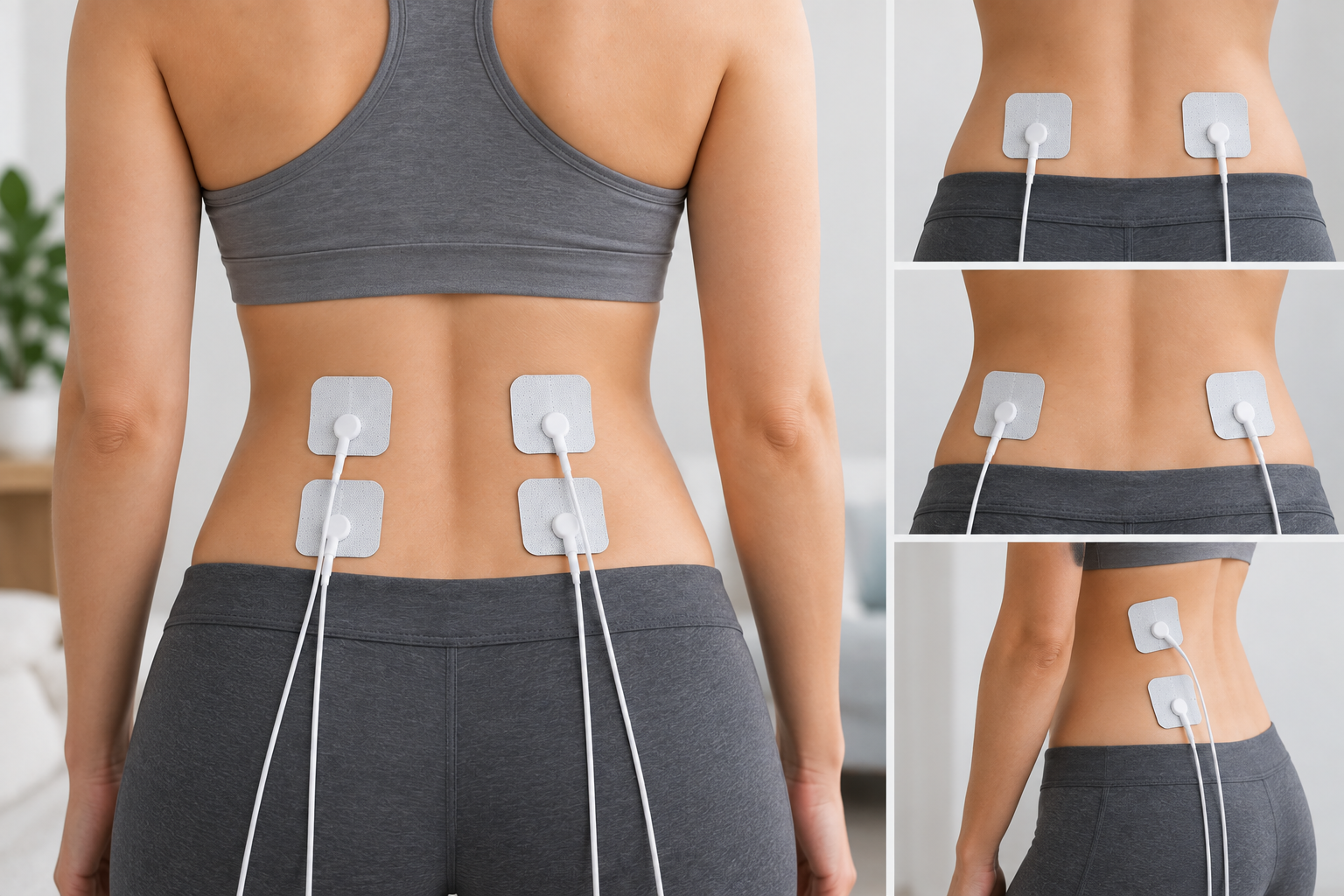
For lower back pain, TENS electrode pads are generally placed on the skin around the painful area. One common approach is to position pads on either side of the area where the discomfort is felt, rather than placing electrodes directly over the spine.
Royal National Orthopaedic Hospital guidance advises placing TENS pads either side of the painful area and keeping them at least 2.5 cm (1 inch) apart. Cambridge University Hospitals also explains that electrodes may be placed on or around the painful area, with placement tailored to the individual and demonstrated by a healthcare professional where appropriate. (rnoh.nhs.uk)
For a typical lower-back arrangement, the pads may therefore sit:
- To the left and right of the painful area.
- Above and below the most uncomfortable area, where appropriate.
- Around the painful region rather than directly on an area of damaged skin.
- Within the lower-back area recommended by your device instructions or healthcare professional.
The exact position should depend on your individual symptoms, the size and shape of your electrodes and the instructions for your particular TENS machine.
Suggested Diagram: Lower Back TENS Pad Placement
A useful educational diagram for this article could show a simple back view of a human torso with the following:
- A shaded lower-back area labelled “Painful area”.
- Two pairs of electrode pads positioned on either side of the lower back.
- A visible gap between individual pads.
- The spine shown as a central reference line.
- A red or crossed-out zone showing unsafe placement over areas such as the front of the neck.
- A note stating: “Always follow your TENS machine instructions and seek professional advice if unsure.”
The diagram should be instructional rather than suggesting that one exact position is medically appropriate for everyone.
Why Does TENS Pad Placement Matter?
TENS works by delivering electrical stimulation through electrodes attached to the skin. Good skin contact and appropriate electrode positioning are therefore important for comfortable, consistent stimulation.
If pads are positioned too close together, poorly attached or placed on unsuitable skin, the sensation may be uncomfortable or inconsistent.
Poor contact can also make a TENS machine feel weaker than expected. If your device suddenly feels less effective, do not immediately assume that you need to increase the intensity. Check the pads, connections, battery and skin contact first.
You can read the TensLeads guide on why a TENS machine may feel weak for a more detailed troubleshooting checklist.
A Simple Lower Back TENS Pad Placement Guide
If TENS has been recommended or you have decided to use it after checking that it is suitable for you, the following process can help you approach electrode placement safely.
1. Identify the general area of discomfort
First, identify the area of your lower back where you feel discomfort.
Do not use this step to diagnose the cause of your pain. Lower back pain can have many possible causes, and TENS cannot determine what is causing your symptoms.
If you have unexplained, persistent or worsening pain, speak with an appropriate healthcare professional rather than relying on TENS alone.
2. Clean and dry the skin
The skin should be clean and dry before you attach the electrodes. Oils, creams and sweat can interfere with adhesion and electrical contact.
Do not place electrodes over:
- Broken skin.
- Open wounds.
- Infected skin.
- Significantly irritated skin.
- Areas with reduced or absent sensation.
The NHS specifically advises against using TENS on irritated, broken, infected or numb areas. (nhs.uk)
3. Keep the machine switched off
Always switch the TENS machine off before applying or removing electrode pads.
Once the pads are securely positioned, connect the leads if required and then switch the machine on according to the manufacturer’s instructions.
4. Position the pads around the painful area
Place the pads on appropriate skin around the area of discomfort. A common general arrangement is to position electrodes on either side of the painful area.
Avoid positioning pads so close together that they touch. RNOH guidance recommends keeping electrodes at least 2.5 cm (1 inch) apart. (rnoh.nhs.uk)
5. Start at a low intensity
After switching on the machine, begin at a low intensity and gradually increase it.
The intended sensation should normally be a noticeable tingling that is strong but comfortable. It should not feel painful.
RNOH guidance recommends gradually increasing the intensity to a strong but comfortable level and reducing it if the stimulation becomes painful. (rnoh.nhs.uk)
Can TENS Pads Go Directly Over the Spine?
This is an area where it is particularly important not to improvise.
Different TENS systems and clinical instructions can provide different electrode-placement recommendations. Rather than assuming that electrodes should be placed directly over the spinal column, follow the instructions supplied with your particular machine.
A conservative general approach for lower-back use is to position pads around the painful area, commonly on either side, while maintaining an appropriate distance between electrodes.
If you have been specifically advised by a healthcare professional to use a different arrangement, follow their guidance.
When in doubt, ask a physiotherapist or another qualified healthcare professional to demonstrate appropriate placement.
Where Should You NOT Put TENS Pads?
Correct placement is not only about finding the painful area. Knowing where not to place electrode pads is equally important.
Front or sides of the neck
Do not place TENS electrodes over the front or sides of the neck. NHS guidance specifically lists the neck among areas where TENS should not be used. (nhs.uk)
Head, eyes or mouth
Do not place electrodes over the eyes or mouth. Avoid using TENS on the head unless specifically instructed by an appropriate healthcare professional.
Broken or infected skin
Electrodes should not be applied over wounds, broken skin, infection or significant irritation.
Numb areas
Avoid areas where you have reduced sensation. If you cannot properly feel the stimulation, it may be more difficult to recognise when the intensity or placement is causing a problem.
Chest and upper back simultaneously
NHS guidance advises not using TENS on the chest and back at the same time. (nhs.uk)
During water exposure
Never use a TENS machine while bathing or showering. TENS devices are not designed to be used in water. (nhs.uk)
While driving or operating machinery
Do not use TENS while driving or using machinery. The sensation, wires or controls could distract you or interfere with safe operation. (nhs.uk)
Lower Back TENS Pad Placement: Common Arrangements
There is no universally correct arrangement, but understanding the general options can make the process easier.
| Placement approach | General idea | Important consideration |
| Either side of painful area | Pads sit to the left and right of the area of discomfort | Maintain an appropriate gap between pads |
| Around the painful region | Electrodes surround or sit around the general area | Stay on suitable, intact skin |
| Above and below area | Pads are positioned around the painful region | Follow your device instructions |
| Professional-guided placement | A clinician demonstrates a suitable arrangement | Particularly useful if you are unsure |
These are general principles, not personalised treatment instructions. The most appropriate arrangement can depend on your circumstances, your device and the location of your symptoms.
How Many TENS Pads Should You Use for Lower Back Pain?
The number of pads you should use depends on the TENS machine and the number of channels it provides.
Some machines use two electrodes connected to one channel, while dual-channel devices may allow two pairs of electrodes to be used independently.
More pads are not automatically better.
Using additional electrodes can change the area being stimulated and may make placement more complicated. Always follow the manufacturer’s instructions for the number of pads and connections your machine supports.
If your device has two channels, do not assume both channels need to be used simply because they are available.
How Large Should Electrode Pads Be for the Lower Back?
Electrode size can affect both coverage and comfort.
Larger pads may cover more skin, while smaller pads can make it easier to position electrodes around a more specific area. The right choice depends on the device, connector compatibility, skin area available and manufacturer’s instructions.
When buying electrode pads for lower back pain, compatibility should be checked carefully. Different TENS machines may use different connector types, pin sizes and pad dimensions.
For replacement pads, check:
- Connector type.
- Pin or stud size.
- Pad dimensions.
- Number of pads supplied.
- Whether the pads are reusable.
- Manufacturer compatibility information.
- Skin comfort and adhesive quality.
Choosing compatible replacement pads is particularly important if your current electrodes are no longer sticking properly.
What If the TENS Pads Feel Uncomfortable?
TENS should not be painful.
If the stimulation feels sharp, burning, excessively uncomfortable or painful, switch the machine off and check the electrode placement and skin contact.
A poor connection or damaged electrode can sometimes produce an unpleasant sensation. Inspect the pads and leads for signs of wear or damage.
If the skin becomes itchy, irritated or red, NHS guidance recommends switching the machine off and removing the pads. (nhs.uk)
Do not attempt to solve an uncomfortable sensation simply by moving the intensity higher or continuing through the discomfort.
When Should You Ask a Healthcare Professional About Pad Placement?
You do not need to guess if you are uncertain about where to put your electrodes.
A physiotherapist or other healthcare professional can demonstrate placement and help you understand whether TENS is appropriate for your situation. Cambridge University Hospitals specifically notes that healthcare professionals can demonstrate electrode placement. (cuh.nhs.uk)
Professional advice is particularly useful if:
- You are unsure where the painful area begins or ends.
- You have reduced sensation.
- Your symptoms are unusual or unexplained.
- You have an implanted electronic device.
- You have epilepsy.
- You are pregnant.
- You have concerns about using electrical stimulation.
- TENS causes unexpected pain or skin problems.
The NHS advises people with a pacemaker or epilepsy not to use TENS and recommends discussing TENS with a doctor or midwife during pregnancy. (nhs.uk)
Does TENS Help Lower Back Pain?
TENS may provide temporary pain relief for some people, but the evidence for lower back pain is not strong enough for NICE to recommend it.
NICE guidance states that TENS should not be offered for managing low back pain, with or without sciatica. Its evidence review found insufficient evidence of clinical benefit. (nice.org.uk)
The NHS similarly explains that TENS can provide temporary pain relief but does not work for everyone. (nhs.uk)
Therefore, if you use a TENS machine for lower back pain, set realistic expectations. A comfortable session may help you manage symptoms temporarily, but TENS should not be presented as a treatment that repairs the underlying cause.
How Long Can TENS Be Used for Lower Back Pain?
There is no universal session length specifically established for lower back pain.
Some NHS patient guidance suggests starting with shorter periods, such as 30–60 minutes, and adjusting use according to individual response and professional advice. Cambridge University Hospitals provides this type of general guidance. (cuh.nhs.uk)
Always follow the instructions supplied with your TENS machine because recommended use can vary between devices.
Never sleep while wearing a TENS machine, and do not use it while driving or in water. (nhs.uk)
Lower Back TENS Placement Checklist
Before starting a session, use this quick checklist:
- Check your machine: Make sure the device, leads and connectors appear intact.
- Check your pads: Make sure the electrode surface is clean, usable and adhesive.
- Check your skin: Only apply pads to clean, dry and intact skin.
- Check placement: Position electrodes around the painful area according to your instructions.
- Check spacing: Make sure pads do not touch and maintain the recommended separation.
- Check intensity: Start low and gradually increase.
- Check sensation: Aim for noticeable but comfortable tingling.
- Check your surroundings: Never use TENS while driving, bathing or showering.
- Check your response: Stop if stimulation becomes painful or the skin becomes significantly irritated.
If your TENS machine feels weak or inconsistent, check the pads, leads, battery and connections before assuming that the intensity needs to be increased. The TensLeads troubleshooting guide on why a TENS machine feels weak covers these checks in more detail.
Choosing a TENS Machine for Lower Back Pain
If you are considering buying a TENS machine, electrode placement is only one part of the decision.
Look for practical features that make safe, consistent use easier, such as:
- Adjustable intensity levels.
- Easy-to-use controls.
- Multiple TENS programmes where appropriate.
- Reliable lead or pad connections.
- A suitable timer.
- Portable design.
- Clearly explained operating instructions.
- Compatible replacement electrode pads.
- Appropriate UKCA or CE marking where applicable.
It is also worth considering the ongoing cost of electrode pads. A TENS machine is only useful if you can maintain it properly, and reusable pads eventually need replacing as their adhesive performance declines.
For more information about what to look for when buying a device, see the TensLeads guide to the best TENS machine features.
Replacement Electrode Pads: What to Check
Good electrode contact is important for consistent stimulation. If your pads have become dry, damaged or difficult to stick to the skin, replacement may be necessary.
When purchasing replacement electrode pads, always check that they are compatible with your machine before ordering.
A pad that does not fit the connector correctly may not provide the expected connection, even if the pad itself appears suitable.
TensLeads offers different electrode-pad options, allowing users to choose according to their device compatibility and preferred pad size.
Key Takeaways
- TENS pads for lower back pain are generally positioned on or around the painful area rather than on unsuitable areas.
- A common general approach is to position electrodes on either side of the painful area while keeping them appropriately separated.
- Never place TENS pads on broken, infected, irritated or numb skin.
- Avoid the front and sides of the neck, eyes and mouth, and follow your device’s specific safety instructions.
- Switch the machine off before applying or removing electrode pads.
- Start at a low intensity and gradually increase it to a strong but comfortable tingling sensation.
- TENS does not work for everyone and is not a cure for lower back pain.
- NICE does not recommend offering TENS for managing low back pain.
- Replace worn electrode pads when they no longer provide reliable adhesion or contact.
- If you are unsure about placement or whether TENS is appropriate for you, seek professional advice.
Frequently Asked Questions
Does TENS help lower back pain?
TENS may provide temporary pain relief for some people, but it does not work for everyone. NICE recommends that TENS should not be offered for managing low back pain, so it should not be considered a proven treatment for the underlying cause of lower back pain. (nice.org.uk)
Where should TENS pads go for lower back pain?
TENS pads are generally placed on or around the painful area, often on either side of it. Keep electrodes appropriately separated and apply them only to clean, dry and intact skin. Because placement can vary depending on the device and individual circumstances, follow the manufacturer’s instructions or ask a healthcare professional to demonstrate suitable positioning. (rnoh.nhs.uk)
How long can TENS be used for lower back pain?
Usage varies between devices and individuals. Some NHS guidance recommends starting with shorter sessions of around 30–60 minutes and adjusting use according to response and professional advice. Always follow the instructions for your specific machine and never sleep, bathe or shower while using TENS. (cuh.nhs.uk)
Products
TENS Machines
Explore portable TENS machines with adjustable intensity and practical controls for convenient at-home use. Always read the manufacturer’s instructions and check that TENS is appropriate for you before use.
Replacement Electrode Pads
Keep your TENS setup working reliably with compatible replacement electrode pads. Check connector type and pad dimensions before purchasing replacements.
Explore TENS Machines; Replacement Electrode Pads
Explore the TensLeads range of TENS machines and replacement electrode pads to find compatible options for your setup.
Safety Disclaimer
This article is provided for general information only and does not constitute medical advice, diagnosis or treatment. NICE does not recommend offering TENS for managing low back pain. TENS is not suitable for everyone. If you are unsure whether TENS is appropriate for you, have unexplained or persistent lower back pain, or have a medical condition that may affect TENS use, speak with a qualified healthcare professional before using a TENS machine. Always follow the instructions supplied with your specific device.