
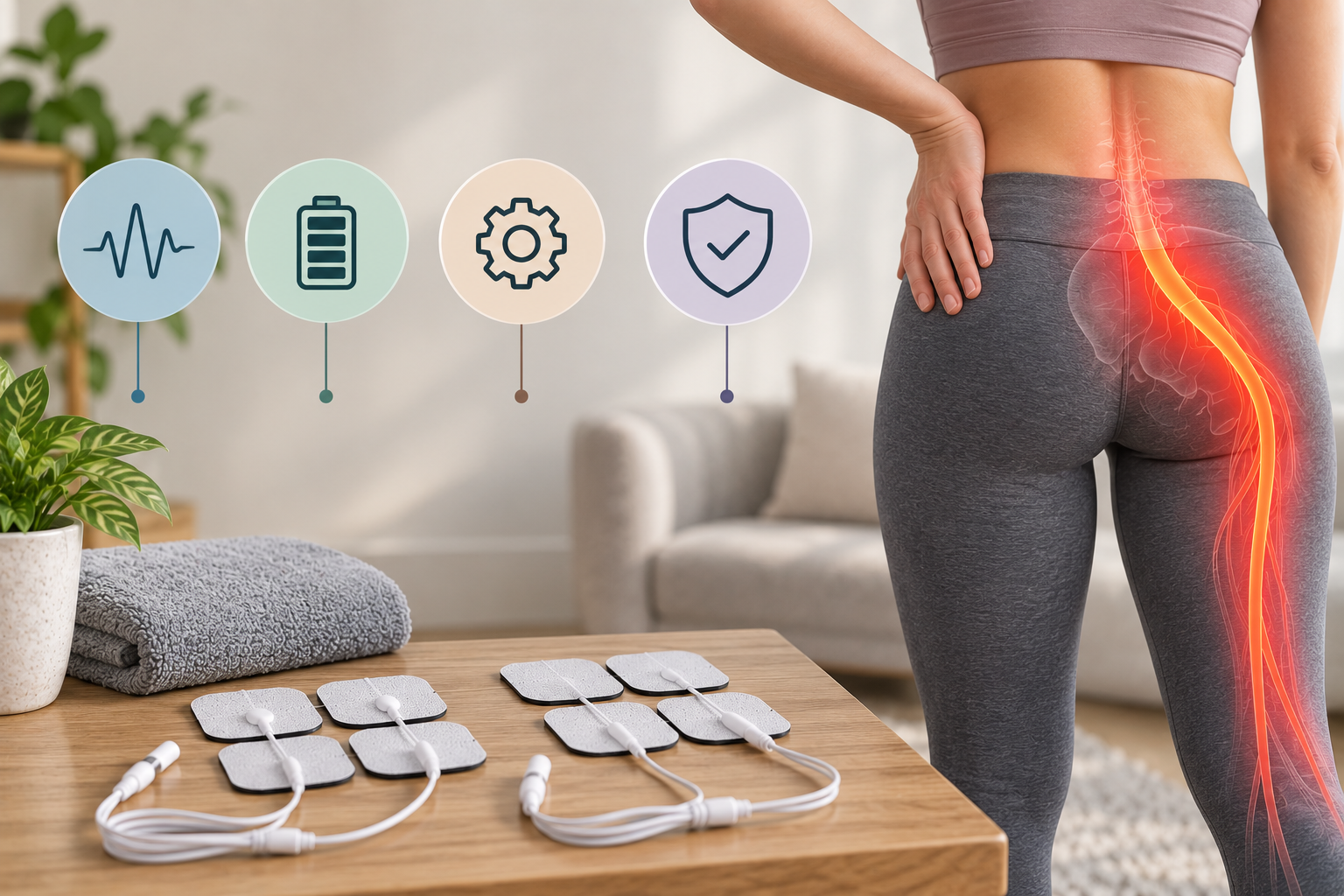
Best TENS Machine for Sciatica: How to Choose the Right One in the UK
If you’re looking for the best TENS machine for sciatica, choosing the right device is about more than finding the model with the most programmes or the highest intensity level. A practical TENS machine should give you straightforward control over stimulation, suitable electrode-pad connections, comfortable intensity adjustment and enough flexibility to fit the way you intend to use it.
TENS (Transcutaneous Electrical Nerve Stimulation) uses mild electrical impulses delivered through electrode pads placed on the skin. It may provide temporary pain relief for some people, but it does not treat the underlying cause of sciatica. In fact, NICE currently recommends not offering TENS for managing low back pain with or without sciatica because its evidence review found insufficient evidence of clinical benefit. (NICE)
So, if you’re comparing TENS machines for sciatica, the goal should not be to find a device that promises to “cure” nerve pain. Instead, look for a reliable, easy-to-use machine that provides the controls, channels, portability and electrode-pad compatibility you actually need.
This UK buying guide walks through the features worth comparing, explains the difference between machine types and covers important questions about TENS use for sciatica, including pad placement and treatment duration.
What You Need to Know
The best TENS machine for sciatica will depend on your individual preferences and how you intend to use the device. Someone who wants occasional treatment at home may prefer a simple, compact machine, while someone who wants more flexibility may benefit from multiple channels and adjustable programmes.
It is also important to consider the ongoing cost of using a TENS machine. Electrode pads are consumable accessories and eventually need replacing as they lose their adhesive properties or become worn. A machine that initially appears inexpensive may become less economical if compatible replacement pads are difficult to find or expensive.
Before buying, therefore, consider both the machine itself and the availability and cost of compatible electrode pads.
For a broader introduction to TENS technology, you can also read our guide to What Is a TENS Machine? to understand how these devices work and what they are generally used for.
Does TENS Help Sciatica?
Before deciding which TENS machine to buy, it is important to understand what the treatment can realistically offer.
The NHS states that TENS can provide temporary pain relief for some people, although it does not work for everyone. The treatment involves placing electrodes on the skin and using a small electrical current to stimulate nerves. (NHS)
However, evidence specifically for sciatica is limited. NICE’s evidence review found no evidence of clinical benefit from TENS compared with sham TENS or usual care in the populations considered, and NICE recommends not offering TENS for low back pain with or without sciatica. (NICE)
This means that buying a TENS machine should be based on realistic expectations. Some individuals may find the stimulation useful for temporary symptom relief, but there is no particular machine or setting that has been established as a cure for sciatica.
What Makes a Good TENS Machine for Sciatica?
There is no specific technical specification that makes a TENS machine medically superior for sciatica. Instead, several practical features can make one device more suitable for you than another.
Adjustable Intensity
Adjustable intensity is one of the most important features to consider. You should be able to start at a low level and gradually increase the stimulation to a comfortable tingling sensation.
The NHS advises gradually increasing the intensity and notes that the stimulation should not be painful. (NHS)
A machine with clearly marked intensity controls makes this process easier, particularly for people who are new to TENS.
Multiple Programmes
Some TENS machines include several pre-set programmes designed to provide different stimulation patterns. Others allow users to manually adjust parameters such as frequency and pulse width.
More programmes do not necessarily mean better treatment. A machine with a smaller number of well-designed, easy-to-understand programmes may be more practical than a device with dozens of settings that are difficult to understand.
If you’re interested in adjusting frequency, pulse width and intensity specifically, our guide to Best TENS Settings for Sciatica can provide additional information.
Number of Channels
Channels determine how many separate electrode circuits a machine can operate.
A single-channel machine may be suitable if you generally want to concentrate on one treatment area. A dual-channel device can provide greater flexibility when you want to connect multiple electrodes or work with more than one area, subject to the manufacturer’s instructions.
For people experiencing symptoms around both the lower back and buttock, for example, a dual-channel machine may provide more flexibility. However, having additional channels does not mean that more electrodes should automatically be used.
Portability
If you want to use your TENS machine away from home, portability becomes particularly important.
A compact, lightweight device can be easier to carry in a handbag, work bag or travel case. Consider the size of the control unit, the battery type and whether the lead wires are easy to manage.
Wireless TENS machines can offer additional freedom from lead wires, while traditional wired devices may appeal to users who prefer a simpler and potentially more economical setup.
Simple Controls
A TENS machine should not feel unnecessarily complicated.
Look for clearly labelled controls, an easy-to-read display and straightforward intensity adjustment. If you are purchasing your first machine, simplicity can be more useful than having a large number of advanced functions.
The best machine is ultimately one that you can operate confidently and safely.
Electrode Pad Compatibility
Electrode pads are an essential part of any TENS system. Without good contact between the pads and your skin, stimulation may become inconsistent or uncomfortable.
Before buying a machine, check what type of electrode-pad connector it uses. You should also check whether compatible replacement pads are readily available.
TensLeads offers replacement pads for different TENS systems, but compatibility should always be confirmed before purchasing.
If your existing TENS machine seems weaker than it used to, worn electrode pads may be one possible reason. You can also read our guide on Why Does a TENS Machine Feel Weak? for practical troubleshooting information.
TENS Machine Comparison: Which Features Matter Most?
| Feature | Why It Matters | What to Look For |
| Adjustable intensity | Allows you to find a comfortable stimulation level | Easy, gradual adjustment |
| Channels | Provides flexibility for electrode placement | One or two channels depending on your needs |
| Programmes | Offers different stimulation patterns | Simple, clearly explained programmes |
| Frequency control | Allows stimulation frequency to be changed | Useful if manual adjustment is available |
| Pulse width | Changes the duration of individual pulses | Adjustable within the manufacturer’s recommended range |
| Portability | Makes the device easier to use away from home | Compact and lightweight design |
| Display | Helps you monitor settings | Clear and easy to read |
| Electrode connection | Determines compatible pads | Check connector type before buying |
| Replacement pads | Affects long-term running costs | Pads should be readily available |
| Battery | Determines convenience | Suitable rechargeable or replaceable battery system |
| Instructions | Supports safe operation | Clear manufacturer’s guidance |
Single-Channel vs Dual-Channel TENS Machines
When comparing TENS machines, the number of channels can make a noticeable difference to how flexible the device is.
Single-Channel Machines
A single-channel TENS machine operates one electrical circuit. This can make the device simple to set up and use.
If you generally want to treat one area at a time and prefer straightforward controls, a single-channel machine may be enough.
There is no reason to assume that a single-channel machine is less effective simply because it has fewer channels. The number of channels is primarily a practical feature rather than an indication of how effective TENS will be for your particular symptoms.
Dual-Channel Machines
Dual-channel machines provide two separate electrical channels. Depending on the design, this can allow multiple electrode pads to be connected and can provide more flexibility when treating a larger area.
For someone who wants to position electrodes around more than one area, such as the lower back and buttock, this may be useful.
However, electrode placement should always follow the manufacturer’s instructions. More pads or more channels do not automatically mean better results.
Which Is Better for Sciatica?
Neither is universally better.
Choose a single-channel machine if simplicity and occasional use are your priorities. Consider a dual-channel machine if you want greater flexibility in how you arrange the electrodes.
The decision should be based on your intended use rather than assuming that more channels automatically provide superior pain relief.
Wired vs Wireless TENS Machines
The choice between wired and wireless devices is another practical consideration.
Wired TENS Machines
Traditional wired TENS machines connect the control unit to electrode pads using lead wires.
They are familiar, straightforward and can be a good option for home use. Because the control unit remains connected to the electrodes by wires, you may need to take a little more care when moving around during a session.
Wired machines can nevertheless offer excellent control and may be preferable if you want a simple device without wireless connectivity.
Wireless TENS Machines
Wireless systems reduce or remove the need for conventional lead wires between the control unit and electrodes, depending on the design.
This can make them appealing if portability and freedom of movement are important to you. They can also create a less cluttered setup.
However, wireless models may have different charging requirements and controls, so check the manufacturer’s instructions and specifications before purchasing.
How Important Are TENS Programmes?
A common mistake when comparing TENS machines is assuming that the model with the largest number of programmes must be the best.
The number of programmes is only useful if you understand what they do and can comfortably use them.
Different programmes can alter stimulation characteristics such as frequency, pulse width and timing. If you prefer to keep things simple, a machine with a smaller number of clearly explained programmes may be preferable.
If you want more control over individual parameters, look for a machine that allows manual adjustment.
For more information about adjusting stimulation parameters, see our guide to Best TENS Settings for Sciatica.
What TENS Settings Should You Look For?
TENS machines may allow you to adjust several different parameters.
Frequency
Frequency determines how many electrical pulses are delivered per second and is measured in hertz (Hz).
Some devices offer higher- and lower-frequency programmes. There is no single frequency that has been established as the best setting for everyone with sciatica.
Pulse Width
Pulse width refers to the duration of each electrical pulse and is commonly measured in microseconds.
Different combinations of frequency and pulse width can produce different sensations.
Intensity
Intensity determines how strong the stimulation feels. It should normally be increased gradually until the sensation is noticeable but comfortable.
Do not assume that maximum intensity will provide better pain relief.
Programme or Mode
Pre-set programmes combine different stimulation parameters. If your device has these programmes, follow the manufacturer’s guidance rather than assuming that one mode is specifically proven to treat sciatica.
Where Should TENS Pads Go for Sciatica?
If you’re asking “where should TENS pads go for sciatica?”, placement depends on where your symptoms occur and the instructions supplied with your particular machine.
In general, electrode pads are positioned on clean, intact skin around the painful area. For sciatic-type symptoms, this may include areas around the lower back, buttock or affected leg.
The pads should not be placed over broken, irritated, infected or numb skin. The NHS also advises avoiding the front and sides of the neck, the eyes and mouth, and advises against using TENS on the chest and back simultaneously. (NHS)
For a detailed explanation of electrode positioning, read our guide to Best TENS Pad Placement for Sciatica.
TENS Pad Placement Checklist
Before starting a session, check that:
- Your skin is clean and dry.
- The electrode pads are firmly attached.
- The pads are positioned according to your machine’s instructions.
- There is an appropriate gap between pads.
- You are not applying pads to broken, infected or irritated skin.
- You are not placing pads over numb areas.
- You are avoiding the front or sides of the neck.
- You are avoiding the eyes and mouth.
- You are not positioning electrodes across the chest.
- The machine is switched off when attaching or removing pads.
How Long Can TENS Be Used for Sciatica?
If you’re wondering “how long can TENS be used for sciatica?”, there is no single treatment duration that applies to everyone.
The appropriate session length depends on the machine, programme, individual circumstances and manufacturer’s instructions. Some TENS machines may recommend sessions lasting around 20 to 30 minutes, but this should not be treated as a universal prescription.
Follow the instructions supplied with your device and stop treatment if you experience pain or significant skin irritation.
The NHS also advises not using TENS while sleeping, driving, operating machinery or while in the bath or shower. (NHS)
Why Electrode Pads Matter to Your Buying Decision
When calculating the cost of a TENS machine, do not focus only on the initial purchase price.
Electrode pads need to be replaced periodically. Their lifespan depends on factors such as frequency of use, skin condition, storage and how carefully they are handled.
Pads that no longer stick properly may provide inconsistent contact. If you find that the stimulation feels weak or uneven, check the condition and positioning of your pads before assuming there is a fault with the machine.
How Much Do Replacement Pads Cost Over Time?
The long-term cost of a TENS machine depends partly on how often you use it and how frequently you need replacement electrode pads.
When comparing machines, consider:
- The initial machine price.
- The price of compatible replacement pads.
- How many pads are supplied with the machine.
- Whether replacement pads are readily available.
- Whether the machine requires proprietary accessories.
- The expected frequency of pad replacement.
- Whether replacement leads or other accessories may eventually be required.
A slightly more expensive machine may be more practical if compatible replacement pads are easy to source and reasonably priced.
You can explore Replacement Electrode Pads when comparing the ongoing costs of your TENS setup.
What Should You Check Before Buying?
Before purchasing a TENS machine for sciatica, use this quick checklist.
Check the Controls
Make sure you can understand and operate the intensity and programme controls.
Check the Channels
Decide whether a single-channel or dual-channel device better matches how you expect to use it.
Check the Programmes
Look at what programmes are actually included rather than choosing based solely on the number advertised.
Check the Electrode Connection
Confirm that the machine uses pads that are readily available and suitable for the device.
Check Replacement-Pad Costs
Look beyond the initial purchase price and consider the ongoing cost of replacement electrode pads.
Check Portability
If you plan to use the machine outside the home, consider its size, weight, battery and lead arrangement.
Check the Instructions
A clear user manual should explain operation, electrode placement, contraindications and safety precautions.
Common Buying Mistakes to Avoid
Choosing Based Only on Price
The cheapest TENS machine is not necessarily the best value. Consider the controls, accessories, warranty, compatibility and ongoing replacement-pad costs.
Choosing the Most Complicated Device
More programmes and controls can sound impressive, but unnecessary complexity may make a machine harder to use.
Ignoring Replacement Pads
A TENS machine requires suitable electrode pads. Always check availability and price before buying.
Assuming More Intensity Means Better Results
A machine with a very high maximum intensity is not necessarily better for sciatica. Comfort and safe use are more important than maximum output.
Buying Without Checking Compatibility
If you already own a TENS machine, check the connector type before purchasing replacement electrode pads.
Using Marketing Claims as Medical Evidence
Claims such as “cures sciatica” or “repairs damaged nerves” should be treated with caution. A product’s features do not establish that it can treat the underlying cause of a medical condition.
When Should You Speak to a Healthcare Professional?
A TENS machine should not be used as a substitute for medical assessment when symptoms need investigation.
If you are unsure whether your symptoms are actually caused by sciatica, speak with a GP, physiotherapist or other qualified healthcare professional.
You should also seek advice if symptoms are persistent, worsening or significantly affecting your everyday activities.
Red-Flag Symptoms
Some symptoms require urgent medical assessment rather than home pain management.
Seek urgent medical attention if you develop new bladder or bowel problems, significant or worsening weakness, or numbness around the genital or anal area.
Do not rely on a TENS machine to manage these symptoms.
Who Should Avoid Using a TENS Machine?
TENS is not appropriate for everyone.
The NHS advises that TENS should not be used by people with a pacemaker or epilepsy and recommends speaking with a doctor or midwife before use during pregnancy. It should also not be used on areas with reduced sensation, broken skin or certain sensitive areas of the body. (NHS)
Always read the instructions supplied with your particular device and seek professional advice if you are uncertain whether TENS is suitable for you.
Frequently Asked Questions
What is the best TENS machine for sciatica?
There is no single TENS machine that can be described as medically proven to be the best for sciatica. When comparing devices, prioritise adjustable intensity, straightforward controls, appropriate channels, useful programmes, comfortable portability and compatible replacement electrode pads. Most importantly, remember that NICE does not currently recommend TENS for low back pain with or without sciatica because evidence of clinical benefit is insufficient. (NICE)
Does TENS help sciatica?
TENS may provide temporary pain relief for some people, but evidence specifically for sciatica is limited. NICE recommends not offering TENS for low back pain with or without sciatica because there is insufficient evidence of clinical benefit. (NICE)
Where should TENS pads go for sciatica?
Pads are generally placed on clean, intact skin around the painful area, following the instructions supplied with your particular TENS machine. Depending on where symptoms occur, this may include areas around the lower back, buttock or affected leg. Avoid broken, infected, irritated or numb skin and unsafe areas such as the front and sides of the neck, eyes and mouth. (NHS)
How long can TENS be used for sciatica?
There is no universally recommended session length specifically for sciatica. Follow your device’s instructions and any guidance provided by a healthcare professional. Do not use TENS while sleeping, driving, operating machinery or in the bath or shower. (NHS)
Is a dual-channel TENS machine better for sciatica?
Not necessarily. A dual-channel device can provide greater flexibility for electrode placement and may be useful when you want to treat a larger area. However, the number of channels does not determine whether TENS will relieve sciatica symptoms.
Are wireless TENS machines better?
Wireless TENS machines can be more convenient for some users because they reduce the need for lead wires. However, convenience does not mean greater clinical effectiveness. Choose between wired and wireless designs based on your preferred setup, portability and ease of use.
How often should TENS pads be replaced?
There is no fixed replacement schedule because pad lifespan depends on use, storage and skin contact. Replace pads when they no longer adhere properly, become worn or cannot maintain reliable contact. Always use replacement pads compatible with your machine.
Can I use any electrode pads with my TENS machine?
No. Electrode pads are not universally interchangeable. Check the connector type and compatibility information for your particular TENS machine before purchasing replacement pads.
Key Takeaways
Choosing the best TENS machine for sciatica is primarily about finding a device that is practical, easy to control and compatible with suitable electrode pads.
Adjustable intensity is particularly useful because TENS should be introduced gradually and kept at a comfortable level. Multiple channels can provide greater flexibility, while pre-set programmes may make the device easier to use. Portability, clear controls and reliable electrode-pad compatibility are also worth considering.
Do not choose a TENS machine based on claims that it can cure sciatica. TENS may provide temporary pain relief for some people, but NICE currently recommends not offering TENS for low back pain with or without sciatica because evidence of clinical benefit is insufficient. (NICE)
If you decide to try TENS, follow the manufacturer’s instructions carefully, use appropriate electrode placement and monitor your skin and symptoms.
Explore TENS Machines and Replacement Electrode Pads
Looking for a TENS machine to support your pain-management routine?
Explore our range of TENS Machines, with options designed around different preferences for portability, controls, programmes and electrode connections.
You can also browse Replacement Electrode Pads to keep your existing TENS machine supplied with compatible pads when your current electrodes become worn or lose their adhesive properties.
Explore TENS Machines; Replacement Electrode Pads and find the equipment that fits your needs and preferred way of using TENS.
Safety Disclaimer
This article is intended for general informational purposes only and should not be considered medical advice. TENS may not be suitable for everyone, and results can vary between individuals. Always read the manufacturer’s instructions before using a TENS machine and speak with a qualified healthcare professional if you have an underlying medical condition, are pregnant, have an implanted electrical device, have reduced sensation or are unsure whether TENS therapy is appropriate for you.
If you develop new bladder or bowel problems, significant weakness or numbness around the genital or anal area, seek urgent medical attention rather than relying on TENS.