
Why Does a TENS Machine Feel Weak? Causes, Fixes and What to Check
A TENS machine should normally produce a noticeable tingling sensation that feels strong but comfortable. If your TENS machine suddenly feels weak, produces little sensation or seems less effective than before, the problem is often related to the electrodes, battery, connections or settings rather than the machine itself. (nhs.uk)
This guide explains the most common reasons a TENS machine may feel weak and what you can safely check before assuming the device needs replacing.
Safety disclaimer: This article provides general information and does not replace medical advice or the instructions supplied with your TENS machine. If stimulation becomes painful, causes burning or significant skin irritation, stop using the device and seek appropriate advice.
Quick Answer: Why Does My TENS Machine Feel Weak?
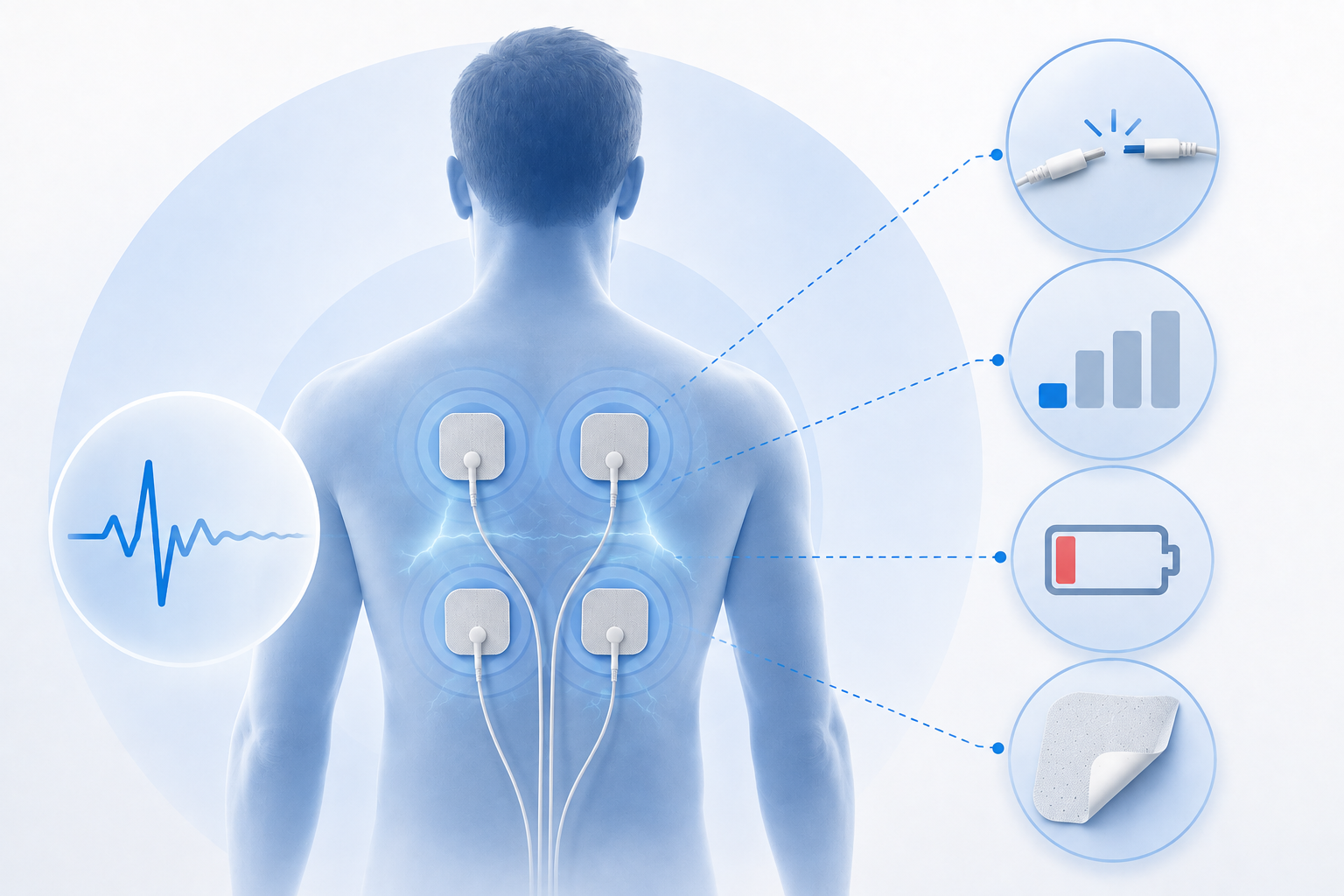
The most common causes are worn or poorly sticking electrode pads, low battery, poor contact between the pads and skin, loose leads or connections, intensity set too low, changes in electrode positioning, getting used to the sensation, a damaged lead or electrode, or an unsuitable or changed programme setting.
NHS guidance recommends placing the electrodes on clean skin, leaving a gap between them and gradually increasing the electrical current until you feel a tingling sensation that is not painful. (nhs.uk)
If your machine used to feel stronger but has recently become weak, start with the pads and battery. These are among the first things NHS guidance recommends checking when TENS stops helping. (Leeds Teaching Hospitals NHS Trust)
What Should a TENS Machine Feel Like?
TENS doesn’t usually feel like a painful electric shock. You should normally notice a tingling or pulsing sensation. The exact feeling varies depending on the programme, intensity, frequency, electrode position and individual sensitivity.
The Royal National Orthopaedic Hospital recommends starting at a low intensity and gradually increasing it until the stimulation feels strong but comfortable. If it becomes painful or uncomfortable, the intensity should be reduced. (Royal National Orthopaedic Hospital)
So there is an important distinction: weak means you barely notice the stimulation; appropriate means you can clearly feel a comfortable tingling sensation; too strong means the stimulation becomes painful or unpleasant. The goal isn’t to make the machine feel as powerful as possible.
1. Your TENS Electrode Pads May Be Worn Out
One of the first things to check is the electrode pads. TENS depends on good contact between the electrodes and your skin. If the adhesive pads have been used repeatedly, they can gradually lose their stickiness and may no longer make reliable contact.
Signs that your pads may need replacing include: they don’t stick properly, the edges keep lifting, they look dry, they have been used many times, the stimulation feels inconsistent, or you need to keep increasing the intensity.
Leeds Teaching Hospitals recommends checking that the pads are in place and sticking properly when TENS stops helping. It also notes that replacement pads can be purchased when they lose their stickiness. (Leeds Teaching Hospitals NHS Trust)
What to do
Check the pads before changing other settings. If they are visibly worn or no longer adhere properly, replace them with compatible electrodes. For reusable pads, follow the storage and care instructions supplied with your particular product.
2. The Battery May Be Running Low
A weak battery can also result in little or no sensation. Great Ormond Street Hospital specifically lists replacing the battery as a troubleshooting step when there is no or low sensation under the electrodes. (GOSH Hospital site)
Check your battery if the display is dim, the machine is behaving differently, the stimulation is weaker than usual, the device has been used frequently, or the battery has been in the machine for a long time.
For a rechargeable TENS machine, charge it according to the manufacturer’s instructions. For a battery-powered model, replace the battery with the correct type. Don’t assume the battery is fine just because the machine still switches on.
3. The Electrodes May Not Have Good Skin Contact
Even if your pads are relatively new, they can feel weak if they aren’t making proper contact with your skin. The NHS recommends placing TENS electrodes on clean skin and making sure there is a gap between the pads. (nhs.uk)
Before applying them: clean the skin, dry it thoroughly, avoid lotions or oils immediately beforehand, make sure the entire electrode is attached, and check that the edges aren’t lifting.
Hair can also interfere with contact. Some NHS TENS guidance recommends clipping excess hair rather than shaving it when necessary. (Norfolk and Norwich University Hospital)
4. Your Intensity May Simply Be Too Low
Sometimes the machine isn’t weak at all — the intensity is simply set too low. The NHS recommends gradually turning up the electrical current until you feel tingling that isn’t painful. (nhs.uk)
Don’t immediately turn the machine to its highest setting. Instead, start at a low intensity, increase it gradually, stop when the sensation becomes strong but comfortable, and reduce it if it becomes painful or unpleasant.
The Royal National Orthopaedic Hospital gives similar advice: start low and gradually increase the intensity until the sensation is strong but comfortable. (Royal National Orthopaedic Hospital)
5. You May Have Become Used to the Sensation
Another reason TENS can feel weaker over time is that you may become accustomed to the sensation. Cambridge University Hospitals notes that when you become accustomed to the sensation, you may need to increase the intensity. (Cambridge University Hospitals)
This doesn’t mean you should keep increasing the intensity indefinitely. If the sensation has gradually become less noticeable, check your electrodes, check the battery, check the intensity, make sure the pads are positioned correctly, and adjust the intensity gradually if comfortable.
If you need unusually high settings to feel anything, investigate the underlying problem rather than simply turning the machine up further.
6. Your Electrode Position May Have Changed
Where the electrodes are placed can affect how stimulation feels. Even moving the pads slightly can change the sensation because the electrical stimulation is being delivered through a different area of skin.
Your healthcare professional or the instructions supplied with your machine should guide you on appropriate placement. The NHS recommends asking a healthcare professional for advice if you’re unsure where to position TENS electrodes. (nhs.uk)
Important
Never move electrodes while the machine is switched on. Turn the machine off first, reposition the pads, then switch it back on and gradually increase the intensity. (nhs.uk)
7. The Leads May Be Loose
If your machine uses cables between the control unit and electrode pads, check each connection. Your setup should effectively be: TENS machine → lead → electrode pad → skin. A loose connection anywhere in that chain can affect stimulation.
Check that the lead is fully inserted, the electrode connectors are secure, there are no visible cracks, the wires aren’t damaged, and the connection isn’t intermittently cutting out. If a lead is damaged or has exposed wiring, don’t continue using it.
8. One TENS Channel May Be Weak
This is particularly relevant to dual-channel TENS machines. If Channel 1 feels normal but Channel 2 feels weak, compare the two setups.
| Check | Channel 1 | Channel 2 |
|---|---|---|
| Intensity | ✓ | ✓ |
| Lead connected | ✓ | ✓ |
| Electrodes sticking | ✓ | ✓ |
| Battery | ✓ | ✓ |
| Programme | ✓ | ✓ |
If your manufacturer’s instructions allow it, you may be able to test compatible leads or electrode pairs to identify whether the problem follows a particular component.
The Healthcare World 3-in-1 Digital TENS and EMS Machine and the Totally TENS TPN-Type machine you’ve provided are both dual-channel models, so this is particularly relevant when troubleshooting those devices.
For more information, see Dual-Channel TENS Machines.
9. Your Electrode Pads May Have Dried Out
Electrode gel can dry out over time, particularly if the pads aren’t stored correctly. Cambridge University Hospitals recommends checking the gel on the pads when TENS is used for longer periods. (Cambridge University Hospitals)
Leeds Teaching Hospitals notes that, for its supplied pads, gently rubbing the sticky side with a small amount of cold water may help restore stickiness. The pads should not be connected to the machine while doing this. (Leeds Teaching Hospitals NHS Trust)
However, don’t assume every electrode pad should be moistened. Always follow the instructions for your specific electrodes. If the pads remain dry or don’t stick properly, replacement is usually the better option.
10. The Wrong Programme May Be Selected
Modern TENS machines can have several modes and programmes. Changing the programme can change how the stimulation feels. Depending on the machine, you might have normal, burst, modulation, continuous, preset programmes, adjustable frequency or adjustable pulse width.
A programme that feels relatively mild isn’t necessarily faulty. Check which programme is selected and compare it with the manufacturer’s instructions.
For example, the Totally TENS TPN-Type supplied for this project offers Burst, Normal and Modulation modes. The Healthcare World Wireless model provides 15 automated programmes and 16 intensity levels, while the Healthcare World 3-in-1 model combines TENS and EMS functions with multiple programmes.
11. The Frequency or Pulse Settings May Have Changed
Some advanced TENS machines allow you to change frequency or pulse width. These settings can alter the sensation. Cambridge University Hospitals explains that stimulation can feel faster or slower when frequency is changed, while intensity controls how strong the sensation feels. (Cambridge University Hospitals)
Therefore, if someone has accidentally changed a setting, the machine may feel different even though it is working normally. If you’re unsure what a setting does, return to the manufacturer’s recommended programme rather than randomly changing multiple settings.
12. Your Skin May Be Affecting the Sensation
Skin condition can influence electrode contact. For example, problems can occur if skin is wet, skin has lotion or oil on it, the pad is partially detached, there is excessive hair, or the skin is irritated.
The NHS recommends clean, dry skin for electrode placement. (nhs.uk) Don’t use TENS over irritated, broken, infected or numb skin. (nhs.uk)
13. The Machine May Be Working Normally
It’s worth remembering that a stronger sensation doesn’t necessarily mean better pain relief. TENS is intended to provide a comfortable electrical sensation. Increasing the intensity simply because you want the machine to “feel stronger” isn’t necessarily useful.
The NHS describes the desired sensation as tingling that should not be painful. (nhs.uk) If the machine produces a clear, comfortable tingling and is being used correctly, there may be no problem to fix.
What to Do When Your TENS Machine Feels Weak
Use this troubleshooting sequence.
Step 1 — Check the pads
Are they still sticky? If not, replace or care for them according to the manufacturer’s instructions. If yes, continue.
Step 2 — Check the skin
Is it clean and dry? If not, clean and dry it. If yes, continue.
Step 3 — Check the connections
Are all leads firmly connected? If not, reconnect them with the machine switched off. If yes, continue.
Step 4 — Check the battery
Is the battery charged? If not, recharge or replace it. If yes, continue.
Step 5 — Check the intensity
Gradually increase the intensity until the stimulation feels strong but comfortable.
Step 6 — Check the programme
Make sure you haven’t accidentally selected a different mode.
Step 7 — Check the electrode position
Make sure the pads are positioned according to your device’s instructions or professional guidance.
Step 8 — Check for damage
Look at the machine, leads and electrodes for visible damage.
If everything appears correct but the machine still produces little or no stimulation, consult the manufacturer’s troubleshooting instructions or contact the seller/manufacturer.
TENS Machine Feels Weak: Quick Troubleshooting Table
| Problem | What to check |
|---|---|
| Weak everywhere | Battery, pads, intensity |
| Suddenly weaker | Battery or electrode condition |
| Pads barely stick | Replace/care for electrodes |
| One area feels weak | Electrode placement/contact |
| One channel feels weak | Channel, lead and electrode pair |
| Works intermittently | Leads and electrode contact |
| Machine turns on but no sensation | Battery, connections and intensity |
| Sensation changed after selecting a programme | Check mode/settings |
| Sensation becomes uncomfortable | Reduce intensity and check pads |
| Burning sensation | Stop using and inspect pads/skin |
Why Does My TENS Machine Feel Weak After 20 Minutes?
This can happen because your perception of the stimulation changes as you become accustomed to it. The Kent Centre for Pain Medicine notes that after around 20 minutes, some users may notice that the tingling seems to diminish and may need to gradually increase the intensity to restore a comfortable tingling sensation. (Ekhuft Leaflets)
Before increasing the intensity, however, check that the electrodes are still firmly attached. If the pads have started lifting, increasing the intensity isn’t the right solution.
Why Does One Pad Feel Stronger Than the Other?
If one electrode feels stronger, check whether both pads are fully attached, whether one pad is older, whether the leads are properly connected, whether the electrodes are positioned differently, and whether the skin is equally clean and dry.
A difference in sensation doesn’t automatically mean that the machine is faulty. If the difference is significant or uncomfortable, switch the machine off and check the setup.
Why Does My TENS Machine Feel Weak With New Pads?
If you’ve already replaced the electrodes and the machine still feels weak, check the next likely causes: battery, lead connections, intensity, programme, electrode positioning, and skin contact.
If you’re using a dual-channel device, also check whether the affected channel has its own intensity control.
Why Does My Wireless TENS Machine Feel Weak?
Wireless models can have some additional things to check.
Check the electrode connection
The wireless electrode unit still needs good contact with the skin.
Check battery levels
Some wireless systems have separate power requirements for the controller and electrode unit.
Check the connection
Make sure the wireless components are correctly connected or paired according to the manufacturer’s instructions.
Check intensity
The wireless design doesn’t change the basic principle: stimulation should be gradually adjusted to a strong but comfortable level.
The Healthcare World Wireless TENS Machine supplied for this project has 15 programmes and 16 intensity levels, making the intensity and programme settings particularly important to check.
Read Wireless TENS Machines.
Why Does My Rechargeable TENS Machine Feel Weak?
If you use a rechargeable model, check the charge level before troubleshooting anything more complicated. A device can still turn on when the battery is running low.
Try fully charging the device, checking the charging indicator, inspecting the charging connection, checking the electrodes, and checking the intensity.
The Healthcare World Wireless TENS Machine you’ve provided is rechargeable, so battery level is an important part of troubleshooting this particular model.
Read Rechargeable TENS Machines.
Can You Just Turn the TENS Machine Up?
You can generally gradually increase the intensity according to the instructions for your device, but you shouldn’t simply turn it up as high as possible. The NHS recommends increasing the current until you feel tingling that isn’t painful. (nhs.uk)
The Royal National Orthopaedic Hospital similarly recommends a strong but comfortable sensation and reducing the intensity if it becomes painful or uncomfortable. (Royal National Orthopaedic Hospital)
Strong and comfortable is appropriate; painful or burning is too much.
When Should You Stop Using the TENS Machine?
Stop using the device if you experience burning, significant pain, persistent skin irritation, a rash, unusual discomfort, damaged wires, a damaged machine, or unexpected electrical sensations.
If the skin becomes itchy, irritated or red, the NHS advises switching off the machine and removing the pads. (nhs.uk) Don’t try to solve burning or skin irritation by increasing or changing the intensity.
When Should You Replace the TENS Machine?
A weak sensation doesn’t automatically mean that you need a new machine. Try troubleshooting the inexpensive components first: pads, battery, leads, settings, connections.
If the device still doesn’t work correctly, check the manufacturer’s warranty and troubleshooting guidance. A machine with damaged electrical components should not be opened or repaired unless this is specifically authorised by the manufacturer.
How to Prevent a Weak TENS Sensation
Good maintenance can prevent many problems.
Store electrodes correctly
Return reusable pads to their protective backing after use.
Keep your skin clean and dry
This helps maintain electrode contact.
Check the battery
Don’t wait until the machine completely stops working.
Inspect leads
Look for damage before use.
Replace worn electrodes
Don’t keep using pads once they have stopped sticking properly.
Follow the manufacturer’s settings
Especially when using advanced programmes.
Does a Weak TENS Sensation Mean TENS Isn’t Working?
Not necessarily. The sensation and the perceived pain-relief effect aren’t exactly the same thing. TENS does not work for everyone, and the NHS recommends speaking with a healthcare professional if you’re unsure whether it is appropriate for you. (nhs.uk)
If your machine produces a comfortable tingling sensation but doesn’t seem to provide useful relief, that is different from a technical fault. In that situation, don’t simply keep increasing the intensity.
FAQs
Why is my TENS machine suddenly weak?
The most common things to check are the electrode pads, battery, skin contact, leads and intensity. NHS guidance specifically recommends checking pad contact and the battery when TENS stops helping. (Leeds Teaching Hospitals NHS Trust)
Why does my TENS machine feel weaker after a while?
You may become accustomed to the sensation. Some NHS guidance notes that intensity may need to be increased gradually as you get used to the stimulation. (Cambridge University Hospitals)
Should a TENS machine feel strong?
It should generally feel like a noticeable tingling sensation that is strong but comfortable, not painful. (Royal National Orthopaedic Hospital)
Should I turn the intensity all the way up?
No. Gradually increase the intensity only until the sensation is strong and comfortable. Reduce it if it becomes painful or unpleasant. (Royal National Orthopaedic Hospital)
Can old TENS pads make the machine feel weak?
Yes. Worn or poorly sticking electrodes can reduce contact with the skin and may contribute to low or inconsistent sensation. (Leeds Teaching Hospitals NHS Trust)
Can a low battery make TENS feel weak?
Yes. NHS hospital guidance specifically recommends checking or replacing the battery when there is low or no sensation. (GOSH Hospital site)
Why is one TENS channel weaker than the other?
Check the intensity setting, lead, electrode pair and skin contact for the affected channel. A dual-channel machine may have independent intensity controls.
Why do my TENS pads feel weak even though they’re new?
Check whether they are fully attached to clean, dry skin and whether the leads are connected correctly. Also check the battery and intensity.
Can electrode placement affect how strong TENS feels?
Yes. Where and how the electrodes are positioned affects the sensation. Follow the placement guidance for your specific device or advice from your healthcare professional. (nhs.uk)
Why does TENS feel weak but still work?
The sensation may simply be less noticeable as you become accustomed to it. If the device is producing a comfortable tingling and is being used correctly, a weaker sensation doesn’t automatically mean it has stopped functioning.
What if TENS suddenly becomes painful?
Switch it off and remove the electrodes. Check the intensity, electrode condition and contact. Don’t continue using the machine if the discomfort persists.
The Bottom Line
If your TENS machine feels weak, don’t immediately assume that the machine is broken. Start with the simplest checks: check the electrode pads, check their contact with the skin, check the battery, check the leads, check the intensity, check the programme and settings, and check the electrode placement.
A TENS machine should normally provide a strong but comfortable tingling sensation, not painful shocks. (nhs.uk)
If the problem continues despite checking these areas, consult the manufacturer’s instructions or contact the manufacturer/seller rather than repeatedly increasing the intensity.
For more troubleshooting help, read TENS Machine Troubleshooting. If you’re considering a different device, Explore TENS and EMS Machines.
Related TensLeads Guides
TENS Machine Guide for Beginners, What Is a TENS Machine?, How Does a TENS Machine Work?, Common TENS Machine Mistakes, One TENS Channel Not Working, Why a TENS Machine Keeps Turning Off, TENS Side Effects, TENS Contraindications, Is TENS Safe?, Can You Use TENS Every Day?, How Long Should You Use a TENS Machine?, Wireless TENS Machines, Rechargeable TENS Machines, Dual-Channel TENS Machines, Best TENS Machine Features, UK TENS Machine Buying Guide.
Medical Sources
NHS — TENS guidance. Cambridge University Hospitals — TENS advice. Great Ormond Street Hospital — TENS troubleshooting. Royal National Orthopaedic Hospital — TENS patient guide. Leeds Teaching Hospitals — TENS for pain control.
Safety Disclaimer: This article is for general educational purposes only and does not provide medical diagnosis or personalised treatment advice. TENS is not suitable for everyone. Always read and follow the instructions supplied with your particular device. If you have an implanted electrical device, epilepsy, are pregnant, have reduced sensation or have unexplained or persistent pain, seek appropriate professional advice before using TENS.